




Hepatitis B: Monitoring Screening and Diagnostic Activities
Health Insurance Reimbursement Data
Nationwide
Number of HBs antigen tests reimbursed in the public and private sectors
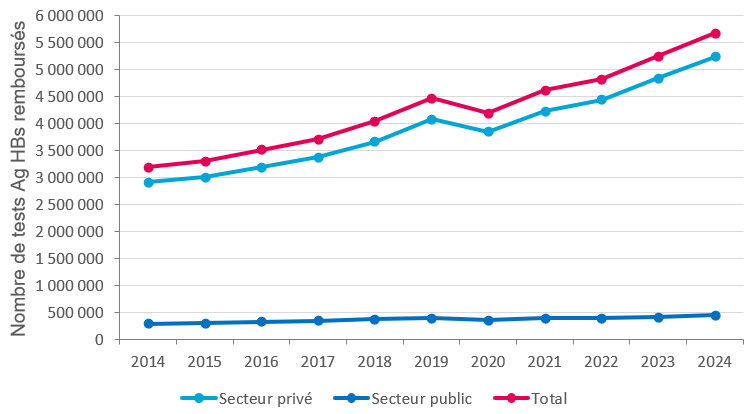
In 2024, 5.668 million HBs antigen (Ag) screening tests (procedures 4710, 4715, 0322, 4500, and 4501 of the Nomenclature of Medical Laboratory Procedures) were performed and reimbursed across all health insurance plans.
From 2014 to 2024, the total number of screening tests increased annually by between 4% and 11%, except in 2020. That year, due to the COVID-19 pandemic, the number of tests decreased by 6% (specifically, -6% in the private sector and -11% in the public sector between 2019 and 2020). The upward trend in the number of tests resumed in 2021, with a 10% increase between 2020 and 2021, followed by an increase of 4% to 9% since 2021.
The annual increase in the number of tests varied similarly in the private and public sectors between 2014 and 2024. Note that screening tests performed during hospitalization in a public facility are not included in the public sector data.
Annual trend in the number of HBsAg tests performed in the private and public sectors and reimbursed by health insurance, 2014–2024, France (data from all insurance schemes)
Number of people tested for HBsAg in the public and private sectors
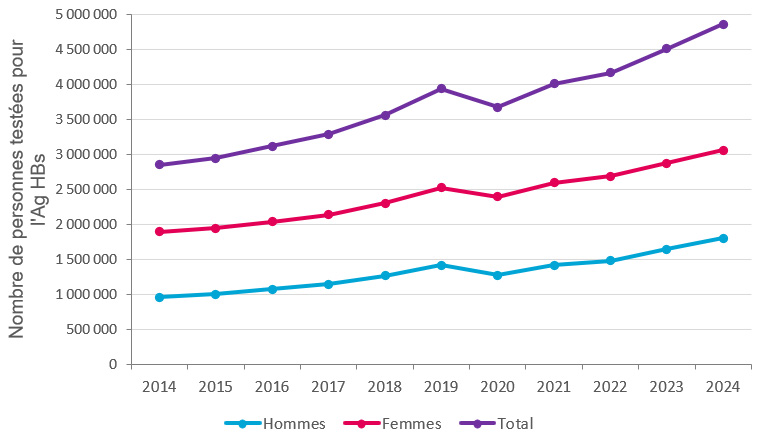
During the 2014–2024 period, the number of people tested for HBsAg rose from 2.851 million in 2014 to 4.858 million in 2024, representing a 70% increase. As observed for the number of annual tests, the number of people tested increased through 2019 (+38% between 2014 and 2019), decreased between 2019 and 2020 (-7%), and then increased again starting in 2021.
Over the entire period, 65% of those tested were women. This proportion remained stable throughout the period.
Annual trend in the number of people tested for HBsAg, by sex, 2014–2024, France (data from all health insurance schemes)
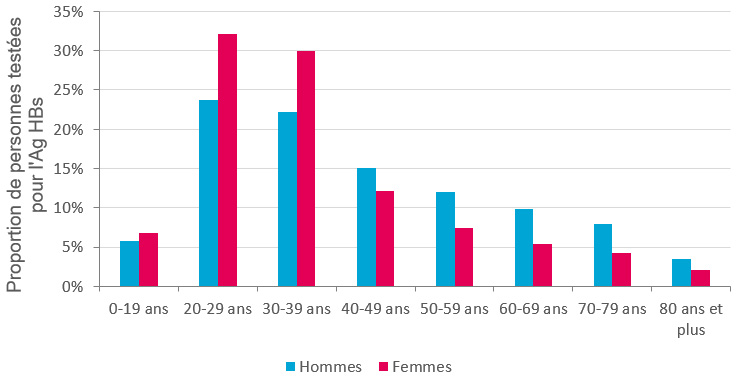
In 2024, as was the case throughout the 2014–2024 period, the most represented age group was 20–39-year-olds, among both women (62%) and men (46%).
Distribution of individuals tested for HBsAg in 2024, by sex and age group, France (data from all health insurance schemes)
At the regional and departmental levels
HBsAg screening rate
In 2024, the HBsAg screening rate (total number of tests relative to the number of people living in France) was 83 tests per 1,000 inhabitants nationwide. It was higher in the overseas departments and regions (DROM) (137 per 1,000) than in mainland France (81 per 1,000).
In mainland France
The regions with the highest HBsAg screening rates in 2024 were Île-de-France (105 per 1,000), the Provence-Alpes-Côte d’Azur (PACA) region (97 per 1,000), and Occitanie (89 per 1,000). The Bourgogne-Franche-Comté and Centre-Val-de-Loire regions had the lowest rates: 61 per 1,000 and 65 per 1,000, respectively.
The departments of Paris (147/1,000), Alpes-Maritimes (116 tests/1,000), and Seine-Saint-Denis (108/1,000) had the highest rates in 2024. The lowest rates were observed in Creuse (48/1,000), Ardennes (50/1,000), and Haute-Loire (50/1,000).
Compared to 2023, screening test rates in 2024 increased in all French regions. The largest increase was observed in Occitanie (11%), followed by Corsica (9%) and Nouvelle-Aquitaine (9%). Over the same period, increases at the departmental level were particularly significant in the Ardennes (37%) and the Hautes-Pyrénées (+20%).
In the Overseas Territories
Screening rates for HBsAg were highest in Guadeloupe (182/1,000) and Martinique (180/1,000) in 2024. Mayotte recorded the lowest rate: 39/1,000. The rates in French Guiana and Réunion were 154/1,000 and 130/1,000, respectively.
Rate of people tested for HBsAg
The rate of people tested for HBsAg (number of people tested relative to the number of people living in France) was 71 people per 1,000 inhabitants in 2024, at the national level. This rate was higher in the DROMs (114 per 1,000) than in mainland France (70 per 1,000).
In mainland France
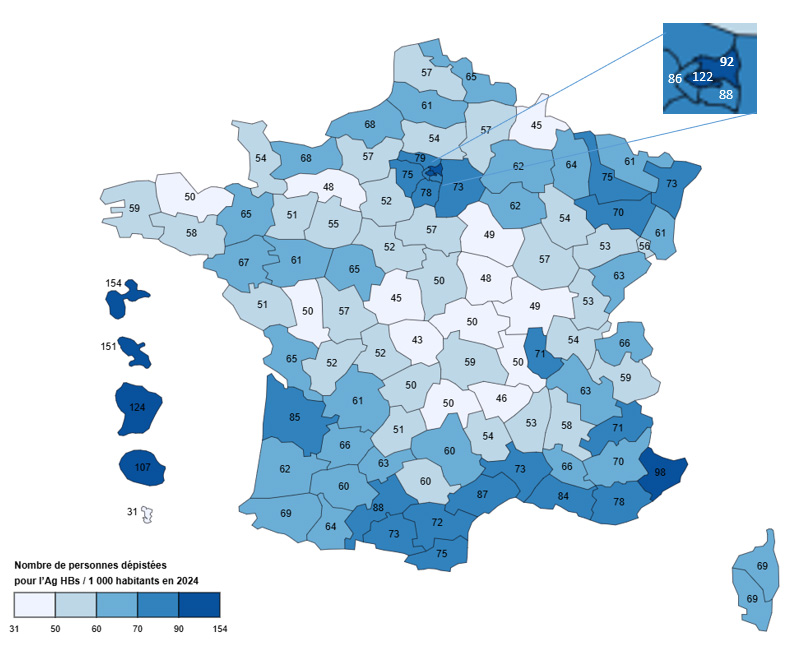
The highest rates of people tested were in Île-de-France (89 per 1,000) and PACA (83 per 1,000), while the lowest rates were observed in Bourgogne-Franche-Comté (54 per 1,000) and Centre-Val de Loire (56 per 1,000).
The departments of Paris (122/1,000), Alpes-Maritimes (98/1,000), and Seine-Saint-Denis (92/1,000) had the highest rates of people tested. The lowest rates were observed in Creuse (43/1,000), Indre (45/1,000), and Ardennes (45/1,000).
In the Overseas Territories
Testing rates were highest in Guadeloupe (154/1,000) and Martinique (151/1,000), and lowest in Mayotte (31/1,000). They were 124/1,000 in French Guiana and 107/1,000 in Réunion.
Number of people screened for HBsAg (per 1,000 inhabitants), by region, France, 2024 (all health insurance plans)
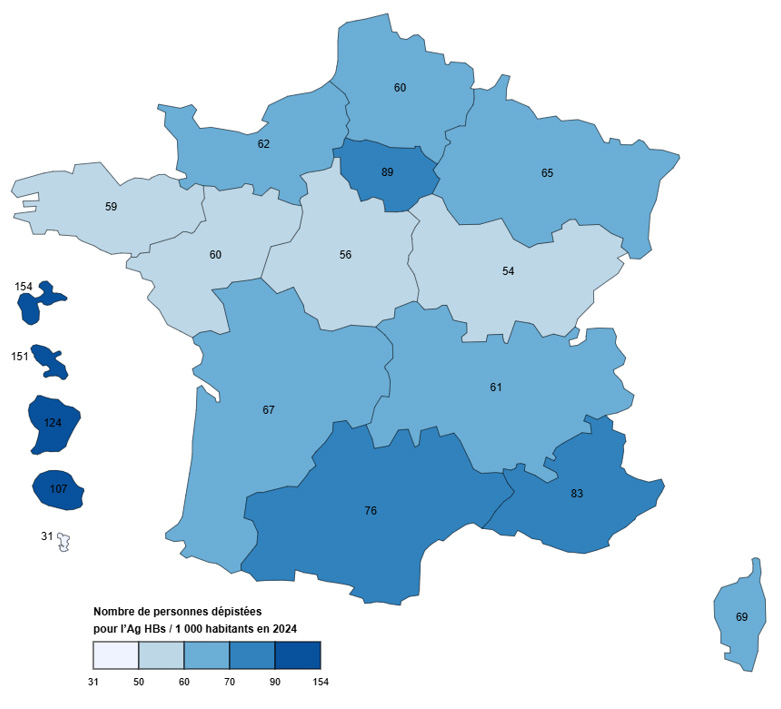
Number of people screened for HBsAg (per 1,000 inhabitants), by department, France, 2024 (all health insurance schemes)
The LABOHEP Survey
The LaboHEP survey is a retrospective cross-sectional survey conducted periodically since 2010 among public and private clinical laboratories. The data collected pertain to the number of tests performed for anti-HCV antibodies (Ac) and HBsAg, as well as the number of individuals newly diagnosed as positive for these markers in the CL (individuals testing positive for the first time in the responding CL) during the year in question.
The data presented pertain to the latest survey on screening activity for the year 2021 (with a comparison to the 2016 estimates from the previous survey). All public and private LBMs, totaling 4,303, were contacted; of these, 2,557 participated in the survey, representing a participation rate of 59%, which was higher among public LBMs (80%) than among private LBMs (58%).
In 2021, according to estimates from the LaboHEP survey:
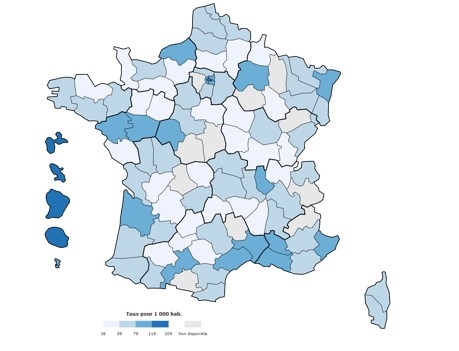
5.4 million [95% CI: 5.1–5.7] HBsAg screening tests were performed, including 4.2 million [95% CI: 4.0–4.4] in private LBMs (78%) and 1.2 million [95% CI: 1.0–1.4] in public LBMs. This number represents a 25% increase compared to 2016 (4.3 million).
Relative to the population living in France, this figure corresponds to an HBsAg screening rate of 80 per 1,000 inhabitants. It is higher in Île-de-France (104 per 1,000), particularly in Paris (190 per 1,000) and Val-de-Marne (110 per 1,000), in Provence-Alpes-Côte d’Azur (92 per 1,000), as well as in the overseas departments and regions (DROM): 209 per 1,000 in French Guiana, 167 per 1,000 in Guadeloupe, 155 per 1,000 in Martinique, 127 per 1,000 in Réunion, and 117 per 1,000 in Mayotte.
Number of HBsAg tests performed per 1,000 inhabitants, by department, LaboHEP 2021, France
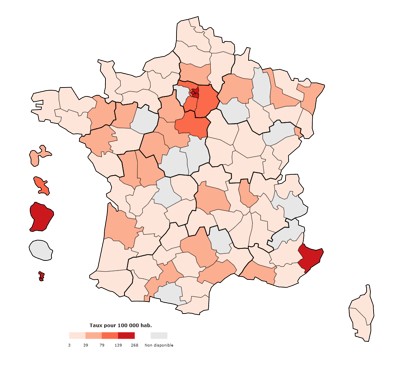
The number of people diagnosed as positive for HBsAg is estimated at 37,462 [95% CI: 33,188–41,736], an increase of 10% compared to 2016. This figure does not reflect the number of people newly diagnosed as HBsAg-positive in France in 2021, as the same person testing positive for the first time in different laboratories is counted multiple times.
Relative to the population living in France, this number corresponds to an estimated rate of people diagnosed as HBsAg-positive of 55 per 100,000 inhabitants. In metropolitan France, this rate is highest in Île-de-France (138 per 100,000), particularly in the departments of Paris (268 per 100,000), Val-de-Marne (178 per 100,000), and Seine-Saint-Denis (146 per 100,000). In the overseas departments and regions (DROM), it reaches 244 per 100,000 in Mayotte and 157 per 100,000 in French Guiana.
Number of people testing positive for HBsAg per 100,000 inhabitants, by department, France, LaboHEP 2021
The positivity rate for HBsAg tests is estimated at 0.69%, down from 2016 (0.79%). It is higher in public-sector medical laboratories (1.17%) than in private-sector ones (0.55%). It reaches 1.32% in Île-de-France and 2.08% in Mayotte.
See Géodes:
Download

article
24 July 2023
Hepatitis B and C Screening in France in 2021: The LaboHEP Survey
article
6 September 2019
Hepatitis B and C Screening in France in 2016: New Edition of the LaboHep Survey
article
6 September 2019
Screening for Hepatitis B and C in France in 2013: the LaboHep Survey.
article
6 September 2019
Screening for Hepatitis B and C in France in 2010: the 2010 LaboHep Survey
CeGIDD Activity Data
Established in 2018 by Santé publique France, the SurCeGIDD surveillance system provides individual data on screening and diagnostic activities at the Free Centers for Information, Screening, and Diagnosis of HIV, Viral Hepatitis, and STIs (CeGIDD).
In 2024, 221 CeGIDDs (73.4%) out of the 301 facilities surveyed submitted their individual data, for a total of 667,161 consultations: 74.7% from mainland regions outside Île-de-France (IDF), 16.2% from the IDF, and 8.7% from the Overseas Departments and Regions (DROM). Nearly two-thirds (65.6%) came from hospital-based CeGIDDs and 34.4% from non-hospital-based CeGIDDs.
The clients seen had a median age of 27 years (interquartile range [IQR]: 22–37), were predominantly cisgender men (65.4%), and three-quarters were born in France (75.5%). Based on their reported sexual practices over the past 12 months, 38.6% of the patients were heterosexual men, 32.6% were heterosexual women, 24.1% were men who have sex with men (MSM), and 2.8% were women who have sex with women (WSW). The majority (83.6%) had health insurance with or without a supplemental plan; 9.0% were covered by PUMA (Universal Health Coverage), C2S (Solidarity-Based Supplementary Health Insurance), or AME (State Medical Aid); and 7.1% had no health coverage.
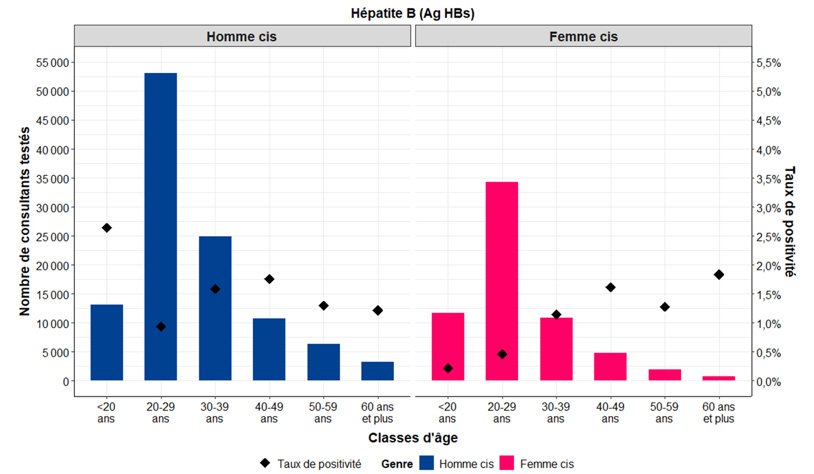
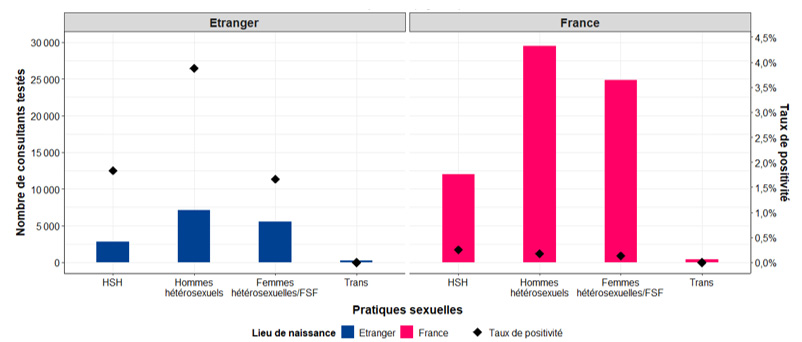
In total, 178,612 HBs antigen (Ag) tests were conducted by the participating CeGIDDs, of which 1.1% were positive. This positivity rate was higher among cisgender men (1.4%) than among women (0.7%). Among the 799 transgender individuals tested, none were positive. Among cisgender men, the positivity rate was highest among those under 20 (2.6%) and lowest among those aged 20–29 (0.9%); among cisgender women, those over 60 had the highest positivity rate (1.8%), while it was lowest among those under 20 (0.2%). Patients born abroad had a significantly higher positivity rate compared to those born in France (4.0% vs. 0.2%), regardless of gender, age group, or their reported sexual practices over the past 12 months.
Geographically, the positivity rate was 1.1% among patients residing in mainland France (1.1% in the Paris region and 1.1% in the rest of mainland France), and 0.9% among those residing in the overseas departments and regions (DROM).
Number of patients tested for HBsAg and positivity rate by gender and age group, SurCeGIDD 2024, France.
Number of patients tested for HBsAg and positivity rate by place of birth and reported sexual practices over the past 12 months, SurCeGIDD 2024, France.
Learn more about epidemiological surveillance within the CEGIDDs

magazines/revues
12 February 2026
Weekly Epidemiological Bulletin, September 24, 2024, No. 16-17 Hepatitis B, C, and Delta: Strengthening Screening, Diagnosis, and Access to Treatment
article
4 July 2022
SurCeGIDD Surveillance: Screening and Diagnosis of HIV, Hepatitis B and C, and Bacterial STIs in CeGIDD in 2020
article
30 November 2022
Screening and diagnosis of HIV, hepatitis B and C, and bacterial STIs at CeGIDD in 2018: individual data from the SurCeGIDD surveillance system
article
6 September 2019
HIV and Hepatitis B and C Screening Activities at Anonymous and Free Screening Clinics (CDAG) in France. A Review of Fifteen Years of Surveillance, 2001–2015.
Other screening data
The proportion of people in the general population who report a history of hepatitis B screening is available for the metropolitan general population and for the overseas departments and regions:
Proportion of infected individuals aware of their infection
In 2004, the national prevalence survey of hepatitis B and C conducted in the general metropolitan population estimated that, among the 280,821 people who were HBsAg-positive (95% CI: 179,730–381,913), 45% (95% CI: 23–69) were aware of their infection.
This estimate was updated in 2016 for the general population in metropolitan France (the “Barotest” virology component of the 2016 France Public Health Barometer): among the 135,706 people who were HBsAg-positive (95% CI: 58,224–313,960), 18% (95% CI: 5–46) were aware of their infection.
In the general metropolitan population and in the overseas departments and regions
Health Barometer Surveys
KABP Survey 2010
In specific populations
Among the Afro-Caribbean population of Île-de-France surveyed by the 2016 AfroBarometer, 47.6% of participants reported never having been screened for hepatitis B in their lifetime.
Regarding pregnant women, the lack of prenatal HBsAg screening (mandatory screening) affected between 1.2% (95% CI: 0.9–1.3) (ENP 2016) and 2.2% (95% CI: 1.9–2.4%) (ELFE 2011) of them, depending on the survey.
article
7 January 2021
Prevention of mother-to-child transmission of the hepatitis B virus in France. 2016 National Perinatal Survey
article
6 September 2019
HIV and HBV Infections Among Afro-Caribbean People in the Île-de-France Region: High Prevalence Rates and Insufficient Screening.
article
6 September 2019
Screening for infectious diseases during pregnancy: results of the Elfe survey in maternity wards, mainland France, 2011.
In 2017, a summary report and 14 regional bulletins were published (Hauts-de-France, Île-de-France, Normandy, Brittany, Pays de la Loire, Centre-Val de Loire, Grand Est, Burgundy-Franche-Comté, Auvergne-Rhône-Alpes, Nouvelle-Aquitaine, Provence-Alpes-Côte d'Azur-Corsica, Occitanie, Réunion-Mayotte, French West Indies-French Guiana)
GEODES
Track the trends in hepatitis B in France and in your region
In relation to

Hepatitis C
thematic dossier
Hepatitis C is a viral infection primarily transmitted through blood. Screening for the disease is crucial to ensuring that infected individuals receive the treatments that can now lead to a cure.

HIV/AIDS
thematic dossier
HIV, or Human Immunodeficiency Virus, is a sexually transmitted human retrovirus. It weakens the immune system, and if left untreated, leads to AIDS.

Vaccination
thematic dossier
Contagious diseases most often affect children at a very young age. Because children are particularly vulnerable, they are a priority target for vaccination programs.











