




Diagnosis of Acute Hepatitis B
Data from the mandatory reporting system for acute hepatitis B
Surveillance of acute hepatitis B at Santé publique France is based on the mandatory reporting system, established in March 2003. This system makes it possible to track trends in the number of diagnosed cases of acute HBV infection and to describe their characteristics.
Trends in the annual number of reported cases of acute hepatitis B between 2003 and 2024
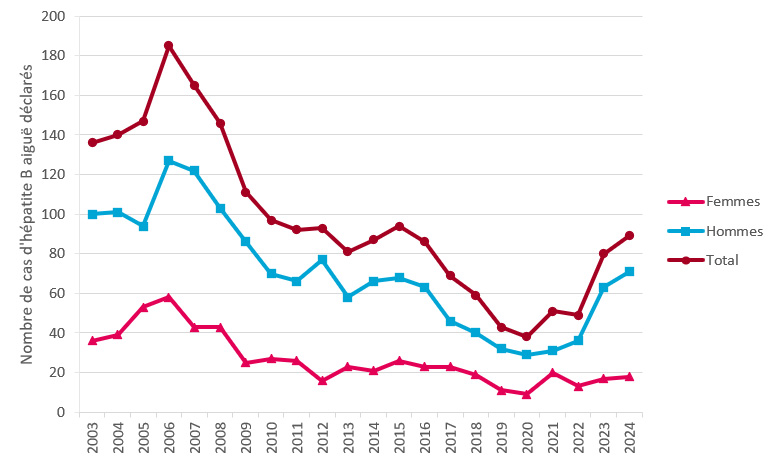
Between 2003 and 2024, 2,138 cases of acute hepatitis B were reported (data as of May 31, 2025).
After an increase between 2003 and 2006, the annual number of reported cases of acute hepatitis B decreased sharply, albeit irregularly, through 2022. This decrease should be interpreted with caution, as it is difficult to distinguish between a true decline in the number of acute hepatitis B diagnoses and significant underreporting, estimated to range from 85% to 91% in 2010, to 77% in 2013, and 73% in 2016 (LaboHEP surveys). Between 2022 and 2024, an increase in the number of cases is observed (+82%). This increase is greater among men (+97%) than among women (+38%). This upward trend between 2022 and 2024 is explained by a greater number of DO reports received (+51% between 2022 and 2024), as well as a higher proportion of DO reports including both the laboratory and clinician forms (required for case validation). This increase is also observed at the European level.
Over the entire 2003–2024 period, slightly more than half of the individuals (56%) were hospitalized, and 68% were reported by a hospital-based practitioner. The proportion of reports submitted by the hospital sector increased over the period, rising from 60% in 2003–2006 to 86% in 2019–2024.
View the data on Odissé
Trend in the annual number of reported cases of acute hepatitis B between 2003 and 2024, total and by sex, France
Characteristics of reported cases of acute hepatitis B
Over the entire 2003–2024 period
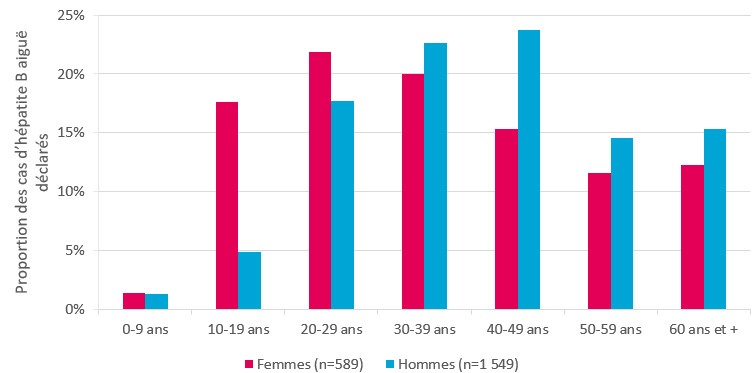
Among the 2,138 cases of acute hepatitis B reported during the 2003–2024 period, the majority were men (n=1,549, 72%), with a male-to-female ratio of 2.6. The median age of patients was 39 years, with women being younger than men (33 years and 41 years, respectively). The most common age groups were 40–49 (24%) and 30–39 (23%) among men, and 20–29 (22%) and 30–39 (20%) among women.
Distribution of reported cases of acute hepatitis B, by sex and age group, 2003–2024, France
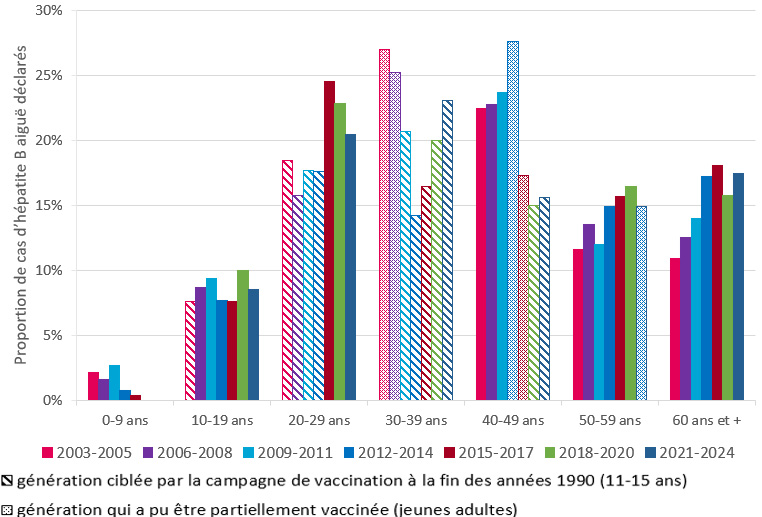
During the period, the proportions of cases aged 30–39 and 40–49, the age groups most represented at the start of the period, decreased in the middle and at the end of the period, respectively, while the proportion of cases aged 20–29 increased and constitutes one of the predominant age groups over the 2015–2024 period. This trend can be explained in part by the vaccination campaigns carried out in schools in the late 1990s, targeting a generation that was primarily aged 20–29 at the start of the period, 30–39 in the middle of the period, and 40–49 at the end of the period.
Trends in the distribution of reported cases of acute hepatitis B by age group, by 3-year period, 2003–2024, France
Of the 2,138 cases reported during the period, HBV vaccination status was available for 1,718 individuals (80%), of whom 44 (2%) reported having received a full course of vaccination (at least three doses).
Clinically and biologically:
1,482 (69%) patients presented with jaundice
848 (44%) had alanine aminotransferase (ALT) levels more than 50 times the normal range
88 (4%) had fulminant hepatitis, the majority of whom were women (56%). The course of fulminant hepatitis was documented for 80 patients, of whom:
29 had recovered following medical treatment,
31 had received a liver transplant,
20 had died, including one after a liver transplant.
Focus on the years 2021–2024
Between 2021 and 2024, 269 cases of acute hepatitis B were reported (data as of May 31, 2025). The male-to-female ratio was 3.0. The median age of patients was 39 years (33 years for women and 40 years for men).
Regarding these 269 reported cases:
10 (4%) reported full vaccination status (at least 3 doses) (vaccination status reported for 186, or 69% of cases);
173 (65%) were hospitalized;
191 (72%) presented with jaundice;
109 (42%) had ALT levels more than 50 times the normal range;
9 (3%) had developed fulminant hepatitis. The course of the disease was reported for 7 cases, of which:
2 had recovered thanks to medical treatment,
4 had received a liver transplant,
1 had died.
Risk exposures during the 6-week to 6-month period preceding the diagnosis of acute hepatitis B
Over the entire 2003–2024 period
Information on risk exposures was available for 1,385 cases, or 65% of those reported during the period.
At least one risk exposure warranting vaccination was identified in 1,029 (82%) patients. These infections could have been prevented if vaccination recommendations had been better followed.
The most frequently reported risk exposures were:
Sexual exposure in 780 (56%) patients (624 men and 156 women), with the proportion ranging from 54% in 2003–2005 to 57% in 2021–2024.
A stay in a country with high HBV endemicity in 466 (34%) patients, with the proportion ranging from 28% in 2003–2005 to 38% in 2021–2024.
Distribution of reported risk exposures during the 6-week to 6-month period preceding the diagnosis of acute hepatitis B, by sex, 2003–2024, France
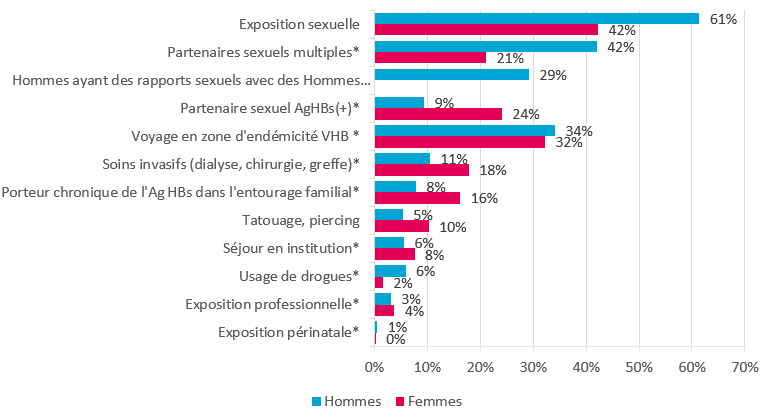
*These risk exposures constitute an indication for vaccination according to current recommendations. For sexual exposure, this includes individuals with sexual partners who are infected with HBV or are chronic HBV carriers, as well as individuals who have sex with multiple partners. Invasive medical procedures do not include surgery as a vaccination indication. For invasive medical procedures, the vaccination indications are as follows: individuals likely to receive massive and/or repeated blood transfusions or blood-derived medications (hemophiliacs, dialysis patients, those with renal failure, etc.); or individuals who are candidates for organ, tissue, or cell transplantation.
Focus on the years 2021–2024
Information on risk exposures was available for 189 of the 269 cases (70%) reported during this period; 83% had at least one exposure meeting a vaccination indication.
The most commonly reported risk exposures were sexual exposure (n=107, 57%) and travel to a country with high HBV endemicity (n=71, 38%).
Risk exposures reported during the 6-week to 6-month period preceding the diagnosis of acute hepatitis B, 2003–2024, France
| Period 2003–2024 | 2021–2024 | ||||
| Number of cases | % | Number of cases | % | ||
| At least one reported risk exposure | 1,385 | 65% | 189 | 70% | |
| Sexual exposure¤ | 780 | 56% | 107 | 57% | |
| Sexual partner Ag HBs (+)* | 185 | 13% | 19 | 10% | |
| Men who have sex with men (MSM) | 297 | 29%** | 52 | 37%** | |
| Multiple sexual partners (>1) * | 505 | 36% | 70 | 37% | |
| Travel to HBV-endemic areas* | 466 | 34% | 71 | 38% | |
| Invasive procedures (dialysis, surgery, transplant)* | 173 | 12% | 24 | 13% | |
| Chronic HBsAg carrier in the family* | 140 | 10% | 15 | 8% | |
| Tattoos, piercings | 93 | 7% | 16 | 8% | |
| Institutional stay* | 85 | 6% | 17 | 9% | |
| Drug use* | 66 | 5% | 15 | 8% | |
| Occupational exposure* | 46 | 3% | 4 | 2% | |
| Perinatal exposure¥ | 7 | 1% | 0 | 0% | |
| Not documented | 753 | 35% | 80 | 30% | |
Source: Mandatory Disclosure, data as of May 31, 2025.
Note: Since exposures may be multiple, the total exceeds 100%.
*These risk exposures constitute a vaccination indication according to current recommendations
** Proportion calculated among men
¤ The “sexual exposure” category includes: having an HBsAg-positive sexual partner, being MSM, or having multiple sexual partners
¥ Infants under 1 year of age born to HBsAg-positive mothers

article
23 September 2024
Surveillance of Acute Hepatitis B in France: Data from Mandatory Reporting, 2011–2022
article
24 September 2019
Surveillance of Acute Hepatitis B Through Mandatory Reporting, France, 2003–2018
Estimate of the number of acute hepatitis B diagnoses
Between 2004 and 2007, the number of acute hepatitis B diagnoses—estimated by applying an estimated completeness rate for 2005 (23.4%) to the number of cases reported under the DO—was 675 new cases diagnosed per year (95% CI: 608–645), corresponding to a rate of 1.1 per 100,000 inhabitants (95% CI: 0.97–1.18).
Since 2010, due to the low coverage of mandatory reporting for acute hepatitis B, the estimated number of acute hepatitis B diagnoses has been derived from the LaboHEP surveys, conducted among random samples of public and private clinical laboratories.
In 2013, the number of acute hepatitis B diagnoses was estimated at 291 cases (95% CI: 254–329), representing a rate of 0.44 cases per 100,000 inhabitants (95% CI: 0.39–0.50).
In 2016, this estimate was 257 cases (95% CI: 225–290), representing a rate of 0.39 per 100,000 inhabitants (95% CI: 0.34–0.44).
Learn more
article
24 September 2019
Estimates of the number of acute hepatitis B diagnoses and the completeness of mandatory reporting in France in 2016: the 2016 LaboHEP survey
GEODES
Track the trends in hepatitis B in France and in your region
In relation to

Hepatitis C
thematic dossier
Hepatitis C is a viral infection primarily transmitted through blood. Screening for the disease is crucial to ensuring that infected individuals receive the treatments that can now lead to a cure.

HIV/AIDS
thematic dossier
HIV, or Human Immunodeficiency Virus, is a sexually transmitted human retrovirus. It weakens the immune system, and if left untreated, leads to AIDS.

Vaccination
thematic dossier
Contagious diseases most often affect children at a very young age. Because children are particularly vulnerable, they are a priority target for vaccination programs.











