



Cardiovascular disease and stroke
Les maladies cardio-neuro-vasculaires regroupent un ensemble de troubles affectant le cœur et les vaisseaux sanguins.
Multiple diseases
Cardiovascular and cerebrovascular diseases encompass a group of common and serious conditions, primarily ischemic heart disease (including myocardial infarction), stroke, heart failure, peripheral artery disease, valvular heart disease, venous thromboembolism, aortic aneurysms, and aortic dissection…
Cardiovascular risk factors: a matter of prevention
Apart from heredity, gender, and age, these diseases all share a number of individual risk factors, most of which are modifiable:
Excessive alcohol consumption
Sleep disorders
Drug use
Other factors such as depression, chronic kidney disease, pregnancy-induced hypertension, hormone-dependent diseases, or environmental factors, such as air or noise pollution, have also been identified as risk factors for cardio-neuro-vascular diseases. The prevention and management of all these factors are major public health challenges.
The burden of cardiovascular and cerebrovascular diseases
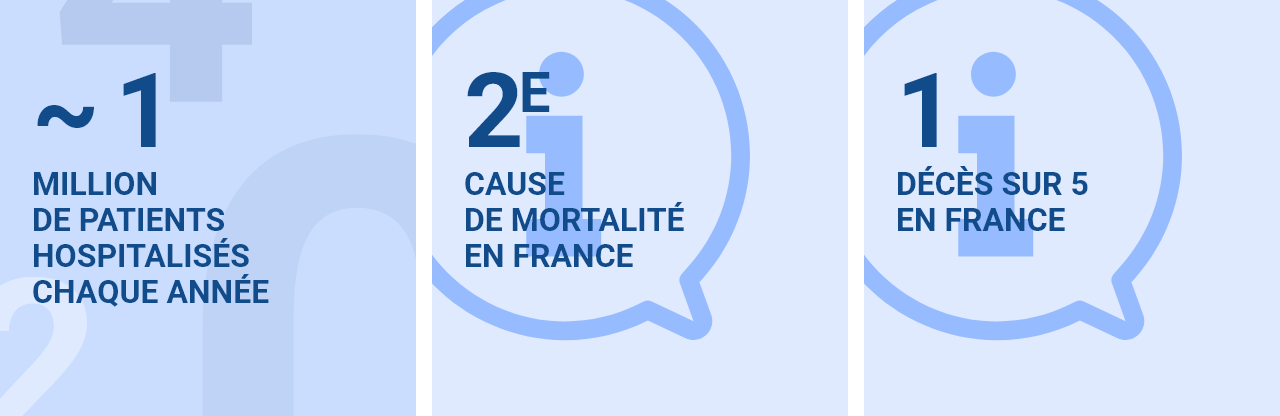
Cardiovascular and cerebrovascular diseases are the leading cause of death worldwide. In France, although they were the leading cause of death for many years, they are now the second leading cause of death, after cancer, due to a steady decline in the number of cardiovascular deaths linked to improvements in prevention and therapeutic management.
Key statistics on cardiovascular disease and stroke
A comprehensive surveillance system for cardio-neuro-vascular diseases
The Public Health France program on cardiovascular and cerebrovascular diseases aims to produce surveillance indicators for cardiovascular diseases and strokes (incidence, hospitalization rates, mortality, premature mortality, survival), and to describe their trends over time and across regions.
These indicators are also analyzed at the subnational level and broken down according to measures of social inequality.
To produce these indicators, the program relies on data from:
The National Health Data System (SNDS), which includes:
Hospitalization data from the Information Systems Medicalization Program (PMSI) of the Technical Agency for Hospitalization Information (Atih)
Inter-insurance system healthcare utilization data (DCIR) from the National Health Insurance Fund (Cnam)
Data on medical causes of death from the Center for Epidemiology on Medical Causes of Death (CépiDc) of the National Institute of Health and Medical Research (Inserm)
Registers of ischemic heart disease and stroke
General population surveys with health examinations (ENNS, Esteban, Albane) or without (Drees disability-health surveys, Santé publique France Barometers).
Specific surveys (Unono Wa Maore, SaMarOya)
This surveillance system relies on numerous partners:
The National Health Insurance Fund (Cnam)
The Technical Agency for Hospitalization Information (ATIH)
The National Institute of Health and Medical Research (Inserm), particularly the Center for Epidemiology on Medical Causes of Death (CépiDc)
Population-based registries of ischemic heart disease and stroke
The Directorate for Research, Studies, Evaluation, and Statistics (Drees)
The High Authority for Health (HAS), providing treatment guidelines for various cardiovascular conditions
Professional societies (French Society of Cardiology, French Society of Hypertension, French Neurovascular Society, etc.)
The French Cardiology Federation
The French Observatory on Drugs and Drug Addiction (OFDT)
The French National Agency for Medicines and Health Products Safety (ANSM)
The Institute for Health Metrics and Evaluation (IHME)
Santé publique France also monitors the links between air pollution and health, including cardiovascular diseases.
Santé publique France is involved in the European joint initiative JACARDI, which aims to reduce the burden of cardiovascular diseases, diabetes, and associated risk factors, both at the individual and societal levels.
Prevention of cardiovascular risk factors
Santé publique France provides the general public with several websites outlining the lifestyle and dietary guidelines to follow to prevent vascular diseases. These sites promote a varied and balanced diet, regular physical activity, and reducing sedentary behavior, as well as offering advice on quitting smoking and reducing alcohol consumption.

Abdominal aortic aneurysm
thematic dossier
An abdominal aortic aneurysm is a dilation of the abdominal aorta that can lead to rupture. A ruptured aneurysm is a life-threatening emergency.

Heart failure
thematic dossier
Heart failure is a condition in which the heart’s pumping function is impaired, preventing it from supplying sufficient oxygen and nutrients. It has a significant impact on patients’ quality of life.

High blood pressure
thematic dossier
High blood pressure (HBP), defined as blood pressure that is too high, is the most common chronic condition in France and a major risk factor for cardiovascular and cerebrovascular diseases.

High cholesterol
thematic dossier
A major cardiovascular risk factor, high cholesterol can generally be prevented or treated through lifestyle and dietary changes, possibly in combination with medication.

Myocardial infarction
thematic dossier
A heart attack is caused by a blockage in a coronary artery that supplies the heart with blood and, consequently, oxygen. This deprivation leads to heart failure and eventually cardiac arrest.

Stroke
thematic dossier
A stroke is a serious condition that causes neurological deficits resulting from vascular brain damage. Strokes can be ischemic or hemorrhagic.
Valvular heart disease
Valvular heart disease refers to conditions affecting the various heart valves (aortic, mitral, tricuspid, and pulmonary) and can lead to numerous cardiac complications

Vascular disorders of pregnancy
thematic dossier
Cardiovascular and cerebrovascular diseases are the second leading cause of death among women and the leading cause of postpartum maternal mortality in France. Certain pregnancy complications...

Venous thromboembolism
thematic dossier
Venous thromboembolism involves the formation of a blood clot that can block blood flow and, in some cases, travel to the lungs and cause a pulmonary embolism.
Our latest news

news
Seniors, pregnant women, and nursing home staff: What is the status of their...

news
Winter Illnesses: A Dynamic and Accessible Way to Track the Spread of...

news












