




Data on the management of chronic hepatitis B
Data on Long-Term Conditions (ALD)
The management of chronic hepatitis B is described here through the Long-Term Illness (ALD) program, established by the health insurance system, with data available in the National Health Data System (SNDS). Analysis of the SNDS’s Inter-Regime Consumption Data (DCIR) makes it possible to identify and estimate the total number of beneficiaries and the number of new beneficiaries of the ALD for chronic hepatitis B (ALD6) (ICD-10 codes = B180 and B181) over a given year and track their trends over time.
These data concern only beneficiaries of the general scheme, the Local Mutualist Sections (SLM), the Bank of France (BDF), the special health and maternity insurance scheme for the electricity and gas industries (CAMIEG), the National Military Social Security Fund (CNMSS), and the Pension and Welfare Fund for Clerks and Notary Employees (CRPCEN).
Total number of ALD beneficiaries (prevalence data)
Nationally
Over the period 2010 to 2023
The data presented below cover the period from 2010 to 2023. However, the 2023 data are not estimated using an algorithm similar to that used for previous years and therefore require consolidation from the SNDS. Trends are therefore discussed for the period from 2010 to 2022.
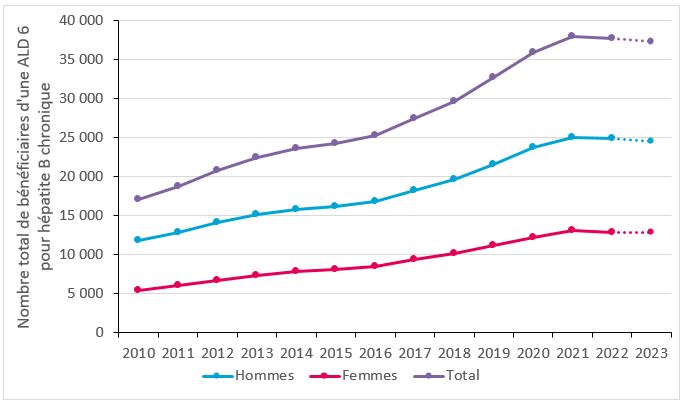
The data show an annual increase in the total number of people with ALD6 for chronic hepatitis B over the period from 2010 to 2021 (annual increase ranging from 2% to 11%); followed by a slight decrease between 2021 and 2022 (annual decrease of 1%). Over the entire period, the total number of beneficiaries rose from 17,126 in 2010 to 37,699 in 2022 nationwide.
The majority of these recipients were men (67%), and 45% of them were aged 30–49.
Annual change in the total number of people with a long-term illness (ALD6) due to chronic hepatitis B during the year in question, 2010–2023, France
Focus on 2022
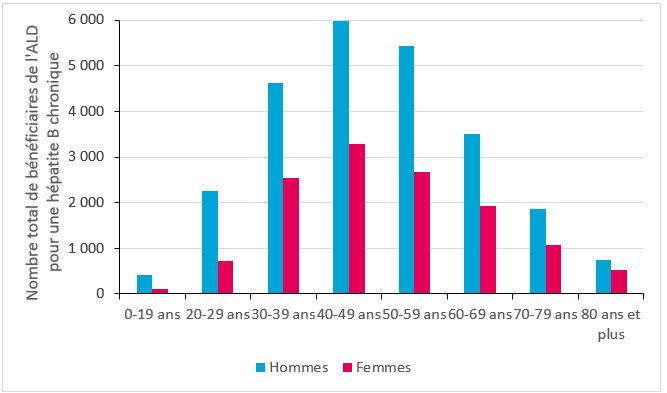
In 2022, a total of 37,699 people in France were classified as having ALD6 for chronic hepatitis B, which, relative to the population living in France, corresponded to a rate of 56 per 100,000 inhabitants.
The majority of these beneficiaries were men (66%). Nearly two-thirds, both men and women, were aged 30–59.
Total number of people with a long-term illness (ALD6) due to chronic hepatitis B in 2022, by sex and age group, France
At the regional and departmental levels
Focus on 2022
In 2022, the rate of patients with a Long-Term Illness (ALD) designation for chronic hepatitis B was higher in the overseas departments and regions (DROM) (67 per 100,000) compared to mainland France (55 per 100,000).
In mainland France:
The Île-de-France (129/100,000), Provence-Alpes-Côte d’Azur (PACA) (50/100,000), Grand-Est (47 per 100,000), and Auvergne-Rhône-Alpes (46 per 100,000) had the highest rates of recipients. Normandy (28 per 100,000) and Hauts-de-France (29 per 100,000) had the lowest rates.
At the departmental level, Seine-Saint-Denis (188/100,000), Val-de-Marne (158 per 100,000), and Paris (156 per 100,000) had the highest rates of recipients, while the lowest rates were observed in Pas-de-Calais (15 per 100,000), Haute-Loire (15/100,000), and Orne (15/100,000).
In the overseas departments and regions (DROM):
The rates were 154 per 100,000 in French Guiana, 98 per 100,000 in Guadeloupe, 56 per 100,000 in Martinique, and 51 per 100,000 in Réunion. The very low number of recipients in Mayotte did not allow for a reliable estimate of this rate.
On Géodes:
Number of people with a long-term illness (ALD) for chronic hepatitis B
Rate of people with ALD for chronic hepatitis B (per 100,000 inhabitants)
Number of new ALD beneficiaries (incidence data)
Over the period 2011 to 2023
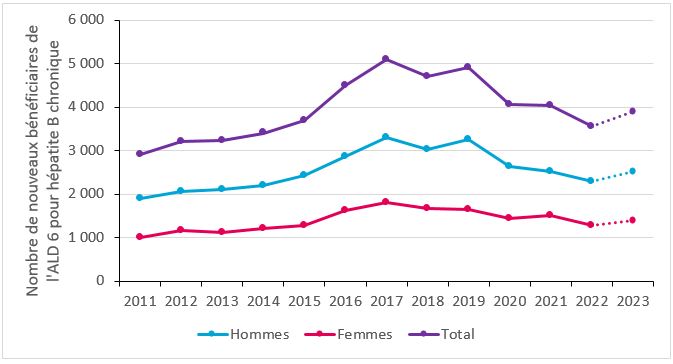
From early 2011 through 2017, the annual number of new ALD6 beneficiaries for chronic hepatitis B increased, rising from 2,911 new beneficiaries in 2011 to 5,106 in 2017, nationwide. This number then decreased irregularly until 2022 (n=3,553).
Annual change in the number of new ALD6 beneficiaries for chronic hepatitis B during the year in question, 2011–2023, France
Focus on 2022
In 2022, 3,553 people in France were newly diagnosed with chronic hepatitis B and granted ALD6 status, which, relative to the population living in France, corresponded to a rate of 5 per 100,000 inhabitants.
In mainland France, this rate of new ALD6 cases was 5 per 100,000. It was highest in Île-de-France (12 per 100,000) and in PACA (5 per 100,000), and ranged from 2 to 4 per 100,000 in the other regions of mainland France. At the departmental level, the highest rates were observed in Seine-Saint-Denis (19 per 100,000 inhabitants), Val-de-Marne (15 per 100,000 inhabitants), Paris (13 per 100,000 inhabitants), and Val-d’Oise (13 per 100,000 inhabitants).
In the overseas departments and regions (DROM), the rate of people newly diagnosed with ALD6 was 15 per 100,000 in French Guiana, 12 per 100,000 in Guadeloupe, 5 per 100,000 in Martinique, and 3 per 100,000 in Réunion.
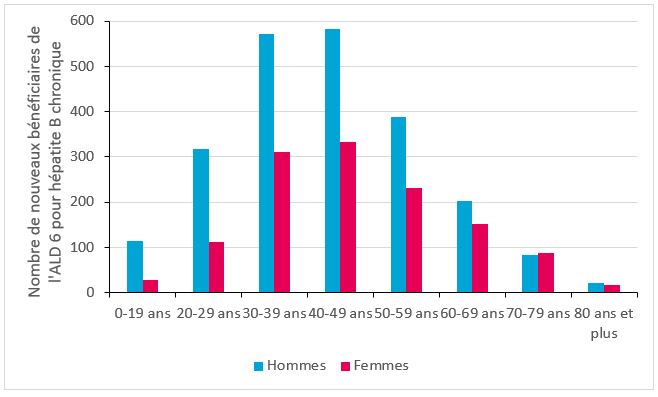
New ALD6 beneficiaries for chronic hepatitis B in France in 2022 were predominantly men (64%). The most represented age groups were those aged 30–39 (25% of men and 24% of women) and those aged 40–49 (26% of men, 26% of women).
Number of new ALD6 beneficiaries for chronic hepatitis B in 2022, by sex and age group, France
Data on hospitalizations
Analysis of data from the PMSI-MCO (Program for the Medicalization of Information Systems—Medicine, Surgery, Obstetrics, and Dentistry) shows, between 2005 and 2020:
A decrease in the rate of patients hospitalized with a primary diagnosis (PD), related diagnosis (RD), or significant associated diagnosis (SAD) of chronic hepatitis B from 0.11% in 2005 to 0.07% in 2020.
A 62% decrease in the number of hospitalized patients with chronic hepatitis B, i.e., those with chronic hepatitis B as a PD/RD or a complication of chronic hepatitis B as a PD/RD associated with chronic hepatitis B as an ASD.
A 43% decrease in the number of deaths among patients hospitalized for chronic hepatitis B.
Learn more:
National surveillance data on chronic hepatitis B from reference centers and voluntary hepatitis networks
Epidemiological data for 2008–2012 are available here.
GEODES
Track the trends in hepatitis B in France and in your region
In relation to

Hepatitis C
thematic dossier
Hepatitis C is a viral infection primarily transmitted through blood. Screening for the disease is crucial to ensuring that infected individuals receive the treatments that can now lead to a cure.

HIV/AIDS
thematic dossier
HIV, or Human Immunodeficiency Virus, is a sexually transmitted human retrovirus. It weakens the immune system, and if left untreated, leads to AIDS.

Vaccination
thematic dossier
Contagious diseases most often affect children at a very young age. Because children are particularly vulnerable, they are a priority target for vaccination programs.











