



Air pollution: What are the risks?
Every day, an adult breathes in 10,000 to 20,000 liters of air, depending on their body type, activities, and other factors… In addition to oxygen (O2) and nitrogen (N2), which together account for an average of 99% of its composition, this air contains pollutants of natural origin (sea spray, dust, pollen, etc.) or resulting from human activities (road traffic, energy production, industry, agriculture, etc.).
The entry of these pollutants into the body can have short- and long-term health consequences.
Short-term risks
Even at low levels, exposure to pollutants can cause, on the same day or in the days that follow, irritation of the eyes, nose, and throat, but can also exacerbate chronic respiratory conditions (asthma, bronchitis, etc.) or increase the risk of a heart attack, and even lead to death.
A study on the short-term impact of particulate matter (PM10) on mortality in 17 French cities between 2007 and 2010 was conducted by Santé publique France. The results show that a 10 µg/m³ increase in PM10 levels on a given day and over the preceding five days is associated with a 0.5% increase in non-accidental mortality. The excess risk is higher among people aged 75 and older (+1.04%), and the effects on mortality are more pronounced in the summer.
These results confirm those of studies conducted since 1997 in France and other countries, most of which have concluded that there is an increase, on the one hand, in mortality and hospitalizations due to cardiovascular causes attributable to fine particulate matter (PM10 and PM2.5), and, on the other hand, an increase in mortality and hospitalizations due to respiratory causes, attributable to ozone (O3) and nitrogen dioxide (NO2) in the summer.
A second study on the short-term impact of nitrogen dioxide (NO₂) on mortality in 18 French urban areas between 2010 and 2014 shows that a 10 µg/m³ increase in NO₂ on the current day and the previous day (0-1-day lag) results in a 0.75% increase in non-accidental mortality (95% CI: [0.4–1.10]). The effects of NO₂ are more pronounced among people aged 75 and older and during the warm season. Thus, a 10 µg/m³ increase in NO₂ is associated with a 3.07% increase in non-accidental mortality the following day among people aged 75 and older. These associations remain stable after adjusting for PM10. These results confirm that exposure to NO2, as a marker of traffic-related pollution, is associated in the short term with mortality, even at concentrations—on an annual average—that comply with European regulations and the WHO guideline value. They also provide exposure-risk relationships that can be used to conduct quantitative assessments of the health impact of air pollution.
Long-term risks
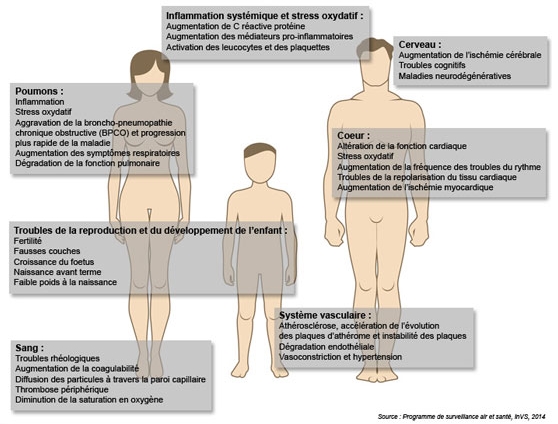
In the longer term, even at low concentration levels, exposure to air pollution over several years can have far more significant health effects than in the short term. Numerous studies demonstrate the role of air pollution in reduced life expectancy and mortality, as well as in the development of cardiovascular diseases, respiratory diseases, and lung cancer. Indeed, through direct cellular toxicity that can lead to genetic alterations, through indirect effects via pro-inflammatory reactions and oxidative stress, and by weakening the body’s defense mechanisms, pollutants can cause:
cardiovascular effects: a reduction in heart rate variability, an increase in blood pressure and blood coagulability, and the progression of atherosclerosis leading to the development of coronary heart disease (myocardial infarction) and strokes.
Respiratory system: reduced respiratory capacity, increased bronchial reactivity, and abnormal cell growth that can lead to the development of chronic obstructive pulmonary disease (COPD), asthma, lower respiratory tract infections, and, in some cases, lung cancer.
New studies also show that air pollution plays a role in reproductive disorders, childhood developmental disorders, neurological conditions, and type 2 diabetes.
40,000
people die each year from air pollution in France
The results of the monitoring program implemented by Santé publique France show a significant association between rising pollution levels—such as PM2.5 particles—and an increase in the number of deaths. Indeed, the Gazel’Air study used data from the Gazel cohort (coordinated by Inserm’s UMS 11 unit) to establish, for the first time in France, the link between 25 years of exposure to air pollution, mortality, and indicators of cardiovascular disease (CVD), respiratory disease, and diabetes in a study population of over 20,000 volunteer EDF-GDF workers followed from 1989 to 2015.
In this study, increased concentrations of PM, nitrogen dioxide (NO₂), and benzene were associated with an increased risk of all-cause non-accidental mortality. Thus, a 10 µg/m³ increase in PM2.5 was associated with a 15% increase in the risk of total non-accidental mortality. This risk was subsequently used in the quantitative health impact assessment (EQIS) for mainland France.
This assessment showed that in our country, nearly 40,000 people die each year from air pollution, corresponding to a loss of 7.6 months of life expectancy.

rapport/synthèse
22 January 2020
Short-term impact of nitrogen dioxide (NO₂) on mortality in 18 French urban areas, 2010–2014

enquêtes/études
23 August 2021
Impact of ambient air pollution on mortality in mainland France. Reduction linked to the spring 2020 lockdown and new data on the total burden for the 2016–2019 period
enquêtes/études
9 July 2024
The relevance and feasibility of a study on the role of ambient air pollution in the incidence and/or severity of COVID-19 in France
enquêtes/études
6 June 2023
Short- and long-term effects of outdoor air pollution on neurological and mental disorders: an opportunity to conduct a quantitative health impact assessment

presse
Air Pollution in the Auvergne-Rhône-Alpes Region: A First Quantitative Assessment of the Impact on Health at the Regional Level

Expected health benefits of a low-emission zone. A prospective quantitative assessment of health impacts for the Paris metropolitan area
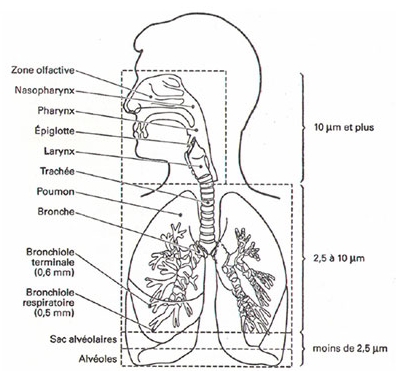
How particles enter the body: (Diagram based on a drawing by Dr. J. Harkema)
The health effects of particulate matter
The Special Case of Ozone
So-called tropospheric ozone (or “low-altitude ” or “bad ozone”) is one of the characteristic pollutants of summer smog (or photochemical smog), along with fine particulate matter. It is a haze formed by chemical reactions between various pollutants (such as nitrogen oxides and VOCs) under the influence of solar radiation and in conditions of stagnant air.
In France, the impact of ozone on mortality has been assessed by several studies. Santé publique France has shown that chronic exposure to ozone is responsible for nearly 500 deaths from respiratory causes each year, with a very marked north-south gradient due to the influence of meteorological conditions on ozone formation.
Studies conducted in 18 French cities have shown that the risk of death associated with ozone and fine particulate matter is higher on hot days. There is thus a synergy between the negative effects of pollutants and temperature.
High temperatures promote ozone production, and this pollutant is particularly prevalent in the summer. Ozone concentrations are thus higher on hot, sunny days. Additionally, people may spend more time outdoors when the weather is nice, thereby increasing their exposure to ozone. Finally, simultaneous exposure to ozone and high temperatures can trigger a more intense response in the body compared to exposure to a single agent, by amplifying inflammatory reactions. These factors can contribute to worsening the health effects of ozone when it is hot.
What should be done in the event of a simultaneous heat wave and ozone pollution?
In the event of a spike in ozone pollution coinciding with a heat wave, the results of analyses conducted in 2003 show that the risks associated with high temperatures are much greater than the risk associated with ozone. Therefore, the priority should be to protect yourself from the heat.
rapport/synthèse
16 September 2019
Impacts of chronic exposure to fine particulate matter on mortality in mainland France and an analysis of the health benefits of various air pollution reduction scenarios
rapport/synthèse
6 September 2019
The 2003 Summer Heat Wave: Relationships Between Temperature, Air Pollution, and Mortality in Nine French Cities. Study Report

article
6 September 2019
Short-term effects of particulate matter (PM10, PM2.5) on mortality in nine French cities
article
6 September 2019
Box. The influence of season and temperature on the effects of ozone and particulate matter on mortality in France.
Short- and long-term effects of outdoor air pollution on neurological and mental disorders
enquêtes/études
6 June 2023
Short- and long-term effects of outdoor air pollution on neurological and mental disorders: an opportunity to conduct a quantitative health impact assessment
In relation to

Climate change
thematic dossier
Climate change is rapidly and profoundly altering the environment. The health impacts of climate change are numerous and varied.

Asthma
thematic dossier
Asthma is a chronic respiratory disease characterized by attacks, which are episodes of breathing difficulties (dyspnea). Asthma has a significant impact on patients’ quality of life.

thematic dossier
Cardiovascular disease and stroke
Les maladies cardio-neuro-vasculaires regroupent un ensemble de troubles affectant le cœur et les vaisseaux sanguins.












