



The specific case of pollution spikes
From an epidemiological perspective, there is no definition of pollution spikes in terms of health effects. At the pollution levels observed in Western countries, there are no thresholds below which no health effects would be observed in the population, whether for long-term or short-term exposure.
Despite their small contribution to overall health impacts, pollution spikes provide an opportunity to raise awareness among stakeholders and the general public about the health effects of air pollution.
Air pollution spikes are identified by exceedances of thresholds (daily or hourly) set by French regulations.
Only a retrospective analysis of a spike allows the effects attributable to pollution to be identified. It is indeed very difficult, if not impossible, to directly measure its impact on healthcare utilization.
The contribution of pollution spikes to the health impacts of pollution varies depending on the cities and years considered. It can account for up to 20% of the overall impact of short-term pollution in certain cities, but it remains well below the effect of long-term exposure.
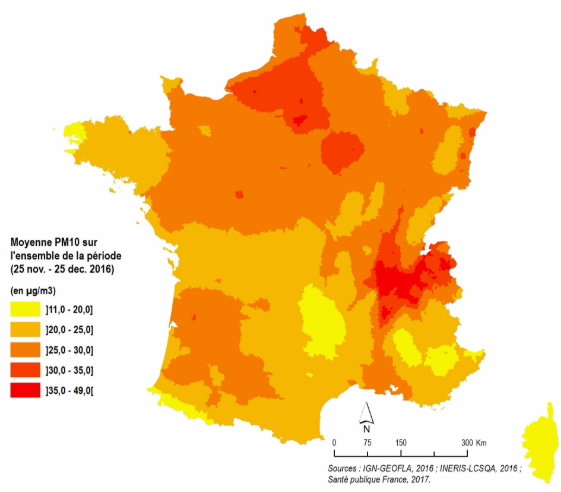
The most recent major pollution spike in France occurred in December 2016. The highest concentrations were observed in the Normandy, Hauts-de-France, Île-de-France, Bourgogne-Franche-Comté, and Auvergne-Rhône-Alpes regions.
Average daily PM10 concentrations by municipality, as modeled during the December 2016 pollution spike
See also

rapport/synthèse
22 May 2019
Health Impact of the PM10 Pollution Episode in November–December 2016
In relation to

Climate change
thematic dossier
Climate change is rapidly and profoundly altering the environment. The health impacts of climate change are numerous and varied.

Asthma
thematic dossier
Asthma is a chronic respiratory disease characterized by attacks, which are episodes of breathing difficulties (dyspnea). Asthma has a significant impact on patients’ quality of life.

thematic dossier
Cardiovascular disease and stroke
Les maladies cardio-neuro-vasculaires regroupent un ensemble de troubles affectant le cœur et les vaisseaux sanguins.












