



Air Pollution: Quantitative Health Impact Assessments – EQIS-PA
Quantitative Health Impact Assessments of Air Pollution (EQIS-PA)
To justify or guide the implementation of measures aimed at reducing public exposure to air pollution, decision-makers often need information on the extent of the health impact of pollution on the population in their jurisdiction. They may also need to assess the expected health impact of measures (or interventions) designed to reduce emissions in their jurisdiction.
Quantitative air pollution health impact assessments (EQIS-PA) are one possible response to these needs. They make it possible to calculate the magnitude of the health burden of air pollution and/or the expected health benefits of various scenarios for reducing pollution levels within a given population.
They also make it possible to assess the potential benefits of an action (intervention) aimed at reducing pollution. The results of an EQIS-PA can also be used to monetarily assess the impacts of exposure to air pollution.
As part of the Air and Health Monitoring Program (Psas), EQIS-PA studies were designed as a decision-support tool enabling various stakeholders (decision-makers, partners, healthcare professionals, etc.) to select, plan, and implement measures to protect public health, as well as a tool to raise public awareness of the health effects of air pollution.
Principles of Quantitative Health Impact Assessments (EQIS-PA)
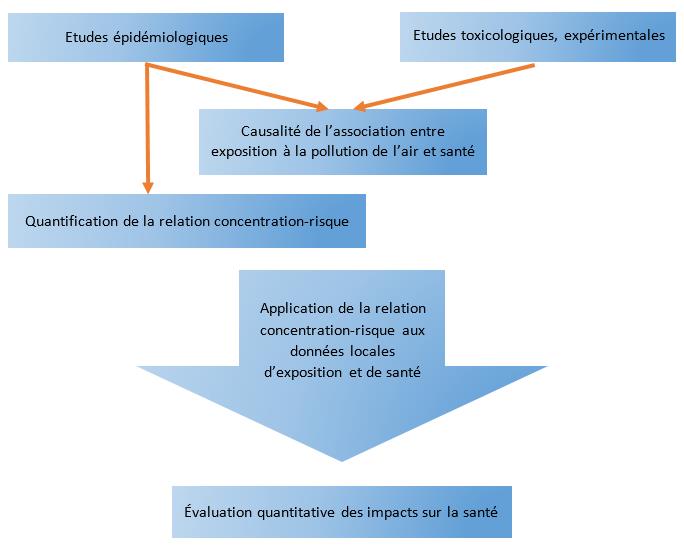
Quantitative Assessment of the Health Impacts of Air Pollution (EQIS-PA): AirQ+ Guides and Calculation Tools
To implement an EQIS-PA, methodological guides developed by Santé publique France, as well as the AirQ+ software developed by the WHO, are available.
Quantitative Assessment of Health Impacts (EQIS-PA) of Air Pollution (EQIS-PA): a guide available in 3 versions tailored to your contexts and needs: a guide available in 3 versions tailored to your contexts and needs
Coinciding with the World Health Organization’s (WHO) update of the AirQ+ software in November 2019—to which Santé publique France contributed—it seemed necessary to update the latest EQIS-PA guide, which dates back to 2013, in order to enrich it with the new knowledge, methods, and tools now available.
This is a practical guide intended for professionals in local governments, state agencies, public organizations, accredited air quality monitoring associations (AASQA), regional health observatories (ORS), consulting firms, and others who wish to conduct EQIS-PA studies while adhering to the general framework recommended by the WHO1.
To help you choose the EQIS-PA best suited to your objectives, we offer three methods based on the tools used within the Psas framework.
These methods, and the corresponding guides, range from the simplest to the most complex:
This guide does not detail all the possibilities offered by the EQIS-PA approach. While the general principle remains the same, several choices are possible at different stages. Only a few options are presented here. The reader may find other approaches in the literature.
In Appendix 4 of each guide, a summary table [ANdsP1] for conducting an EQIS-PA presents:
the proposed objectives, the corresponding types of EQIS, and what they will produce;
the main data, skills, and prerequisites required;
the steps for conducting an EQIS;
possible scenarios and the various calculation tools depending on the selected objective and data;
the key factors to consider when interpreting and presenting the results.
The choice of EQIS type depends primarily on the answers to the following questions:
What do I want to do?
What air pollution exposure data do I have available?
Please note: this guide does not answer the following questions:
Which source should I target to reduce the impact of air pollution? In other words, which source has the greatest impact? Or which source is the most dangerous?
What is the health impact of a point source, such as an industrial facility or a major highway?
What is the health impact of exposure to indoor air pollution?
What is the economic impact of air pollution?
Prerequisites or skills required or to be acquired:
know how to work with databases;
possess a minimum level of expertise and/or consult with experts in epidemiology, air quality, statistical methods, and geodata processing;
have an analysis of the representativeness of the measurement or modeling results used for the EQIS;
be able to explain all the assumptions underlying the choices made.
EQIS-PA at the national level
Ambient air pollution: estimates of its impact on the incidence of chronic diseases and associated economic impacts, mainland France, 2016–2019
Santé publique France has conducted a new quantitative health impact assessment (EQIS) to estimate:
the impact of long-term exposure to ambient air pollution (particulate matter and nitrogen dioxide) on the incidence of eight respiratory, cardiovascular, and metabolic diseases, and the health benefits associated with reduced air pollution in mainland France (broken down by region, excluding overseas departments and regions);
the associated economic impacts in mainland France.
These results are supplemented by exploratory analyses based on the level of social deprivation.
The EQIS is based on the recommendations of the WHO’s EMAPEC project and the EQIS-PA guide from Santé publique France. It was conducted in partnership with the Aix-Marseille School of Economics (Aix-Marseille University/CNRS), INERIS, ORS Île-de-France, CREAI-ORS Occitanie, CITEPA, and Inserm CIC1401 at the University of Bordeaux.
Depending on the disease and pollutant considered, the study estimates that between 12% and 20% of new cases of respiratory diseases in children (i.e., between 7,000 and nearly 40,000 cases) and between 7% and 13% of new cases of respiratory, cardiovascular or metabolic diseases in adults (i.e., between 4,000 and nearly 78,000 cases) are attributable annually to long-term exposure to ambient air pollution linked to human activities. It also highlights that reducing concentrations of fine particulate matter (PM2.5) and nitrogen dioxide (NO2) to levels equivalent to WHO guideline values would prevent a large proportion of these cases.
Furthermore, the economic impact is estimated at 12.9 billion euros related to PM2.5—nearly 200 euros per year per capita—and 3.8 billion euros for NO2—59 euros per year per capita. If WHO guideline values were met, these benefits would be €9.6 billion (or €148 per year per capita) and €1.7 billion (or €26 per year per capita), respectively.
Learn more:
Estimation of morbidity attributable to long-term exposure to ambient air pollution and economic impacts in mainland France, 2016–2019. Volume 1: Quantitative Health Impact Assessment (ÉQIS-PA). (report and national summary)
Estimation of morbidity attributable to long-term exposure to ambient air pollution and economic impacts in mainland France, 2016–2019. Volume 2: Assessment of economic impacts. (report and national summary)
Estimation of the potential health benefits of improved ambient air quality, 2016–2019 (regional summaries)
Ambient air pollution: new estimates of its impact on the health of the French population (press release dated 01/29/25)
Ambient Air Pollution: Estimates of Its Impact on the Health of the French Population, 2016–2019
Santé publique France conducted a new EQIS-PA on mortality in metropolitan France in order to:
estimate the impact on mortality of the decreases in ambient air pollution levels—and thus the reduction in the population’s exposure to particulate matter (PM) and NO2—observed during the first lockdown implemented on March 16, 2020, in connection with COVID-19;
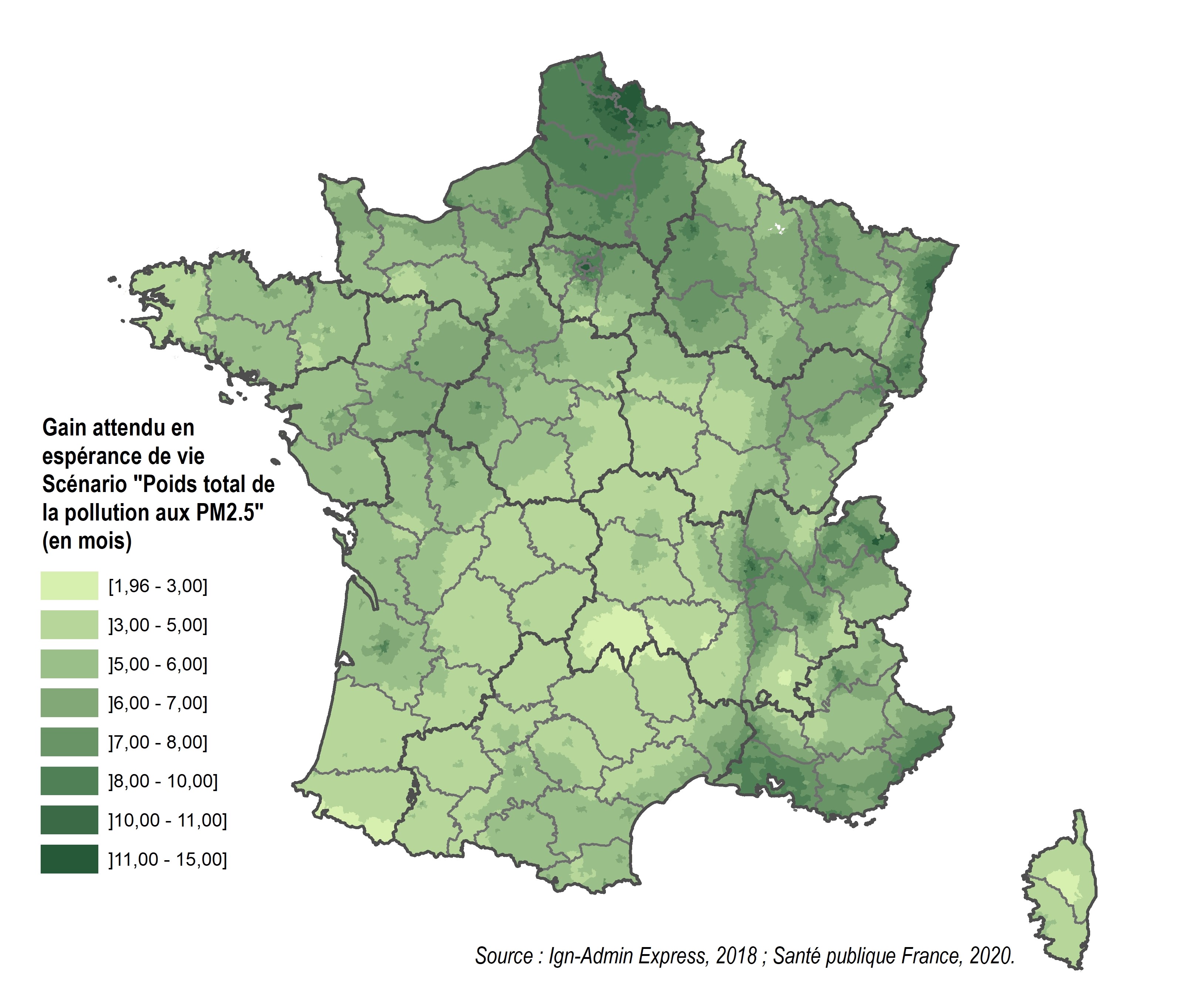
to assess the long-term impact of the population’s exposure to fine particulate matter (PM2.5) and NO2 on mortality for the period 2016–2019 in order to update the estimates produced for the period 2007–2008 and published in 2016.
The results on the long-term burden of ambient air pollution showed that pollution-related mortality remains a significant risk in France, with 40,000 deaths attributable each year to fine particulate matter (PM2.5) and 7,000 deaths attributable to NO2. In terms of life expectancy, this corresponds to 7.6 months for PM2.5 and 1.6 months for NO2.
Learn more:
Impact of ambient air pollution on mortality in metropolitan France. Reduction linked to the spring 2020 lockdown and new data on the total burden for the 2016–2019 period (report and summary)
Ambient air pollution: a current public health issue and lessons from the spring 2020 lockdown related to COVID-19 (infographic)
Ambient air pollution: new estimates of its impact on the health of the French population (press release dated 04/14/21)
Economic Assessment of the Effects of Ambient Air Pollution on Mortality in Metropolitan France, 2016–2019
This economic assessment provides further justification for taking action to improve air quality and reduce public exposure to air pollution in France.
Building on work by Santé publique France, the Aix Marseille School of Economics-GREQAM (Aix-Marseille University) conducted a new economic assessment in 2021 of the impact of long-term exposure to ambient air pollution on mortality in France. The results showed that the economic impact associated with the 40,000 deaths attributable each year to fine particulate matter (PM2.5) amounts to approximately €130 billion, while that associated with the 7,000 deaths attributable to NO2 amounts to €23 billion annually.
Learn more:
EQIS on pollution episodes
Health impact of the PM10 pollution episode in November–December 2016:
From an epidemiological perspective, there is no definition of pollution peaks in terms of health effects. At the pollution levels observed in Western countries, there are no thresholds below which no health effects would be observed in the population, whether for long-term or short-term exposure. The study showed that the contribution of pollution episodes to the health impacts of pollution varies depending on the cities and years considered. It can account for up to 20% of the overall impact of short-term pollution in certain cities, but it remains well below the effect of long-term exposure.
Share of pollution episodes in the short-term health effects of air pollution in French cities:
This study, conducted in major metropolitan areas, showed that reducing pollution levels only during pollution episodes does not ensure effective prevention of the health impacts of air pollution. These impacts result primarily from day-to-day exposure over the long term.
EQIS Mainland France, 2007–2008
A previous EQIS conducted by Santé publique France in 2016 established a national estimate for mainland France of the health burden of PM2.5 fine particulate matter pollution linked to human activity for the period 2007–2008.
Economic Impact of Chronic Exposure to Fine Particles on Mortality in France, 2007–2008
Building on the work of Santé publique France, the Aix Marseille School of Economics-GREQAM (Aix-Marseille University) conducted an economic assessment in 2017 of the impact of chronic exposure to fine particulate matter on mortality in France.
EQIS-PA at the local and regional levels
Since 1999, the Psas has been producing calculation tools and methodological guides for conducting EQIS-PA studies at the local and regional levels.
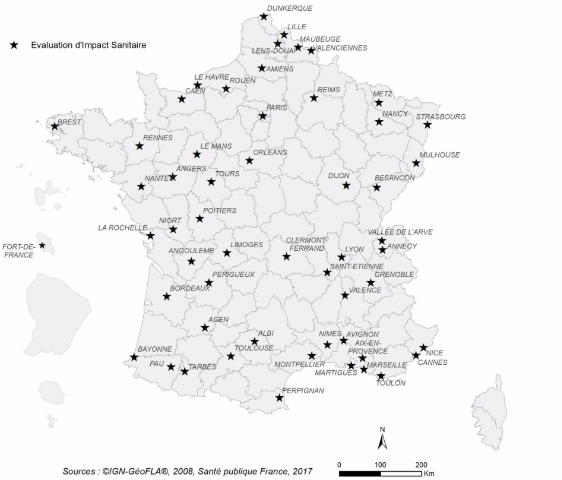
Between 1999 and 2016, 120 EQIS-PA studies were conducted across 55 French urban areas, covering 990 municipalities and just over 21 million residents.
A summary of these EQIS and the expectations expressed by stakeholders is available here.
Urban areas covered by an EQIS-PA between 1997 and 2016
Results of the local and regional EQIS-PA surveys by Santé publique France
The study showed that each year in Auvergne-Rhône-Alpes, nearly 4,300 deaths are attributable to population exposure to fine particulate matter (PM2.5) and 2,000 deaths to exposure to nitrogen dioxide (NO2: a tracer pollutant for traffic-related pollution). The results, broken down across several subregional scales, underscore the importance of continuing efforts to reduce air pollution by addressing all sources of pollution. They help raise public awareness and support local stakeholders in implementing public policies aimed at improving air quality.
Expected health benefits of a low-emission zone: prospective EQIS-PA for the Paris metropolitan area
Among the measures to combat air pollution, low-emission zones, which are based on the Crit’air classification, have already proven effective in several major European metropolitan areas.
To best support their design and implementation, ORS Île-de-France developed in 2018, in collaboration with its partners Airparif and Santé publique France, an innovative approach to prospectively assess their health impacts across four scenarios: two geographic areas (Paris and the area inside the A86 ring road) and two levels of restrictions tested.
The health impacts of outdoor air pollution are a major concern in the Arve Valley, where the concentration of human activities, topography, and climatic conditions contribute to the accumulation of pollutants. A study (EQIS-PA) was conducted to help local stakeholders assess the expected benefits of improved air quality on mortality and life expectancy.
Local EQIS-PA studies conducted in 2016:
Tillier C. Impact of chronic exposure to air pollution on mortality in France: a focus on the Alsace-Champagne-Ardenne-Lorraine region. Saint-Maurice: Santé publique France; 2016. 2 p.
Gault G. Impact of chronic exposure to air pollution on mortality in France: focus on the Aquitaine-Limousin-Poitou-Charentes region. Saint-Maurice: Santé publique France; 2016. 2 p.
Public Health France. Impact of chronic exposure to air pollution on mortality in France: focus on the Auvergne-Rhône-Alpes region. Saint-Maurice: Public Health France; 2016. 2 p.
Tillier C. Impact of chronic exposure to air pollution on mortality in France: focus on the Bourgogne-Franche-Comté region. Saint-Maurice: Santé publique France; 2016. 2 p.
Guillois Y. Impact of chronic exposure to air pollution on mortality in France: a focus on the Brittany region. Saint-Maurice: Public Health France; 2016. 2 p.
Corso M, Menudier L. Impact of chronic exposure to air pollution on mortality in France: a focus on the Centre-Val de Loire region. Saint-Maurice: Santé publique France; 2016. 2 p.
Host S, Legout C. Impact of chronic exposure to air pollution on mortality in France: a focus on the Île-de-France region. Saint-Maurice: Santé publique France; 2016. 2 p.
Cochet A. Impact of chronic exposure to air pollution on mortality in France: focus on the Languedoc-Roussillon and Midi-Pyrénées regions. Saint-Maurice: Public Health France; 2016. 2 p.
Provost H, Heyman C. Impact of chronic exposure to air pollution on mortality in France: a focus on the Nord–Pas-de-Calais–Picardie region. Saint-Maurice: Santé publique France; 2016. 2 p.
Blanchard M. Impact of chronic exposure to air pollution on mortality in France: focus on the Normandy region. Saint-Maurice: Public Health France; 2016. 2 p.
Pascal L. Impact of chronic exposure to air pollution on mortality in France: focus on the Provence-Alpes-Côte d’Azur region. Saint-Maurice: Santé publique France; 2016. 2 p.
Liebert A-H. Impact of chronic exposure to air pollution on mortality in France: a focus on the Pays de la Loire region. Saint-Maurice: Santé publique France; 2016. 2 p.
In relation to

Climate change
thematic dossier
Climate change is rapidly and profoundly altering the environment. The health impacts of climate change are numerous and varied.

Asthma
thematic dossier
Asthma is a chronic respiratory disease characterized by attacks, which are episodes of breathing difficulties (dyspnea). Asthma has a significant impact on patients’ quality of life.

thematic dossier
Cardiovascular disease and stroke
Les maladies cardio-neuro-vasculaires regroupent un ensemble de troubles affectant le cœur et les vaisseaux sanguins.












