



Air pollution: short-term effects
The Public Health France PSAS has been a pioneer in the field of monitoring the short-term effects of air pollution and has contributed to international developments in this area.
So-called multicenter studies (covering multiple cities or metropolitan areas) form the basis for monitoring the short-term effects of air pollution. Robust and grounded in several years of data, they rely on statistical methods that enable the establishment of day-to-day links between pollution and health indicators. In these studies, numerous factors (temperature, seasonal epidemics, etc.) are taken into account to ensure that only the effects attributable to pollution are attributed to it.
Today, the 20 French urban areas participating in the program—including two overseas territories—allow for the diversity of air pollution in France to be taken into account. Between 2007 and 2010, while none of these metropolitan areas exceeded the European regulatory limit (40 μg/m³ as an annual average for PM10), only Dijon met the World Health Organization’s guideline value (20 μg/m³).
Studies conducted since 1997 have mostly concluded that there has been an increase:
on the one hand, in mortality and hospitalizations due to cardiovascular causes, attributable to fine particulate matter (PM10 and PM2.5);
and, on the other hand, in mortality and hospitalizations due to respiratory causes, attributable to ozone (O3) in the summer.
|
City |
Population |
% of people aged 74 and older |
Population density (people/km²) |
Number of PM10 monitoring stations |
Annual average |
Annual average temperature (°C) |
Annual average NO2 (μg/m³) |
|---|---|---|---|---|---|---|---|
|
Bordeaux |
647,789 |
9 |
2,841 |
3 |
22 |
13.3 |
21.4 |
|
Dijon |
238,329 |
9 |
714 |
1 |
19.3 |
10.9 |
25.7 |
|
Grenoble |
471,116 |
8 |
2,838 |
3 |
27.5 |
11.7 |
26.1 |
|
Lens-Douai |
329,428 |
8 |
689 |
3 |
27.3 |
10.8 |
28.5 |
|
Le Havre |
240,290 |
9 |
1,313 |
2 |
24.6 |
11.3 |
23.1 |
|
Lille |
1,108,991 |
7 |
1,812 |
3 |
30.9 |
10.8 |
29.4 |
|
Lyon |
1,031,266 |
8 |
4,445 |
2 |
29.5 |
12.6 |
33.6 |
|
Marseille |
969,402 |
10 |
2,193 |
2 |
31.8 |
15.4 |
35.2 |
|
Montpellier |
387,155 |
8 |
1,249 |
1 |
23.2 |
15.1 |
31.1 |
|
Nancy |
331,846 |
8 |
997 |
2 |
23.8 |
10.5 |
26.5 |
|
Nantes |
595,985 |
8 |
1,018 |
2 |
21.4 |
11.9 |
20.4 |
|
Nice |
433,747 |
12 |
3,615 |
1 |
29.2 |
16.1 |
26.8 |
|
Paris |
6,630,370 |
7 |
8,701 |
9 |
27 |
12.2 |
36.1 |
|
Rennes |
239,155 |
7 |
2,139 |
1 |
21.9 |
11.5 |
18.5 |
|
Rouen |
447,449 |
9 |
1,257 |
3 |
25.8 |
10.4 |
28.7 |
|
Strasbourg |
440,605 |
7 |
1,985 |
2 |
25.6 |
10.9 |
32.0 |
|
Toulouse |
758,797 |
7 |
1,432 |
3 |
21.7 |
13.5 |
22.0 |
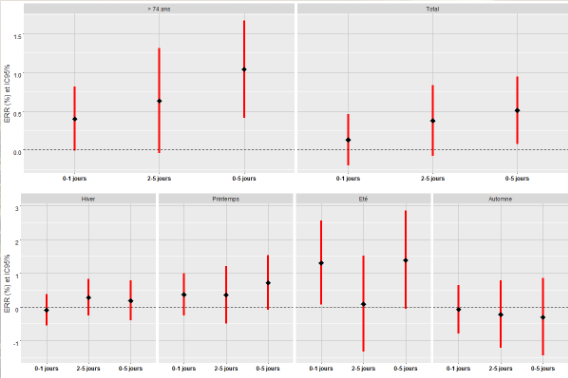
Recent findings show that a 10 µg/m³ increase in PM10 levels on a given day and over the preceding five days is associated with a 0.5% increase in non-accidental mortality. This increase is higher among people aged 75 and older (+1.04%). The effects on mortality are more pronounced in the summer.
Percentage increase in non-accidental mortality associated with a 10 µg/m³ increase in PM10, by age group and season, 2007–2010
See also

article
6 September 2019
Short-term impact of particulate matter (PM10) on mortality in 17 French cities, 2007–2010
In relation to

Climate change
thematic dossier
Climate change is rapidly and profoundly altering the environment. The health impacts of climate change are numerous and varied.

Asthma
thematic dossier
Asthma is a chronic respiratory disease characterized by attacks, which are episodes of breathing difficulties (dyspnea). Asthma has a significant impact on patients’ quality of life.

thematic dossier
Cardiovascular disease and stroke
Les maladies cardio-neuro-vasculaires regroupent un ensemble de troubles affectant le cœur et les vaisseaux sanguins.












