




Data
Following an unprecedented decline between 2016 and 2019 amid strong commitment to tobacco control, followed by a period of stability during the COVID-19 pandemic, the prevalence of daily smoking has been declining again since 2021. Since the launch of the first National Tobacco Reduction Plan (PNRT) in 2014, the prevalence of daily smoking among 18- to 75-year-olds has fallen from 25% to 18% in 2024.
Smoking prevalence in France remains high compared to the European average and higher than in neighboring countries. Anglo-Saxon countries have significantly lower smoking prevalence rates, with 8% of smokers in New Zealand, 12% in the United Kingdom, and 11% in the United States.
According to the OFDT, the social cost of tobacco (value of lives lost, loss of quality of life, production losses, and cost to public finances) is approximately 156 billion euros.
Smoking remains widespread in France, even though it is declining
Data from the Public Health France Barometer show that in 2024:
Less than a quarter of French people aged 18–79 report smoking (24.0%);
Fewer than two in ten French people aged 18–79 report smoking daily (17.4%);
Daily smokers consumed an average of 12.8 cigarettes (or equivalent) per day.
The fight against smoking has been stepped up since 2014 with the implementation of national plans leading to a number of measures, such as plain packaging, the reimbursement of nicotine replacement therapies like any other medication, renewed prevention campaigns including the annual “Month Without Tobacco” initiative, and price increases aimed at reaching an average price of €12.50 per pack of cigarettes by 2023. The regulatory and prevention measures implemented have thus likely contributed significantly to the decline observed over the past 10 years.
The Impact of Health and Social Crises on the Halt in the Decline of Smoking
Between 2019 and 2021, smoking prevalence increased slightly, while daily smoking stabilized. Following the social crisis of late 2018 (the Yellow Vests movement), the years 2020 and 2021 were marked by an exceptional health and social crisis linked to the COVID-19 pandemic. The impact of these crises cannot be ruled out regarding the halt in the decline in smoking prevalence in France observed since 2019. Indeed, the population’s mental health deteriorated significantly during this period, with an increase in diagnosed depressive episodes occurring over the past twelve months among 18- to 75-year-olds between 2017 and 2021. However, previous research has shown that anxiety and depressive disorders are associated with smoking. The deterioration in mental health linked to the health and social situation could thus be one of the causes of the halt in the decline in smoking.
The resumption of the downward trend
The downward trend, which began in 2016 and was interrupted during the COVID-19 pandemic, is resuming. Smoking and daily smoking are significantly lower compared to 2021. Among 18- to 75-year-olds in mainland France in 2024 (a population comparable to previous editions of the Santé publique France Barometer), 25% report smoking (32% in 2021), and 18% smoke daily (25% in 2021). These declines are part of a trend that began in 2016. Since the launch of the first National Plan to Reduce Smoking (PNRT) in 2014, the prevalence of daily smoking among 18- to 75-year-olds has fallen from 25% to 18% in 2024, representing 4 million fewer daily smokers over 10 years.
Men smoke more than women
In 2024:
26.8% of men and 21.5% of women aged 18–79 report smoking;
The prevalence of daily smoking was 19.7% among men and 15.3% among women; between 2021 and 2024, daily smoking declined among both men and women;
The prevalence of occasional smoking was 6.6% and 7.2% among men (8.3%) and 6.1% among women;
Among daily smokers, men consumed an average of 14.0 cigarettes per day and women 11.4.
Trends in smoking prevalence and daily smoking by gender among people aged 18–75 in mainland France, 2000–2024
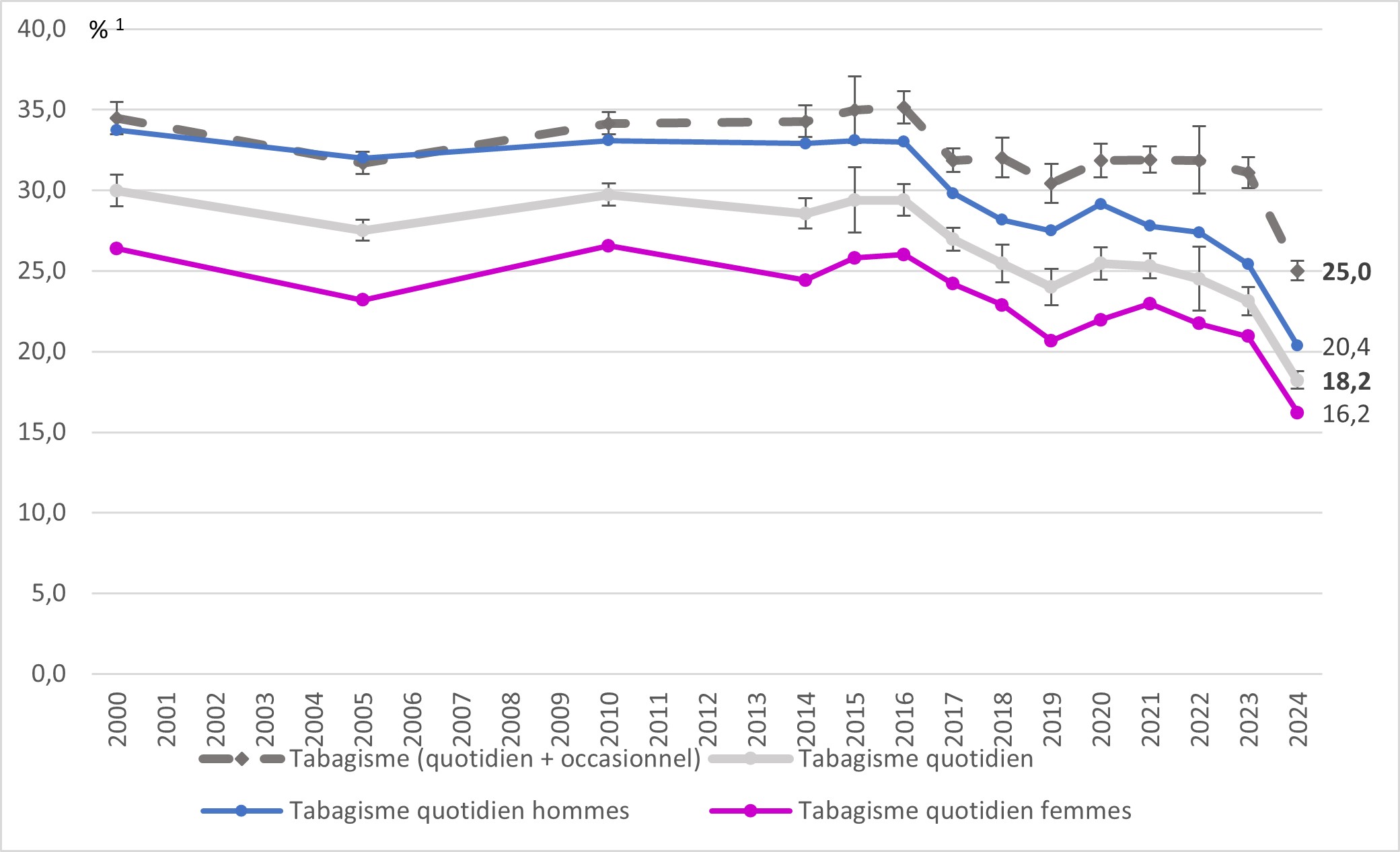
To compare the results observed in 2024 with those of previous editions of the Santé publique France Barometer, the analysis should be limited to people aged 18–75 and mainland France. The survey methodology changed in 2024. Changes compared to previous editions are presented, but they should be interpreted with caution.
Read the summary: Smoking: use, desire to quit, and quit attempts
Smoking is not uncommon during pregnancy
According to the 2021 National Perinatal Survey (ENP 2021)—the sixth since 1995—conducted in March 2021 among 12,723 women in mainland France, the proportion of those reporting tobacco use during the third trimester of pregnancy is decreasing: 12.2% in 2021 versus 16.3% in 2016. This trend is consistent with the decline observed among adults.
Significant declines among 18- to 44-year-olds
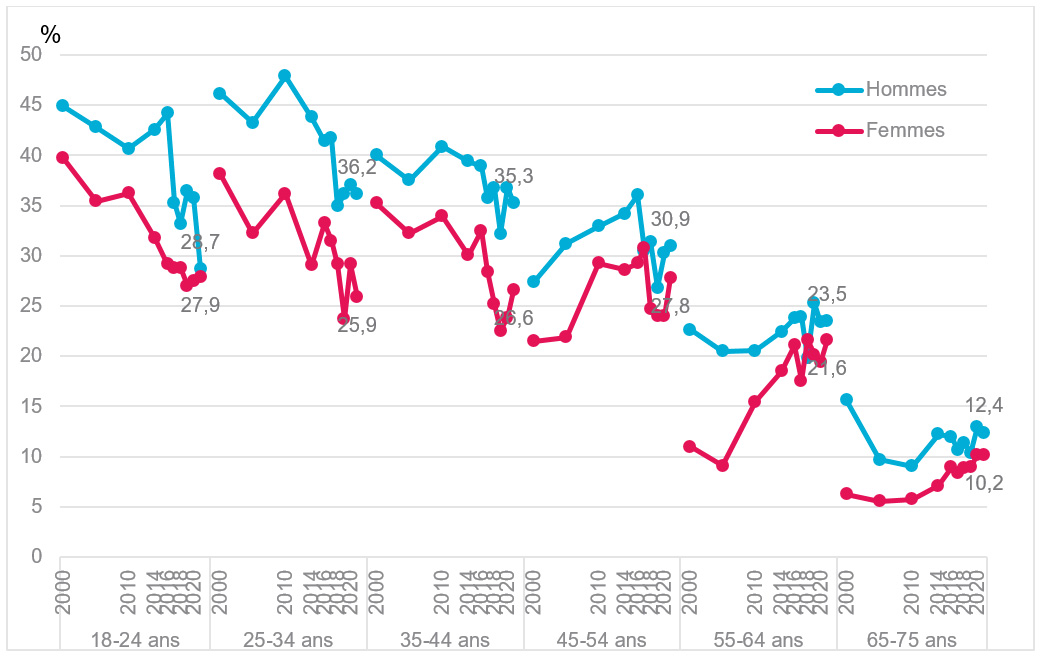
An analysis of trends in the prevalence of daily smoking by sex and age group between 2000 and 2021 reveals differing trends:
among 18- to 44-year-olds: smoking declined between 2000 and 2019. Prevalence stabilized between 2019 and 2021, except among men aged 18 to 24, among whom a decline was observed;
among those aged 45–54: conversely, prevalence increased between 2000 and 2016, decreased slightly between 2016 and 2019, and then stabilized;
among those aged 55–75: while the trend was relatively stable among men, prevalence increased among women. These increases result from a generational effect: women aged 55 to 75 today experienced the rise in female smoking starting in the 1960s and 1970s, and some of them have not quit smoking.
Prevalence (in %) of daily smoking by age and sex among people aged 18–75, France, 2000–2021
Social inequalities in smoking rates remain pronounced
Analysis based on three indicators shows that in 2024, among 18- to 79-year-olds:
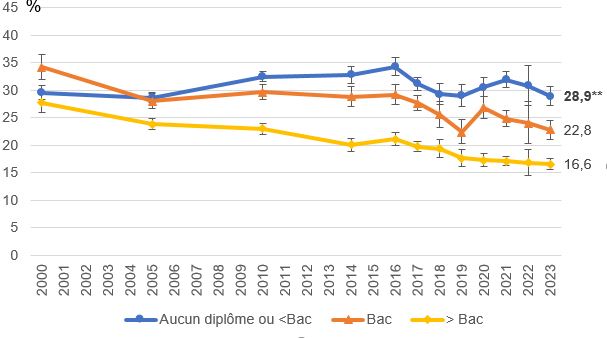
The prevalence of daily smoking is significantly higher among those with lower educational attainment: it ranges from 13.0% among those with a degree higher than a high school diploma to 20.9% among those with no diploma or a diploma lower than a high school diploma.
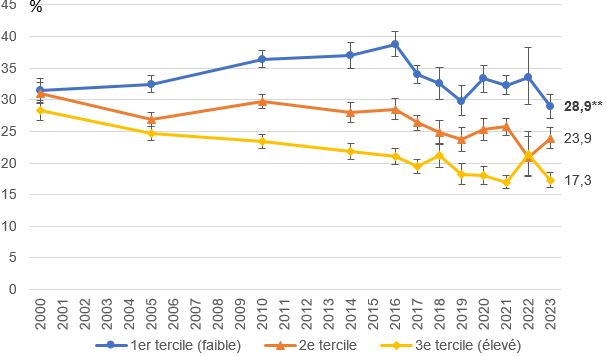
The prevalence of daily smoking is lowest among those who report being financially comfortable (10.1%) and highest among those who perceive their financial situation as difficult or who cannot make ends meet without going into debt (30.0%).
Daily smoking is significantly less common among managers and professionals (11.8%) than among manual workers (25.1%) or clerical workers (18.5%).
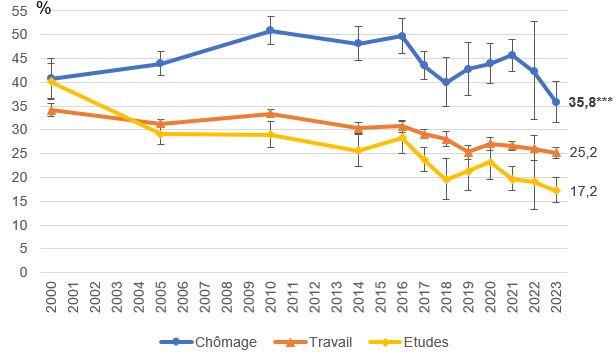
Finally, the prevalence of daily smoking is significantly lower among retirees (8.8%), students (12.2%), and employed individuals (19.2%) than among the unemployed (29.7%)
Since the early 2000s, social inequalities in smoking have evolved in several phases:
between 2000 and 2016, disparities based on socioeconomic status widened;
between 2016 and 2019, they narrowed;
between 2019 and 2021, these gaps tended to widen again, reaching 15 points in 2021 for education and income and 18 points for employment status;
between 2021 and 2023, smoking prevalence decreased among the less advantaged socioeconomic groups, suggesting a further narrowing of the gaps between the most and least advantaged (approximately 12 points).
Prevalence of daily smoking by educational attainment among people aged 18–75, France, 2000–2023
Prevalence of daily smoking by monthly income per household among people aged 18–75, France, 2000–2023
Prevalence of daily smoking by employment status among adults aged 18–64, France, 2000–2023
A sharp decline in tobacco use among adolescents
The ESCAPAD surveys conducted by the OFDT among 17-year-olds show that:
the proportion of 17-year-olds who have tried cigarettes has fallen, from 59.0% in 2017 to 46.5% in 2022;
the proportion of daily smokers among 17-year-olds has also fallen sharply, from 25.1% in 2017 to 15.6% in 2022.
Regional Disparities
There are regional disparities in smoking rates.
In 2024, daily smoking among 18- to 79-year-olds ranged from 14.6% to 20.9% depending on the region of mainland France. Two regions had a prevalence significantly lower than the average of the other regions: Île-de-France (14.6%) and Auvergne-Rhône-Alpes (16.0%); while three regions stand out with a prevalence higher than the average of the other regions: Grand-Est (19.8%), Occitanie (20.6%), and Provence-Alpes-Côte d’Azur (20.9%).
In the overseas departments and regions (DROM) surveyed, prevalence is much lower in Martinique (9.5%), Guadeloupe (9.6%), and French Guiana (10.4%) compared to the average of the other regions; in contrast, prevalence in Réunion is not significantly different from the rest of France.
Percentage of adults aged 18–79 who report smoking daily, by region, in 2024
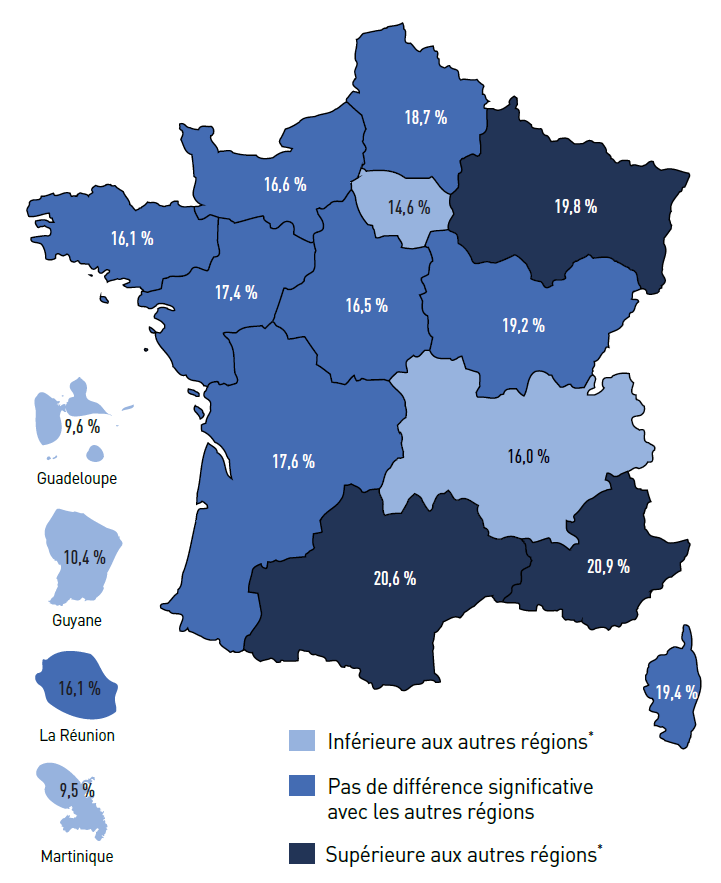
* Significant difference (p < 0.05, chi-square test); comparisons were adjusted for sex, age, and data collection method
Desire to quit smoking and attempts to quit
In 2024, more than half of daily smokers (55.0%) reported wanting to quit smoking. Smokers with a high school diploma or higher were more likely to want to quit smoking (59.1%) than those without a diploma or with a lower level of education (52.0%). Managers and professionals (60.2%) and intermediate-level workers (60.5%) are also more likely to want to quit smoking than manual workers (52.3%) and clerical workers (52.7%).
In 2024, 17.3% of daily smokers aged 18–79 reported having made an attempt to quit for at least one week in the past 12 months. The proportion of daily smokers who have tried to quit smoking in the past 12 months also varies by socioeconomic factors, with more quit attempts among the most affluent daily smokers. Smokers with a high school diploma or higher were more likely to have tried to quit smoking (23.1%) than smokers with no diploma or a lower level of education (13.1%). Managers and professionals (20.0%) also made more attempts to quit smoking than employees (16.0%) and manual workers (14.2%). Students (33.8%) attempted to quit smoking more frequently than employed individuals (17.4%) or unemployed individuals (18.1%).
Growing Use of E-Cigarettes
In 2023, 41.8% of 18- to 75-year-olds had already tried e-cigarettes, and 8.3% were using them at the time of the survey, with 6.1% doing so daily. The prevalence of vaping and daily vaping has been increasing since 2016.
Nearly all daily vapers aged 18–75 reported having experience with tobacco. In 2021, 55.5% of daily vapers were also smokers, 43.7% were former smokers, and only 0.9% had never smoked.
Prevalence of vaping among people aged 18–75, France, 2014–2023

The Impact of Plain Packaging
Recommended by the World Health Organization (WHO) since 2008, plain packaging for tobacco products became mandatory in France for packs sold starting January 1, 2017.
Santé publique France measured the impact of this measure by comparing smokers’ perceptions before the introduction of the new packaging (2016) and after (2017). To do so, two indicators were used: whether smokers liked the appearance of the packs they usually buy, and how embarrassed they felt about taking out their pack because of its appearance.
The results show:
That the proportion of smokers who say they like the appearance of their cigarette pack fell to one-third in 2017 (16%) compared to 2016 (53%).
That the number of smokers who feel embarrassed to take out their pack in public because of its appearance was twice as high in 2017 (12%) as in 2016 (6%).
A significant decline in the appeal of the pack due to its appearance is observed among 18- to 24-year-olds: they are now just as unlikely as others to appreciate the pack’s appearance.
The cancer risks associated with smoking are generally well known, but smokers downplay them
Public perceptions of smoking, its associated risks, and the benefits of quitting can influence behavior. The latest edition of the Cancer Barometer from the National Cancer Institute and Santé publique France (2021) offers some insights:
A generally accurate perception of the risks, but perceived danger thresholds that remain high:
in 2021, more than 8 out of 10 people state that smoking tobacco certainly causes cancer, a proportion that has been rising since 2015;
but smokers believe that the risk of tobacco-related cancer begins at 9.2 cigarettes per day and an average of 13.4 years of smoking. These thresholds have decreased since 2015 but remain high.
A tendency to downplay risks is observed, particularly among smokers, through a minimization of the danger posed by their own habits and a persistence in holding certain misconceptions:
more than one in two smokers (53%) places at least one of the perceived risk thresholds—whether in terms of years of smoking or the number of cigarettes smoked per day—above their own consumption;
more than one in two people still believe that “Exercising helps clear tobacco from the lungs.”
Healthcare professionals’ involvement needs to be strengthened: only 23% of smokers report having discussed smoking with a healthcare professional in the past 12 months. Yet smoking cessation advice from a healthcare professional increases six-month quit rates by around 70%.
Social inequalities in risk perception are less pronounced than in 2015 but still present, mirroring inequalities in smoking prevalence:
fewer people with lower levels of education perceive the cancer risk associated with smoking;
people with the lowest incomes are those who report the highest perceived danger thresholds
For more information:
Anne Pasquereau, Romain Guignard, Raphaël Andler, Viêt Nguyen-Thanh. Smoking: use, desire to quit, and quit attempts.
Guignard R, Soullier N, Pasquereau A, Andler R, Beck F, Nguyen-Thanh V. Factors associated with the desire to quit smoking and quit attempts among smokers. Results from the 2021 Santé publique France Barometer. Bull Epidemiol Hebd 2023; (9-10):159-65. https://beh.santepubliquefrance.fr/beh/2023/9-10/2023_9-10_2.html
Pasquereau A., Guignard R., Andler R., Le Nézet O., Spilka S., Obradovic I., Airagnes G., Beck F., Nguyen-Thanh V. Prevalence of smoking in mainland France in 2023 among 18- to 75-year-olds, results from the 2023 edition of the OFDT’s EROPP survey. Le point sur, November 2024. Saint-Maurice: Santé publique France, 7 p.
Departmental prevalence of daily smoking: estimates for small areas based on data from the 2021 Santé publique France Barometer. Zeghnoun Abdelkrim, Richard Jean-Baptiste.
Regional analysis of daily smoking among adults in France in 2021. Bull Épidémiol Hebd. 2024;(11):222-8. Thabuis A, Rivière M, de Lauzun V, Bernillon P, Martel M, Guignard R, et al.
Pasquereau A, Andler R, Guignard R, Gautier A, Soullier N, Richard JB, et al. National and regional prevalence of smoking in France in 2021 among 18- to 75-year-olds, according to the Santé publique France Barometer. Bull Épidémiol Hebd. 2022;(26):470-80.
Pasquereau A, Andler R, Arwidson P, Guignard R, Nguyen-Thanh V. Tobacco use among adults: review of five years of the national anti-smoking program, 2014–2019. Bull Epidémiol Hebd. 2020;(14):273–81.
Pasquereau A, Andler R, Guignard R, et al. Tobacco use in France in 2017: initial results from the 2017 Health Barometer. Weekly Epidemiological Bulletin. 2018;14-15:265-73.
Léon C, du Roscoät E, Beck F. Prevalence of depressive episodes in France among 18- to 85-year-olds: results from the 2021 Health Barometer. Bull Épidémiol Hebd. 2023;(2):28-40.
Bonaldi C, Boussac M, Nguyen-Thanh V. Estimation of the number of deaths attributable to smoking in France from 2000 to 2015. Weekly Epidemiological Bulletin. 2019;(15):278-84.
Olie V, Pasquereau A, Assogba F A.G, Arwidson P, Nguyen-Thanh V, Chatignoux E, et al. Trends in smoking-related morbidity and mortality among women in metropolitan France: a concerning situation. Weekly Epidemiological Bulletin. 2018;(35-36):683-94.
Pasquereau A, Andler R, Guignard R, Richard JB, Nguyen Thanh V, and the 2016 and 2017 Santé publique France Barometer groups. Smokers’ perception of cigarette packs before and after the introduction of plain packaging. Results of the 2016 and 2017 Santé publique France Barometers. Saint Maurice: Santé publique France, 2019. 10 p.
OFDT. Drugs at Age 17. Analysis of the 2022 ESCAPAD Survey. Trends. 2023;(155).
Public Health France and Inserm. National Perinatal Survey Report 2021. October 2022.
GEODES
Follow the trends in tobacco use in France and in your region
In relation to

COPD and chronic respiratory failure
thematic dossier
Chronic obstructive pulmonary disease is a chronic respiratory condition caused, in the vast majority of cases, by smoking. It has a significant impact on patients’ quality of life.

thematic dossier
Cardiovascular disease and stroke
Les maladies cardio-neuro-vasculaires regroupent un ensemble de troubles affectant le cœur et les vaisseaux sanguins.











