




What are the health consequences of smoking?
Smoking causes many diseases. On average, one in two regular smokers dies as a result of smoking. The only way to protect yourself is to quit smoking.
The Cigarette: A “Chemical Factory”
Tobacco smoke is an aerosol, meaning a mixture of gases and particles. This mixture forms at temperatures ranging from 1,000° to 1,500°C. Ash appears as the smoke forms. It is at this point that the 2,500 chemical compounds contained in unburned tobacco transform into more than 4,000 substances, many of which are toxic.
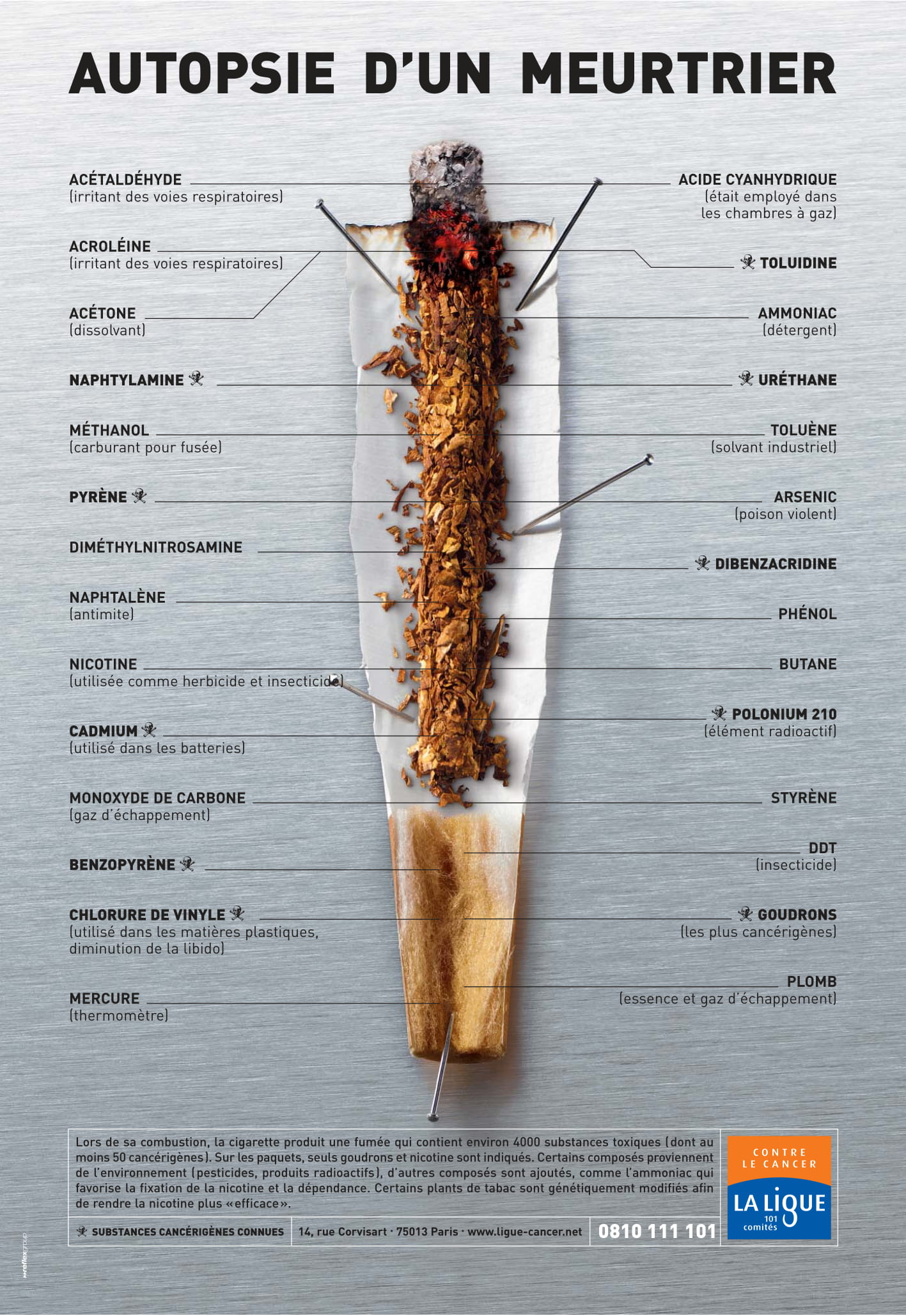
The smoke cools very quickly before reaching the smoker’s mouth. Its composition is not constant, and its nature varies depending on the type of tobacco, how it was dried, the treatments applied, additives, and so on. It always contains nicotine, tar, and flavoring agents, but there are many others, such as toxic gases (carbon monoxide, nitrogen oxide, hydrocyanic acid, ammonia) and heavy metals (cadmium, lead, chromium, mercury). Nicotine is the substance (a powerful alkaloid) that causes addiction. This addiction is very strong: it develops within the first few weeks of exposure and even with low tobacco consumption.
The poster “Autopsy of a Murderer” – National Cancer League (2004) lists the various toxic substances produced by cigarette smoke.
See also

Chemical composition of tobacco (Inserm)
"Light" cigarettes do not reduce the risks
The smoke from so-called “light” cigarettes is virtually identical to that of regular cigarettes. The “light” effect is based primarily on the presence of micropores in the filter. These allow ambient air to dilute the smoke and reduce the proportion of tar and nicotine inhaled. The effectiveness of these filters is tested on machines that “smoke” at a constant rate and intensity. Unlike the machine, the addicted smoker has neither a stopwatch nor a device to measure the volume of the puffs they inhale. Instead, they unconsciously seek a precise dose of nicotine. When they switch to a “light” cigarette, they quickly learn to take larger puffs of diluted smoke, and the light cigarette becomes a regular one. All that remains is the “lighter” taste (due to dilution) and the false impression of reduced risks… This is why, in September 2003, the terms “light,” “légères,” or “mild” were banned.
Smoking causes many diseases
Smoking is a major cause of disease, associated with a significant impact on public health. It is the leading cause of preventable death, with an estimated 75,000 deaths in 2015, accounting for approximately 13% of all deaths in mainland France. On average, one in two regular smokers dies from the consequences of smoking.
One in three cancers is caused by smoking. The most well-known is lung cancer, 80 to 90% of cases of which are linked to active smoking. But other cancers are also caused by tobacco: throat, mouth, lips, pancreas, kidneys, bladder, and uterus. Esophageal cancer is more common when tobacco and alcohol are combined.
Active smoking can also cause cardiovascular diseases: smoking is one of the main risk factors for heart attacks. Strokes, peripheral artery disease, aneurysms, and high blood pressure are also linked, in part, to tobacco smoke. Vascular damage can also cause erectile dysfunction.
COPD (or chronic obstructive pulmonary disease) is a chronic respiratory disease primarily caused by smoking. This disease can progress to chronic respiratory failure. At any stage of the disease, smoking is a factor that exacerbates the condition.
Other conditions are linked to or worsened by smoking: gastritis, peptic ulcers, type II diabetes, hypercholesterolemia, hypertriglyceridemia, eczema, psoriasis, lupus, ENT (ear, nose, and throat) and dental infections, cataracts, and AMD (Age-Related Macular Degeneration), which can lead to blindness. Not to mention periodontitis, a gum disease that causes receding gums and tooth loss.
Smoking can also lead to
A decrease in sexual function and fertility
Changes in the skin (wrinkles, dull complexion, yellowed fingers) because tobacco reduces oxygenation of the skin, making it dull and less supple; thus, wrinkles and fine lines appear prematurely
Gum disease, tooth discoloration, and bad breath: tobacco yellows teeth, increases the risk of tooth loss, and weakens the gums
Deterioration of the oral and nasal mucosa, lips, and tongue, as well as taste buds, vocal cords, and salivary glands
Deficiencies in vitamins B and C
Damage to the cerebral arteries (effects on memory, vision, and hearing)
Damage to the esophagus and stomach
A 20-fold increased risk of lung cancer when smoking is combined with prolonged exposure to radon. Radon is a naturally occurring radioactive gas that is released from the ground; in regions where it is present, it accumulates in poorly ventilated buildings. This dual exposure—to oneself and those around you—can serve as motivation to quit smoking.
Learn more about radon (Ministry of Health and Prevention)
Radon in Indoor Air (flyer, Ministry of Health and Prevention)
There is no safe level of smoking. For example, the risk of developing lung cancer depends not only on the number of cigarettes smoked each day but also on how long you have been smoking. The only effective way to reduce this risk is to quit smoking.
Smoking during pregnancy carries multiple risks
For the pregnancy itself:
Smoking is believed to be responsible for approximately 35% of ectopic pregnancies, meaning the fetus does not implant in the correct location
The risk of miscarriage in early pregnancy is three times higher
Smoking is a cause of premature birth
For fetal development:
The more you smoke, the greater the toxicity for the fetus. In the uterus, the fetus receives oxygen through the mother’s blood. However, when she smokes, her blood becomes saturated with carbon monoxide, a particularly dangerous gas. Additionally, nicotine impairs proper blood circulation. The baby therefore does not receive enough oxygen. Other chemicals in smoke are also toxic to fetal development, which can be delayed. This is known as intrauterine growth restriction (low birth weight, small stature, small head circumference).
Secondhand smoke exposure in non-smoking pregnant women affects the unborn child: the chemicals in the tobacco smoke inhaled by the mother pass into the mother’s bloodstream and into that of the fetus
Finally, smoking can increase the time it takes to conceive. Once you quit smoking, everything can return to normal.
See also
Secondhand smoke: an involuntary but dangerous exposure
Secondhand smoke refers to the inhalation of smoke emitted by one or more smokers (from the smoke produced by burning cigarettes or from smoke exhaled by smokers). By extension, the term “secondhand smoke” is also used to describe a fetus’s exposure to the mother’s smoking (active or passive).
Tobacco smoke contains more than 4,000 chemicals, including nicotine, irritants, toxic substances (carbon monoxide, tar), and more than 50 carcinogens.
While extremely harmful to the smoker, smoke is equally harmful to non-smokers.
While secondhand smoke is more toxic in enclosed spaces, it is also harmful in open environments, particularly in covered areas (patios, awnings, etc.).
Many people affected
Secondhand smoke can affect:
the smoker’s family and friends
people they encounter in their daily lives
but also the fetus in the mother’s womb
It is estimated that in 2014, 15.5% of employed people aged 15 to 75 were exposed to secondhand smoke indoors at their workplace. At home, 28.2% of people aged 15–75 reported that someone smoked inside their home. Over the past ten years, this proportion has declined, as it stood at 32.8% in 2005.
Among 17-year-olds, 24.0% reported being exposed to secondhand smoke at home and 62.9% in front of their school in 2017.

article
6 September 2019
Smoking behaviors among late adolescents. The 2017 Escapad Survey
Proven risks
Secondhand smoke exacerbates existing health conditions and causes new ones.
In France, it is estimated that several hundred nonsmokers die prematurely each year from diseases caused by secondhand smoke. Specifically, it is estimated that 1,100 adults die each year from secondhand smoke due to heart attacks, strokes, lung cancer, or chronic respiratory diseases.
Downloadable publication
article
6 September 2019
World No Tobacco Day, May 31, 2011 [Editorial]
The longer and more intense the exposure, the higher the risk of developing cancer, even though it remains lower than for active smokers. For certain conditions, such as cardiovascular events (e.g., heart attacks), the effects of secondhand smoke are believed to be similar to those of active smoking, even when exposure to others’ smoke is low.
Effects on the fetus
In cases of active smoking by a pregnant woman:
Increased risk of miscarriage, ectopic pregnancy, and preterm birth
Delayed fetal development
Lower birth weight (for a given gestational age)
In utero fetal death (47% increased risk)
Reduced academic and cognitive abilities
Development of congenital malformations
Secondhand smoke exposure among non-smoking pregnant women whose partners smoke has a measurable effect on the child, although less significant.
Effects on infants: smoking in the presence of an infant doubles the risk of sudden infant death.
Effects of secondhand smoke on young children:
Irritation of the eyes, nose, and throat
Increased frequency of upper respiratory infections and ear infections
Higher risk of asthma and respiratory infections (pneumonia and bronchitis)
A small but significant reduction in lung development
Effects of smoking on adults
Heart attacks: For a nonsmoker, exposure to secondhand smoke increases the risk of having a heart attack by 27%.
Lung cancer: The risk of developing lung cancer in a non-smoker increases by 25% if their spouse smokes.
Sinus cancer: Secondhand smoke more than doubles this risk.
Strokes: Secondhand smoke damages artery walls and doubles the risk of stroke.
Downloadable publication
article
23 September 2025
Smoking in the home in France in 2014 and trends since 2005
Legal protection
Since February 1, 2007, smoking has been prohibited:
In all enclosed and covered public spaces open to the public or that serve as workplaces
On all forms of public transportation
On the grounds of public and private elementary, middle, and high schools (including outdoor areas) and in facilities intended for the care, education, or housing of minors.
Since January 1, 2008, smoking has been prohibited in social venues (bars, tobacco shops, restaurants, nightclubs, and casinos)
For more information:
PUBLICATION AVAILABLE FOR DOWNLOAD
In relation to

COPD and chronic respiratory failure
thematic dossier
Chronic obstructive pulmonary disease is a chronic respiratory condition caused, in the vast majority of cases, by smoking. It has a significant impact on patients’ quality of life.

thematic dossier
Cardiovascular disease and stroke
Les maladies cardio-neuro-vasculaires regroupent un ensemble de troubles affectant le cœur et les vaisseaux sanguins.











