




Data
Screening services
Reimbursed screenings in the private and public sectors, excluding public hospitalizations (SNDS)
In 2024, 3.7 million people were screened for syphilis at least once, representing a national screening rate of 53 per 1,000 inhabitants (Figure 1).
Nearly two-thirds (64%) of those screened in 2024 were women. The screening rate was thus more than 50% higher among women (66 per 1,000) than among men (40 per 1,000). The screening rate was particularly high among women aged 15–25 and 26–49 (149 per 1,000 and 145 per 1,000, respectively). Among men, those aged 26–49 were screened most frequently (76 per 1,000).
Between 2014 and 2024, the rate of people screened at least once a year for syphilis increased by 90% (53 vs. 28 per 1,000). It tripled, in particular, among men aged 15 to 25. The screening rate increased by 20% between 2022 and 2024, with the increase being more pronounced among men (+29%) than among women (+16%). Among women, the increase was highest among those aged 50 and older (+35%) and among those under 15 (+34%, n=5,048 in 2024).
Among young people aged 15 to 25, those aged 15–17 are screened less frequently than those aged 18–25 (25 vs. 138 per 1,000). However, their screening rate has also increased by approximately 2.6-fold over the past ten years.
Figure 1 - Syphilis screening rates* by sex and age group, France, 2014–2024

The syphilis screening rate was higher in the French overseas departments and regions (DROM): Martinique (135 per 1,000), Guadeloupe (129 per 1,000), French Guiana (123 per 1,000), and Réunion (108 per 1,000). In mainland France, rates were higher in Île-de-France, PACA, and Occitanie (Figure 2).
Figure 2 - Syphilis screening rates* by region of residence, France, 2024

These data include syphilis serology tests performed in clinical laboratories without a prescription as part of the “Mon test IST” program. In its first month of operation, the program provided syphilis screening to approximately 48,000 people. The number of beneficiaries increased the following month (to approximately 76,000) and reached approximately 81,000 by December 2024. Men and women were equally represented among the beneficiaries. The largest proportion of people screened in 2024 under this program was in the 18–25 age group (47% in September, then decreasing to 40% in December).
Screenings at CeGIDDs (SurCeGIDD)
In addition to the screenings reimbursed by health insurance, approximately 285,000 free syphilis screenings were reported by CeGIDDs in 2024. About two-thirds of those screened were cisgender men (67.0%), one-third were cisgender women (32.5%), and 0.5% were transgender individuals.
Diagnosed infections: incidence rates, positivity rates, and case characteristics
Infections diagnosed in the private sector and treated (SNDS)
The number of people diagnosed and treated for syphilis at least once during the year in the private sector has increased since 2019 (start of surveillance). In 2024, this number was estimated at approximately 6,500, representing a 12% increase compared to 2022 and 2023. Men accounted for 89% of cases.
The incidence rate of diagnosed cases was 9 per 100,000, much higher among men than among women (17 vs. 2 per 100,000), particularly among those aged 26 to 49 (36 per 100,000) (Figure 3).
The overall incidence rate increased by 12% between 2022 and 2024. This increase was more pronounced among women (+24%) than among men (+10%), particularly among those aged 50 and older (+44% vs. +19%). An increase in the incidence rate was observed among adults in all age groups: among those aged 50 and older (+21%), among those aged 15–25 (+19%), and among those aged 26–49 (+7%).
Among young people aged 15 to 25, regardless of gender, minors (15–17 years old) had an incidence rate nearly 10 times lower than those aged 18–25 (1 vs. 12 per 100,000).
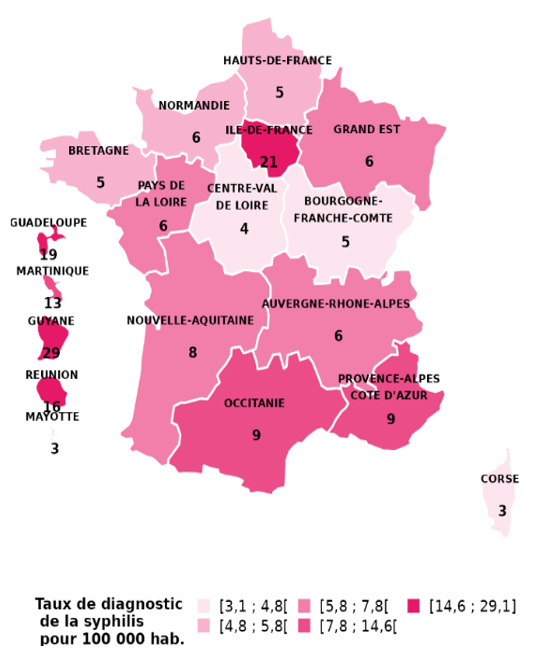
At the regional level, the highest incidence rates in 2024 were observed in French Guiana (29 per 100,000), Île-de-France (21), Guadeloupe (19), Réunion (16), and Martinique (13) (Figure 4).
Figure 3. Incidence rate* of syphilis diagnoses in the private sector by sex and age group, France, 2014–2024
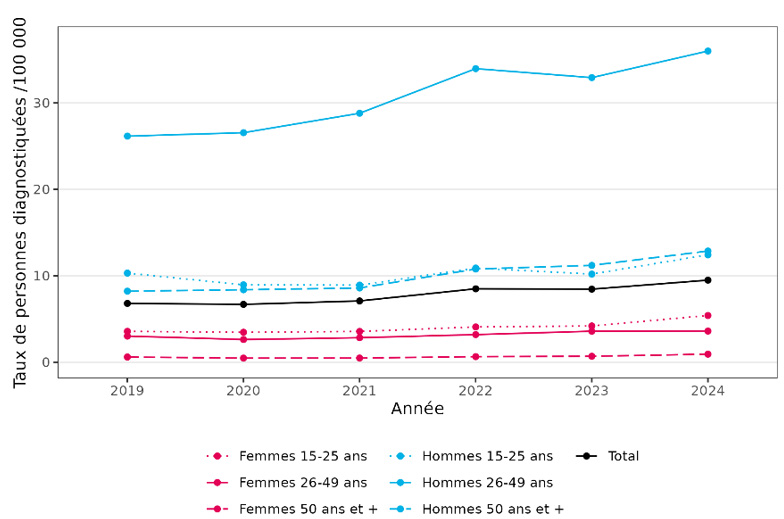
Figure 4. Incidence rate* of syphilis diagnoses in the private sector by region of residence, France, 2024
Infections diagnosed at CeGIDD (SurCeGIDD)
The number of recent syphilis cases (<1 year) reported by CeGIDDs was approximately 2,500 in 2024. The majority of cases were cisgender men (83%), 15% were cisgender women, and 2% were transgender individuals (Table 1). The median age of those diagnosed was 33 years: 35 years among cisgender men, 34 years among transgender individuals, and 24 years among cisgender women. Among those for whom information was available, 26% were born abroad. MSM accounted for 66% of cases, heterosexual men for 17%, heterosexual women for 12%, and FSM for 1%, while 4% of cases reported no sexual intercourse in the past 12 months. The majority of patients (84%) had had at least 2 sexual partners in the 12 months preceding diagnosis. Clinical signs of STIs were identified during the consultation in 33% of cases. HIV seropositivity was discovered concurrently with the diagnosis of syphilis in 2% of cases. Syphilis was diagnosed at the primary stage in 54% of cases, while it was diagnosed at the secondary stage in 19% and at the early latent stage in 27%.
The screening positivity rate, at 1.5% in 2024, has remained stable since 2022. When information on sexual practices was available, the positivity rate was approximately six times higher among MSM (3.3%) than among heterosexual women (0.6%) and heterosexual men (0.5%) (Figure 5).
In 2024, as in 2023, the positivity rate for syphilis diagnoses in CeGIDD was highest in French Guiana (8.7%). It was also high in Réunion (3.1%) (Figure 6).
Figure 5. Positive rate (%) of syphilis tests at CeGIDD by gender of patients and sexual practices, France, 2022–2024
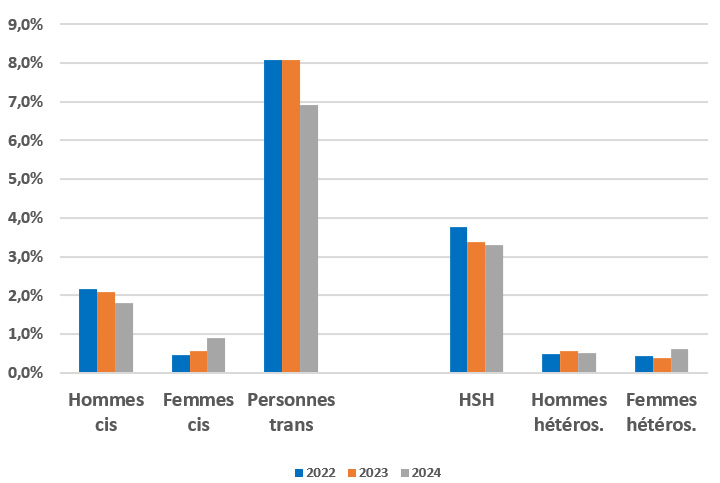
Figure 6. Positivity rate (%) of syphilis tests at CeGIDDs, by CeGIDD region*, France, 2024

Characteristics of Cases in Primary Care (Sentinelles Network)
According to data from the Sentinelles network, cases of syphilis at all stages diagnosed in primary care in 2024 (n=45) primarily involved men (91%). Among cases where sexual practices were known, MSM constituted the vast majority (82%). Most cases (89%) also reported having had at least two sexual partners in the past 12 months. In contrast, people born abroad accounted for only 12% of cases, and the median age of cases was 45 years.
In the year preceding diagnosis, 28% of patients had experienced an episode of bacterial STI. Among all cases, 30% were known to be HIV-positive, and 32% had used HIV pre-exposure prophylaxis in the past three months. Syphilis was diagnosed at an early stage (< 1 year) in 84.4% of cases.
In relation to

Hepatitis B and D
thematic dossier
Viral liver infections can be very severe; hepatitis B and D are transmitted through sexual contact, blood, and from mother to fetus. Vaccination and screening are the cornerstones of prevention.

Sexual health
thematic dossier
Santé publique France focuses in particular on four areas of sexual health: sexually transmitted infections, including HIV; contraception; combating discrimination; and violence.

HIV/AIDS
thematic dossier
HIV, or Human Immunodeficiency Virus, is a sexually transmitted human retrovirus. It weakens the immune system, and if left untreated, leads to AIDS.











