




The disease
Syphilis is a sexually transmitted infection caused by the bacterium Treponema pallidum. As a significant public health concern, syphilis is monitored by Santé publique France, and prevention and screening programs are in place to target the populations most at risk.
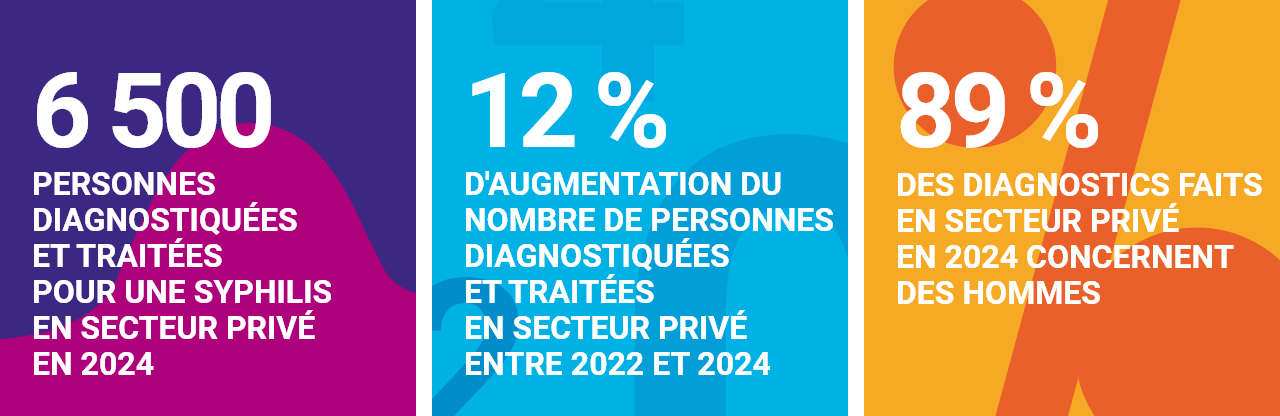
Key statistics on syphilis
Sexual transmission
Syphilis is transmitted during foreplay and sexual intercourse (vaginal or anal penetration, oral-genital, oral-anal, and possibly oral-oral contact). Transmission of the responsible bacterium, Treponema, occurs only through direct contact, as this pathogen cannot survive in the open air.
The stages of syphilis
The symptoms of syphilis appear in three successive phases:
Early syphilis
The primary stage is characterized by an ulceration 5 to 15 mm in diameter on the skin or mucous membranes. This chancre appears approximately 20 days (10 to 100 days) after exposure. Painless, it often goes unnoticed.
The secondary stage manifests as skin and mucous membrane rashes, known as “eruptions,” which last from a few days to a few weeks and are often accompanied by swollen lymph nodes. This stage occurs approximately 6 to 16 weeks after infection and lasts an average of 1 to 2 years. Other clinical signs of secondary syphilis may also be observed if other organs are affected (nervous system, heart, etc.).
The early latent phase is characterized by a clinically silent stage (absence of signs or symptoms) lasting less than 1 year.
Late syphilis (>1 year)
The tertiary stage has become rare. It occurs around the third year (2 to more than 10 years). Neurological, cardiovascular, and psychiatric disorders are its characteristic manifestations.
The late latent phase is characterized by a silent clinical stage (absence of signs or symptoms) in syphilis that has been present for more than one year.
The diagnosis of syphilis requires a medical examination and confirmation via a blood test.
Potentially serious consequences
Syphilis can cause serious complications if left untreated, such as damage to the brain, nerves, heart, arteries, and eyes, as well as harm to the newborn if the mother is infected.
Antibiotic treatment
Treatment for syphilis involves an injection of an antibiotic (penicillin).
For more information: https://www.cnr-ist.fr
Condoms and screening to combat syphilis
As part of syphilis screening, a clinical examination is performed by a doctor to look for clinical signs, and a definitive diagnosis relies on a blood test and/or local swabs.
Links
In relation to

Hepatitis B and D
thematic dossier
Viral liver infections can be very severe; hepatitis B and D are transmitted through sexual contact, blood, and from mother to fetus. Vaccination and screening are the cornerstones of prevention.

Sexual health
thematic dossier
Santé publique France focuses in particular on four areas of sexual health: sexually transmitted infections, including HIV; contraception; combating discrimination; and violence.

HIV/AIDS
thematic dossier
HIV, or Human Immunodeficiency Virus, is a sexually transmitted human retrovirus. It weakens the immune system, and if left untreated, leads to AIDS.











