




Data
View data on the epidemiological situation regarding Chlamydia trachomatis infections in France on Santé publique France.
Screening activities: continued increase in the number of screenings
Reimbursed screenings in the private and public sectors (SNDS)
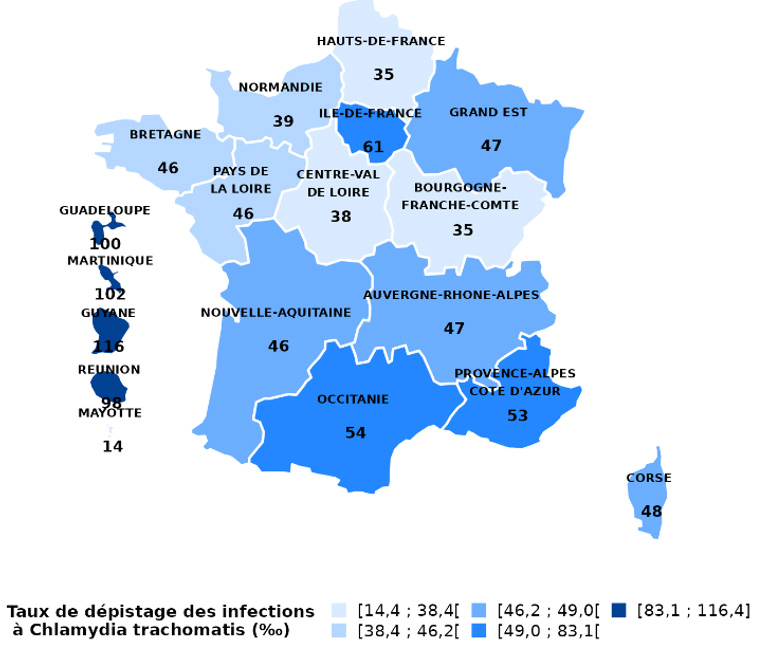
In 2024, 3.4 million people were screened at least once for Chlamydia trachomatis infection, representing a national screening rate of 50 per 1,000 inhabitants (Figure 1).
More than two-thirds (69%) of those screened in 2024 were women, with a screening rate twice as high (67 per 1,000) as that of men (31 per 1,000). This rate is even higher among women aged 15 to 25 (155 per 1,000) and 26 to 49 (138 per 1,000).
The screening rate for Chlamydia trachomatis infection has risen sharply (+162%) over 10 years, between 2014 and 2024 (19 vs. 50 per 1,000). From 2022 to 2024, the increase in the screening rate was +30%, slightly higher among men than among women (34% vs. 29%). Among women, the increase is more pronounced in the 50-and-older age group (+52%) compared to those aged 26–49 (+30%) and 15–25 (+20%).
Among young people aged 15 to 25 of all genders, those aged 15–17 are screened less frequently than those aged 18–25 (23 vs. 136 per 1,000). However, their screening rate has also risen sharply (+166%) over the past 10 years.
Figure 1. Screening rates* for Chlamydia trachomatis infections by sex and age group, France, 2014–2024

The screening rate for Chlamydia trachomatis infection in 2024 is significantly higher in French Guiana (116 per 1,000), Martinique (102), Guadeloupe (100), and Réunion (98) than in mainland France (Figure 2). In mainland France, it is highest in Île-de-France (2).
Figure 2 - Screening rate* for Chlamydia trachomatis infections by region of residence, France, 2024
These figures include PCR tests for chlamydia and gonorrhea performed in clinical laboratories without a prescription for all insured individuals, and free of charge for those under 26 as part of the “Mon test IST” program since September 2024. During the program’s first month of operation, approximately 41,000 people were screened for Chlamydia trachomatis and Neisseria gonorrhoeae infections. The number of participants increased starting the following month and ranged between 66,000 and 68,000 per month from October to December 2024.
Among those tested, people aged 18 to 25 were the most numerous (between 44% and 50% depending on the month) under this program in 2024. Men and women were equally represented among those tested.
Screenings at CeGIDDs (SurCeGID surveillance)
In addition to screenings reimbursed by health insurance, approximately 306,000 free screenings for Chlamydia trachomatis infection conducted by CeGIDDs were reported in 2024. About two-thirds of those screened were cisgender men (65.2%), 34.3% were cisgender women, and 0.4% were transgender individuals.
Prevalence of Chlamydia trachomatis infection (PrévIST) in 2023
The prevalence of Chlamydia trachomatis infection among people residing in mainland France, aged 18 to 59, was estimated at 0.93% [95% confidence interval (95% CI): [0.4–2.1] among women and 0.58% [95% CI: 0.2–1.6] among men.
This prevalence was highest among those aged 25 to 29 (3.9% [95% CI: 0.9–14.9] of women and 6.7% [95% CI: 1.8–21.8] of men), and then decreased with age. The youngest and oldest age groups were very rarely affected.
Diagnosed infections: incidence rate, positivity rate, and case characteristics
Infections diagnosed in the private sector and treated (SNDS)
The number of people diagnosed and treated for Chlamydia trachomatis infection at least once during the year in the private sector has steadily increased since 2014. In 2024, this number was estimated at approximately 61,100, representing a 15% increase compared to 2022. Men accounted for 56% of cases.
The incidence rate of cases diagnosed and treated for Chlamydia trachomatis infection in 2024 (people diagnosed at least once during the year) was 89 per 100,000 inhabitants, higher among men than among women (104 vs. 75). The male-to-female ratio has in fact reversed since 2021. As in previous years, the incidence rate in 2024 remains much higher among young women aged 15 to 25 (306 per 100,000) (Figure 3). Among men, those aged 26 to 49 had the highest incidence rate (205 per 100,000). The incidence rate of Chlamydia trachomatis diagnoses increased by 14% compared to 2022. This increase is observed primarily among men (+24%), particularly those aged 15 to 25 (+35%). However, among women of all ages, the increase was 3%, and 5% between 2024 and 2023, whereas the rate had been declining slightly since 2021 (-3% between 2021 and 2023). This increase is driven primarily by young women aged 15 to 25 (+13% between 2023 and 2024). Consequently, there is a significant increase in the incidence rate of cases diagnosed and treated for this infection among young women and men aged 15 to 25 between 2023 and 2024 (+21% among young men).
Among young people aged 15 to 25, those aged 15–17 had an incidence rate nearly 11 times lower than that of those aged 18–25 (32 vs. 338 per 100,000). However, this rate doubled between 2014 (16 per 100,000) and 2024.
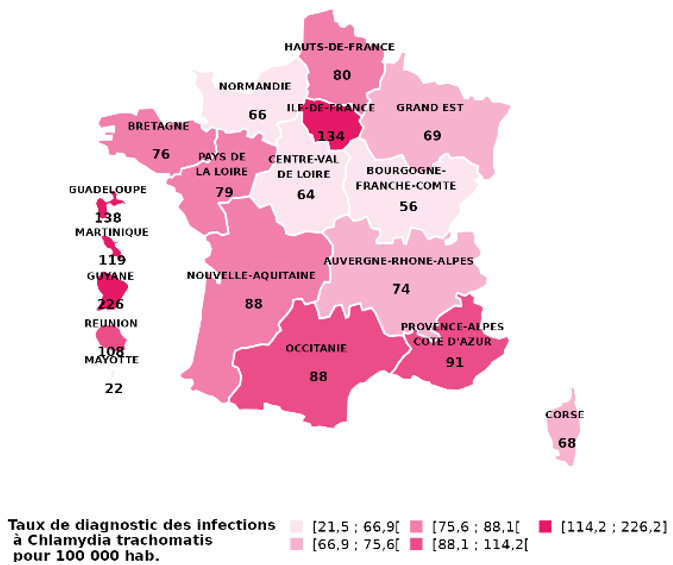
In 2024, incidence rates were highest in French Guiana (226 per 100,000 inhabitants), Guadeloupe (139), Martinique (119), Réunion (107), and Île-de-France (134) (Figure 4).
Figure 3. Incidence rate* of Chlamydia trachomatis diagnoses in the private sector by sex and age group, France, 2014–2024
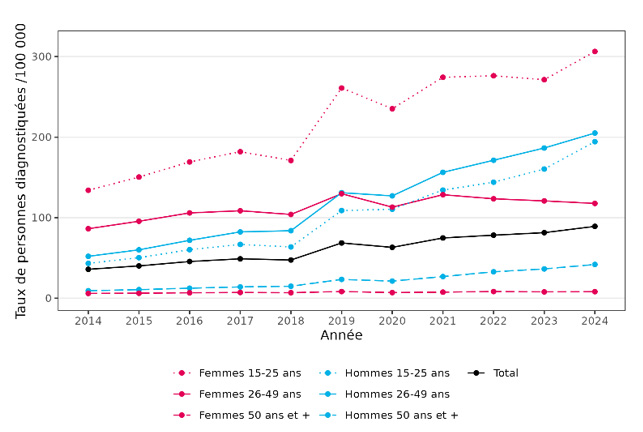
Figure 4 - Incidence rate* of Chlamydia trachomatis diagnoses in the private sector, by region of residence, France, 2024
Infections diagnosed at CeGIDD (SurCeGIDD)
The number of Chlamydia trachomatis infections reported by CeGIDDs was approximately 22,200 in 2024.
Among the diagnosed cases, 64.1% were cisgender men, 35.6% were cisgender women, and 0.4% were transgender individuals (Table 1). The median age of individuals diagnosed with this STI was 24 years, 26 years among cisgender men, 22 years among cisgender women, and 29 years among transgender individuals. Those under 18 accounted for 4% of cases. Among individuals for whom information was available, 20% were born abroad. Heterosexual men accounted for 36% of cases, MSM for 23%, heterosexual women for 35%, and women who have sex with women (WSW) for 2%, while 4% of cases reported no sexual intercourse in the past 12 months. The majority of cases (82%) had had at least two sexual partners in the 12 months prior to diagnosis. Clinical signs of STIs were identified during the consultation in only 21% of cases.
The test positivity rate was 7.6% in 2024 (7.9% among cisgender women, 7.4% among cisgender men, and 6.4% among transgender individuals). This rate decreased compared to 2023 across all genders (Figure 5). Among individuals whose sexual practices were known, positivity rates in 2024 were, as in previous years, highest among heterosexual women (8.5%), MSM (7.8%), and heterosexual men (7.4%), with women who have sex with women having a rate of 5.3%.
Regional positivity rates are highest in the Antilles (18.8%), in Guadeloupe, Martinique (12.7%), and French Guiana (13.5%) (Figure 6).
Figure 5 - Positivity rate (%) of Chlamydia trachomatis tests at CeGIDD by gender of patients and sexual practices, France, 2022–2024
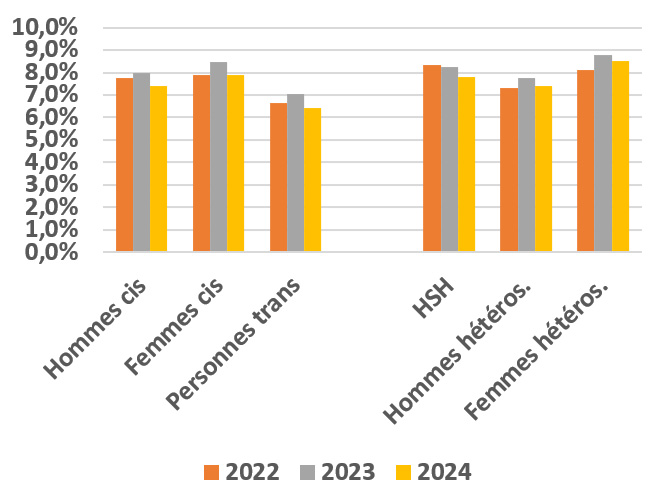
Figure 6. Positivity rate (%) of Chlamydia trachomatis tests at CeGIDDs, by CeGIDD region, France, 2024

Characteristics of infections diagnosed in primary care (Sentinelles network)
Cisgender men accounted for the majority (55%) of Chlamydia trachomatis infections diagnosed in primary care in 2024, according to data from the Sentinelles network (n=307). Cisgender women accounted for 43% of cases, and transgender individuals for 2%. Among cases where sexual practices were known, 40% were heterosexual women and 29% were MSM.
People born abroad accounted for 11% of cases. More than half of the cases (62%) reported having had at least two sexual partners in the past 12 months.
The infection had been diagnosed due to STI symptoms in 39% of cases. In the year prior to diagnosis, 19% of patients had experienced an episode of bacterial STI. HIV pre-exposure prophylaxis had been used in the past three months by 16% of cases, while 4% of cases were HIV-positive.
Diagnoses of Lymphogranuloma Venereum
Lymphogranuloma venereum (LGV) is a Chlamydia trachomatis infection caused by genovar L strains. It is responsible for anorectal infections, primarily among MSM.
As part of the Anachla 2024 survey conducted by the National Reference Center (CNR) for Bacterial STIs, Chlamydia trachomatis-positive anorectal samples from 1,665 patients from 135 laboratories in mainland France and overseas territories were genotyped. Among these patients, 187 were carriers of LGV, with this strain accounting for 11.2% of anorectal Chlamydia trachomatis infections. This proportion was 7.8% in 2023, 13.4% in 2022, 16.9% in 2021, and 13.4% in 2020. The proportions of LGV observed in the Anachla surveys therefore fluctuate, but remained below 20% during the first five years of the survey.
In 2024, cisgender men accounted for 96.3% of LGV cases (a stable proportion). All of these were MSM when the gender of the partners was known. The remaining cases involved transgender individuals (3.7%). Approximately half of the patients diagnosed with LGV had no anorectal symptoms and were HIV-negative.
In relation to

Gonorrhea
thematic dossier
On the rise between 2022 and 2024, and more common among men (particularly those aged 26–49) and young people, gonorrhea is a sexually transmitted infection caused by the gonococcus bacterium....

Syphilis
thematic dossier
Caused by the bacterium Treponema pallidum, syphilis is sexually transmitted. It can also be transmitted from mother to child during pregnancy. This disease can affect all organs and have serious...

Sexual health
thematic dossier
Santé publique France focuses in particular on four areas of sexual health: sexually transmitted infections, including HIV; contraception; combating discrimination; and violence.











