




The disease
Chlamydia trachomatis Infections
Sexually transmitted chlamydia infections are caused by Chlamydia trachomatis. Serovar L of this bacterium is responsible for lymphogranuloma venereum (LGV) or Nicolas-Favre disease.
As a significant public health concern, these infections are monitored by Santé publique France and are also subject to prevention and screening measures tailored to the various high-risk populations.
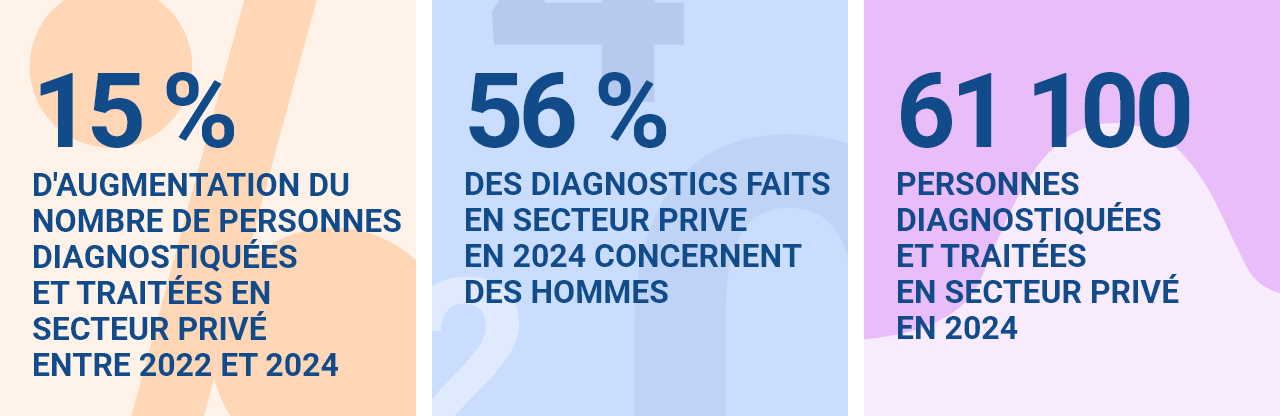
Key statistics on Chlamydia trachomatis infections
Sexual transmission
Chlamydia infections are transmitted during foreplay and unprotected sexual intercourse (vaginal, anal, oral-genital, or oral-anal sex).
Symptoms are often mild
Urogenital and ocular Chlamydia infections (serotypes D through K)
Half of all cases (in both men and women) are asymptomatic.
In men, the incubation period lasts 7 to 10 days. The infection can cause urethritis. Local and regional complications have become rare; Fiessinger-Leroy-Reiter syndrome (rarely complete) involves urethritis, conjunctivitis, rheumatism, and skin and mucosal lesions.
In women, the infection may present as latent cervicitis with leukorrhea. The clinical picture may also be dominated by cystalgia, urethral syndrome, dyspareunia, or spotting. Acute, febrile forms are associated with adnexal pain and metrorrhagia. The condition may progress to salpingitis, with the risk of chronic pelvic pain, infertility, and ectopic pregnancy.
In both men and women, there are also anorectal (purulent anorectitis) and pharyngeal (most often asymptomatic) manifestations.
Lymphogranuloma venereum (LGV)
After an incubation period of 3 to 30 days, a microchancre appears at the site of inoculation (anus, rectum, glans, vagina, pharynx, urethra), followed a few days later by inguinal lymphadenopathy or polyadenopathy that may progress to fistulization. A presentation of ulcerative proctitis, although nonspecific, is frequently associated with the diagnosis of rectal LGV.
Molecular biology techniques (NAAT: PCR) are the gold standard tests for diagnosing urogenital infections caused by Chlamydia trachomatis. These methods are suitable for all specimen sites, including the first urine stream and self-collected vaginal swabs, which are easier to perform for screening purposes.
Learn more: https://www.cnr-ist.fr
Potentially serious consequences
Chlamydia trachomatis infections can cause upper genital tract infections in women, infertility, ectopic pregnancy, and harm to the newborn if the mother is infected. The risks of complications mainly affect women, but men can also be affected (epididymitis, prostatitis) and can transmit the infection to their partners.
Antibiotic treatment
Lower tract infections (urethritis and cervicitis) and asymptomatic cases are treated as first-line therapy with a single 1-gram dose of the antibiotic azithromycin. The standard treatment for LGV also relies on an antibiotic (doxycycline) but for a longer duration, lasting 3 to 4 weeks. Surgery may be necessary in cases of complications.
The patient must inform their sexual partners so they can be screened and treated for gonorrhea, in order to break the chain of transmission.
Condoms and screening to combat Chlamydia trachomatis infections
To combat sexually transmitted infections such as Chlamydia trachomatis infections, condoms, along with screening, are the most effective means.
Screening is the only way to establish a diagnosis. If the result is positive, it allows for the prescription of appropriate antibiotic treatment to reduce the risk of progression and transmission. Simple and painless, it is performed via a swab in women, and via a swab or urine test in men.
Screening can be performed following a consultation with your primary care physician, gynecologist, or a dermatologist-venereologist, who will refer you to a laboratory, or it can be done free of charge at the Free Centers for Information, Screening, and Diagnosis (CeGiDD) and family planning or family education centers.
In relation to

Gonorrhea
thematic dossier
On the rise between 2022 and 2024, and more common among men (particularly those aged 26–49) and young people, gonorrhea is a sexually transmitted infection caused by the gonococcus bacterium....

Syphilis
thematic dossier
Caused by the bacterium Treponema pallidum, syphilis is sexually transmitted. It can also be transmitted from mother to child during pregnancy. This disease can affect all organs and have serious...

Sexual health
thematic dossier
Santé publique France focuses in particular on four areas of sexual health: sexually transmitted infections, including HIV; contraception; combating discrimination; and violence.











