



Data for mainland France
Enhanced Surveillance Data
From May 1 to November 30 each year, Santé publique France coordinates enhanced seasonal surveillance of chikungunya, dengue, and Zika in the metropolitan departments in collaboration with the relevant Regional Health Agencies (ARS) (see surveillance system and partners).
Learn more

bulletin national
14 October 2026
Acute Respiratory Infections (Flu, Bronchiolitis, COVID-19). Bulletin dated October 14, 2026.
Since July 2006, chikungunya infection has been a notifiable disease in metropolitan France and the French departments in the Americas, and since 2008 on Réunion.
The criteria for reporting chikungunya are the presence of a sudden-onset fever >38.5°C, debilitating joint pain, and laboratory confirmation (positive IgM or positive PCR).
For dengue, the reporting criteria are a sudden-onset fever exceeding 38.5°C with at least one pain-related symptom (headache, arthralgia, myalgia, low back pain, retroorbital pain) and laboratory confirmation (RT-PCR, NS1 test, or positive IgM)
Epidemiological surveillance of arboviral diseases has enabled the regular identification of outbreaks of locally transmitted dengue, chikungunya, and Zika. This report provides a summary of these findings since the first identification in 2010.
Learn more:
From May 1 to November 30 of each year, Santé publique France coordinates enhanced seasonal surveillance of chikungunya, dengue, and Zika in the metropolitan departments where the vector mosquito, Aedes albopictus, is present, in collaboration with the relevant Regional Health Agencies (ARS) (see surveillance system and partners).
From May 1 to November 27, 2020, the following cases were confirmed:
834 imported cases of dengue (of which 64% had traveled to Martinique and 23% to Guadeloupe);
6 imported cases of chikungunya;
1 imported case of Zika.
Since the start of this enhanced surveillance period, six indigenous dengue outbreaks have been identified, for which epidemiological investigations and field actions were immediately implemented (notably vector control):
In Provence-Alpes-Côte d'Azur, 3 outbreaks were identified:
An outbreak of 3 locally acquired dengue cases with onset dates (DDS) between August 1, 2020, and August 11, 2020, in La Croix-Valmer (Var).
Another outbreak involving 5 cases in Nice, with onset dates (OD) ranging from August 11, 2020, to September 4, 2020.
An outbreak of 2 cases with onset dates (OD) ranging from September 19, 2020, to October 4, 2020, in Saint Laurent du Var.
In Occitanie, three isolated autochthonous cases were also reported:
One locally acquired case of dengue fever in the Hérault department with a date of onset of symptoms (DDS) of July 17, 2020.
One locally acquired case of dengue contracted in either Hérault or Gard, with a date of onset on August 31, 2020.
One locally acquired case of dengue in the Gard department, with a date of onset (DDS) on September 3, 2020.
See also the dengue situation in Martinique and Guadeloupe: view data for overseas territories.
| Number of confirmed cases of chikungunya, dengue, and Zika by region included in enhanced surveillance (cases counted only for departments where Aedes albopictus is present), from May 1 to November 27, 2020 | ||||||
|---|---|---|---|---|---|---|
| Regions | Confirmed imported cases | Confirmed local cases | ||||
| Dengue | Chikungunya | Zika | Dengue | Chikungunya | Zika | |
| Grand-Est | 29 | 1 | 0 | 0 | 0 | 0 |
| New Aquitaine | 53 | 0 | 0 | 0 | 0 | 0 |
| Auvergne-Rhône-Alpes | 104 | 2 | 0 | 0 | 0 | 0 |
| Burgundy-Franche-Comté | 16 | 0 | 0 | 0 | 0 | 0 |
| Centre-Val-de-Loire | 4 | 0 | 0 | 0 | 0 | 0 |
| Corsica | 9 | 0 | 0 | 0 | 0 | 0 |
| Ile-de-France | 331 | 2 | 1 | 0 | 0 | 0 |
| Occitanie | 124 | 0 | 0 | 3 | 0 | 0 |
| Hauts-de-France | 0 | 0 | 0 | 0 | 0 | 0 |
| Pays-de-la-Loire | 44 | 0 | 0 | 0 | 0 | 0 |
| Provence-Alpes-Côte d'Azur | 120 | 1 | 0 | 10 | 0 | 0 |
| Total | 834 | 6 | 1 | 13 | 0 | 0 |
List of departments where Aedes albopictus is present as of May 1, 2020:
Ain, Aisne, Alpes-de-Haute-Provence, Alpes-Maritimes, Ardèche, Ariège, Aude, Aveyron, Bas-Rhin, Bouches-du-Rhône, Charente, Charente-Maritime, Cher, Corrèze, Corse-du-Sud, Côte d'Or, Deux-Sèvres, Dordogne, Drôme, Essonne, Gard, Gers, Gironde, Haute-Corse, Haute-Garonne, Hautes-Alpes, Hautes-Pyrénées, Haute-Savoie, Haut-Rhin, Hauts-de-Seine, Hérault, Indre, Isère, Landes, Loire, Loire-Atlantique, Lot, Lot-et-Garonne, Lozère, Maine-et-Loire, Nièvre, Paris, Puy-de-Dôme, Pyrénées-Atlantiques, Pyrénées-Orientales, Rhône, Saône-et-Loire, Savoie, Seine-et-Marne, Seine-Saint-Denis, Tarn, Tarn-et-Garonne, Val-de-Marne, Var, Vaucluse, Vendée, Vienne, Yvelines.
Maps showing the distribution of the tiger mosquito (Aedes albopictus) in metropolitan France: click here
From May 1 to November 30 of each year, Santé publique France coordinates enhanced seasonal surveillance of chikungunya, dengue, and Zika in the metropolitan departments where the vector mosquito, Aedes albopictus, is present, in collaboration with the relevant Regional Health Agencies (ARS) (see surveillance system and partners).
From May 1 to November 29, 2019:
657 imported cases of dengue, 14% of which had visited Réunion Island;
56 imported cases of chikungunya;
6 imported cases of Zika;
9 locally acquired cases of dengue;
3 locally acquired cases of Zika.
An outbreak of 2 locally acquired cases of dengue was reported in the Rhône department.
An outbreak of 7 locally acquired cases of dengue has been identified in the Alpes-Maritimes.
An outbreak of 3 locally acquired cases of Zika virus infection was identified in the Var department.
For these two dengue outbreaks in the Rhône and Alpes-Maritimes departments and the two Zika virus cases in the Var department, epidemiological investigations have been launched to identify any other potential cases and to strengthen prevention and surveillance measures.
Healthcare professionals in the affected areas have also been trained to identify and report any other potential cases.
Mosquito control operators immediately launched entomological investigations and undertook targeted mosquito control measures. These actions are systematically accompanied by a prior information campaign for local residents.
The figures are as follows:
| Number of confirmed cases of chikungunya, dengue, and Zika by region involved in enhanced surveillance (cases counted only for departments where Aedes albopictus is present), from May 1 to November 29, 2019 | ||||||
|---|---|---|---|---|---|---|
| Regions | Confirmed imported cases | Confirmed locally acquired cases | ||||
| Dengue | Chikungunya | Zika | Dengue | Chikungunya | Zika | |
| Grand-Est | 19 | 2 | 0 | 0 | 0 | 0 |
| New Aquitaine | 68 | 6 | 1 | 0 | 0 | 0 |
| Auvergne-Rhône-Alpes | 88 | 9 | 1 | 2 | 0 | 0 |
| Burgundy-Franche-Comté | 11 | 1 | 0 | 0 | 0 | 0 |
| Centre-Val-de-Loire | 1 | 0 | 0 | 0 | 0 | 0 |
| Corsica | 5 | 0 | 0 | 0 | 0 | 0 |
| Ile-de-France | 218 | 24 | 1 | 0 | 0 | 0 |
| Occitanie | 116 | 8 | 2 | 0 | 0 | 0 |
| Hauts-de-France | 1 | 0 | 0 | 0 | 0 | 0 |
| Pays-de-la-Loire | 21 | 1 | 0 | 0 | 0 | 0 |
| Provence-Alpes-Côte d'Azur | 109 | 5 | 1 | 7 | 0 | 3 |
| Total | 657 | 56 | 6 | 9 | 0 | 3 |
List of departments where Aedes albopictus is present as of May 1, 2019 (the 9 new departments classified as Level 1 in 2018 are in bold): Ain, Aisne, Alpes-de-Haute-Provence, Alpes-Maritimes, Ardèche, Ariège, Aude, Aveyron, Bas-Rhin, Bouches-du-Rhône, Charente-Maritime, Corrèze, Corse-du-Sud, Côte d’Or, Dordogne, Drôme, Essonne, Gard, Gers, Gironde, Haute-Corse, Haute-Garonne, Hautes-Alpes, Hautes-Pyrénées, Haut-Rhin, Hauts-de-Seine, Hérault, Indre, Isère, Landes, Loire, Lot, Lot-et-Garonne, Lozère, Maine-et-Loire, Nièvre, Paris, Puy-de-Dôme, Pyrénées-Atlantiques, Pyrénées-Orientales, Rhône, Saône-et-Loire, Savoie, Seine-et-Marne, Seine-Saint-Denis, Tarn, Tarn-et-Garonne, Val-de-Marne, Var, Vaucluse, Vendée.
From May 1 to November 30 each year, Santé publique France coordinates enhanced seasonal surveillance of chikungunya and dengue in the metropolitan departments where the vector mosquito, Aedes albopictus, is present, in collaboration with the relevant Regional Health Agencies (ARS). Since 2016, the plan to prevent the spread of arboviral diseases has also included enhanced surveillance of the Zika virus (see surveillance system and partners + map below).
From May 1 to November 30, 2018:
189 imported cases of dengue;
6 imported cases of chikungunya;
8 locally acquired cases of dengue.
An outbreak of locally transmitted dengue virus, serotype 2, was identified in the Alpes-Maritimes department (Saint-Laurent-du-Var) in September and October 2018. A total of 5 cases were identified.
An outbreak of locally transmitted dengue, serotype 1, was identified in the Hérault department (municipality of Clapiers), with 2 locally transmitted cases occurring in late September and early October.
A case of dengue, serotype 1, occurred in October in the Gard department (Nîmes) with no epidemiological link to the previous outbreaks. Investigations conducted immediately upon reporting the case did not identify any other cases. Epidemiological
investigations were launched to identify any other potential cases and to strengthen prevention and surveillance measures. Healthcare professionals in the three municipalities where the cases were identified were also trained to recognize and report other individuals with suspected dengue. Mosquito control operators immediately conducted entomological investigations and undertook targeted mosquito control measures. These actions were systematically accompanied by a prior information campaign for local residents.
Localized outbreaks of dengue have already occurred on several occasions in 2010, 2013, 2014, and 2015 along the French Mediterranean coast, affecting between 1 and 7 people.
They are broken down as follows:
Number of confirmed cases of chikungunya, dengue, Zika, and flavivirus* infections, by region included in enhanced surveillance (cases counted only for departments where Aedes albopictus is present), from May 1 to November 30, 2018
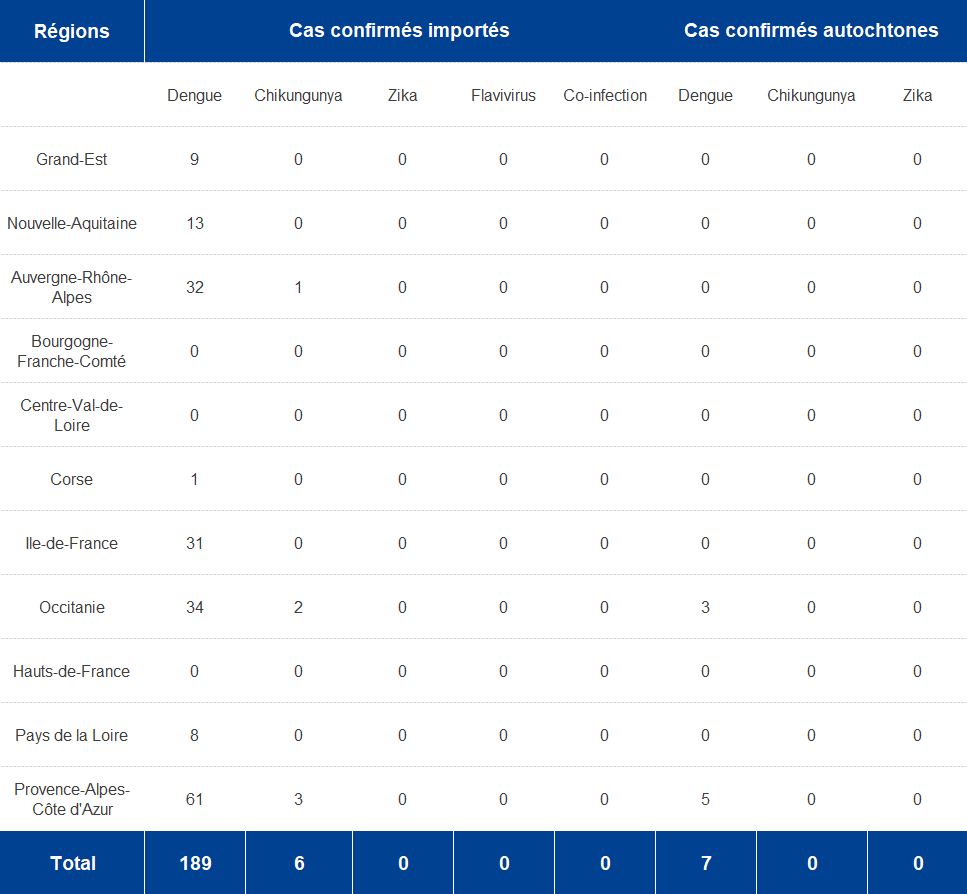
* Unable to determine whether the infection was West Nile virus or dengue.
List of departments where Aedes albopictus is present: Ain, Aisne, Alpes-de-Haute-Provence, Alpes-Maritimes, Hautes-Alpes, Ardèche, Ariège, Aude, Aveyron, Bouches-du-Rhône, Corrèze, Corse-du-Sud, Haute-Corse, Dordogne, Drôme, Gard, Haute-Garonne, Gers, Gironde, Hérault, Indre, Isère, Landes, Lot, Lot-et-Garonne, Lozère, Maine-et-Loire, Pyrénées-Atlantiques, Hautes-Pyrénées, Pyrénées-Orientales, Bas-Rhin, Haut-Rhin, Rhône, Saône-et-Loire, Savoie, Tarn, Tarn-et-Garonne, Var, Vaucluse, Vendée, Hauts-de-Seine, Val-de-Marne.
From May 1 to November 30 each year, Santé publique France coordinates enhanced seasonal surveillance of chikungunya and dengue in the metropolitan departments where the vector mosquito, Aedes albopictus, is present, in collaboration with the relevant Regional Health Agencies (ARS). Since 2016, the plan to prevent the spread of arboviral diseases has also included enhanced surveillance of the Zika virus (see surveillance system and partners + map below).
From May 1 to November 24, 2017:
137 imported cases of dengue were confirmed;
4 imported cases of chikungunya were confirmed;
15 imported cases of Zika were confirmed.
Two epidemiologically linked outbreaks of locally transmitted chikungunya have been identified in a neighborhood of the town of Le Cannet-des-Maures since August 11, 2017, and in a neighborhood of the town of Taradeau since September 15, 2017. These two municipalities, located about 10 kilometers apart, are in the Var department. As of October 31, 2017, 17 cases had been identified (Cannet-des-Maures: 9 confirmed and 2 probable; Taradeau: 6 confirmed). The onset date of symptoms for the most recent confirmed case of chikungunya in the Var department was September 9, 2017. In accordance with the plan to prevent the spread of arboviral diseases, the alert level for A. albopictus was lowered to Level 1 45 days after the onset of clinical symptoms in the last reported case, on October 24, 2017 (learn more).
On September 26, 2017, an autochthonous case of Zika was identified in a resident of the Provence-Alpes-Côte d’Azur region. The transmission occurred through sexual contact with an infected partner during a trip abroad to the Caribbean.
The cases are broken down as follows:
Number of confirmed cases of chikungunya, dengue, Zika, and flavivirus*, by region included in enhanced surveillance (cases counted only for departments where Aedes albopictus is present), from May 1 to November 24, 2017
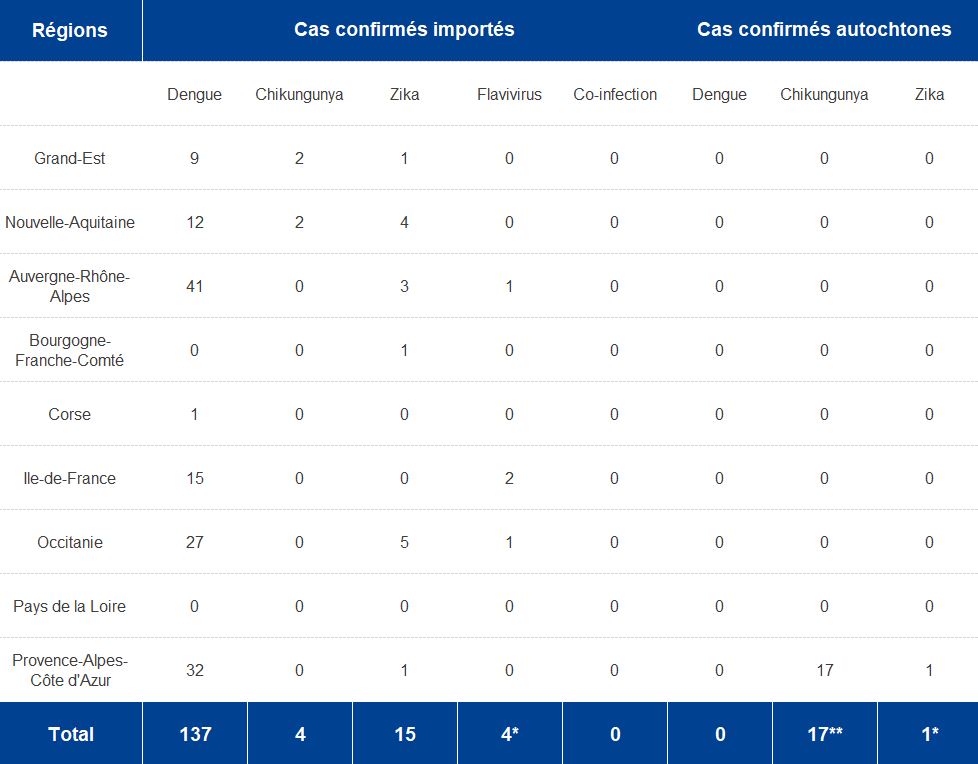
* It is impossible to determine whether the infection was caused by the Zika virus or dengue.
** 15 confirmed cases and 2 probable cases.
*** Sexually transmitted infection from an imported case returning from the Caribbean
List of departments where Aedes albopictus is present: Ain, Alpes-de-Haute-Provence, Alpes-Maritimes, Ardèche, Aude, Aveyron, Bouches-du-Rhône, Corse-du-Sud, Haute-Corse, Dordogne, Drôme, Gard, Haute-Garonne, Gers, Gironde, Hérault, Isère, Landes, Lot, Lot-et-Garonne, Pyrénées-Atlantiques, Pyrénées-Orientales, Bas-Rhin, Haut-Rhin, Rhône, Saône-et-Loire, Savoie, Tarn, Tarn-et-Garonne, Var, Vaucluse, Vendée, Val-de-Marne.
From May 1 to November 30 each year, Santé publique France coordinates enhanced seasonal surveillance of chikungunya and dengue in the metropolitan departments where the vector mosquito, Aedes albopictus, is present, in collaboration with the relevant regional health agencies. Since 2016, the plan to prevent the spread of arboviral diseases has also included enhanced surveillance of the Zika virus (see surveillance system and partners + map below).
From May 1 to November 30, 2016:
167 imported cases of dengue were confirmed;
18 imported cases of chikungunya were confirmed;
450 imported cases of Zika were confirmed;
1 imported case of dengue/Zika co-infection was confirmed;
3 cases of Zika transmitted sexually were confirmed.
There have been no cases of local vector-borne transmission.
They are broken down as follows:
Number of confirmed cases of chikungunya, dengue, and Zika, by region subject to enhanced surveillance (cases counted only for Level 1 departments), from May 1 to November 30, 2016*
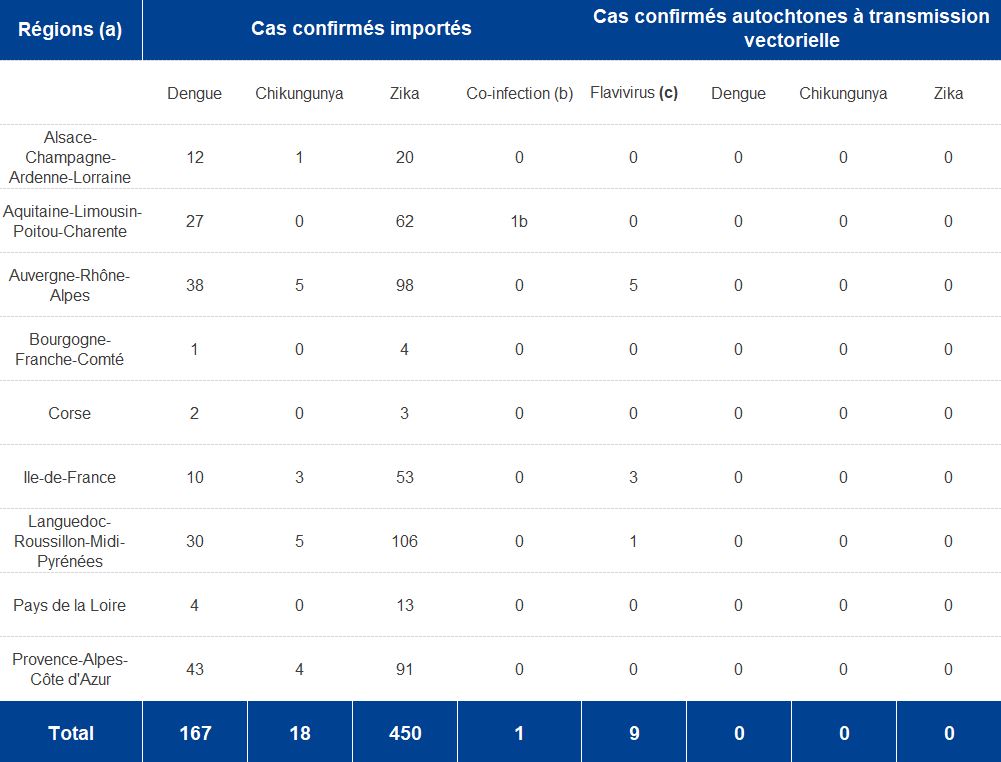
a List of Level 1 departments: Ain, Alpes-de-Haute-Provence, Alpes-Maritimes, Ardèche, Aude, Bouches-du-Rhône, Corse-du-Sud, Haute-Corse, Dordogne, Drôme, Gard, Haute-Garonne, Gironde, Hérault, Isère, Landes, Lot, Lot-et-Garonne, Pyrénées-Atlantiques, Pyrénées-Orientales, Bas-Rhin, Rhône, Saône-et-Loire, Savoie, Tarn, Tarn-et-Garonne, Var, Vaucluse, Vendée, Val-de-Marne.
b Dengue-Zika co-infection.
c Serological results that do not allow for differentiation between dengue and Zika.
* (Data consolidated as of December 22, 2016)
From May 1 to November 30 each year, the InVS coordinates enhanced seasonal surveillance of chikungunya and dengue in the metropolitan departments where the vector mosquito, Aedes albopictus, in collaboration with the relevant Regional Health Agencies (ARS) (see surveillance system and partners).
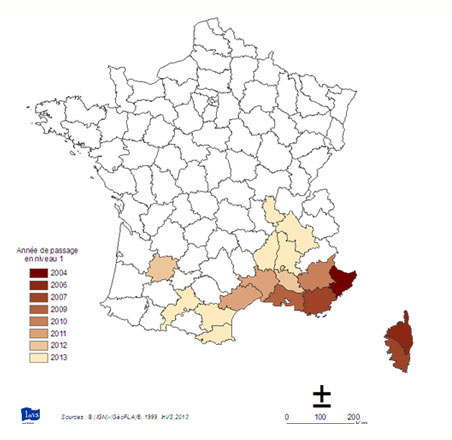
Since September 2015, the departments of Tarn and Vendée have been included in the list of departments where the Aedes albopictus mosquito is established. The number of departments covered by the regional enhanced surveillance program has thus risen to 22.
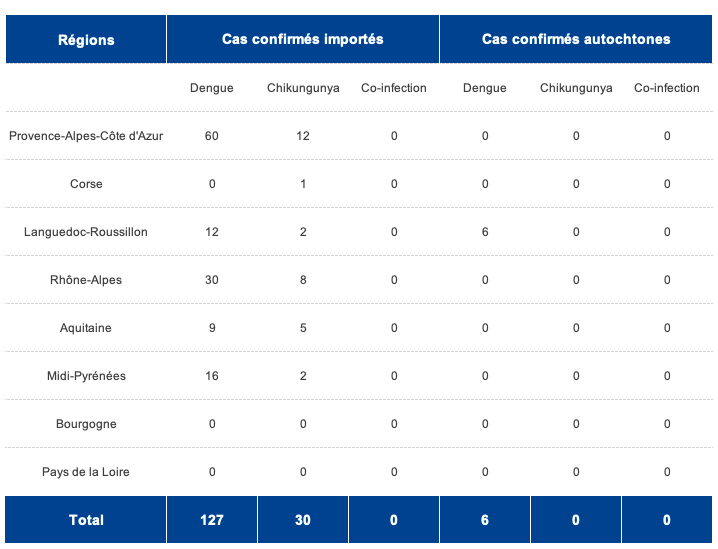
From May 1 to November 27, 2015:
127 imported cases of dengue were confirmed;
30 imported cases of chikungunya were confirmed;
6 locally acquired cases of dengue were confirmed.
On August 19, 2015, two locally acquired cases of dengue were confirmed within the same family in Nîmes (Gard department, Languedoc-Roussillon region).
As of September 25, 2015, epidemiological investigations had identified 4 locally acquired cases of dengue linked to this outbreak, bringing the total number of locally acquired cases to 6.
In accordance with the national plan to “prevent the spread of chikungunya and dengue” and in order to limit transmission of the virus by the Aedes albopictus mosquito, epidemiological and entomological investigations, as well as mosquito control measures, were immediately implemented by the ARS, the Cire, and the Interdepartmental Agreement for Mosquito Control along the Mediterranean Coast (EID Méditerranée). Health care professionals, medical laboratories, and health care facilities, as well as city halls and local authorities, were notified in the affected areas.
For more information: http://www.ars.languedocroussillon.sante.fr
The figures break down as follows:
Number of confirmed cases of chikungunya and dengue, by region under enhanced surveillance, from May 1 to November 27, 2015
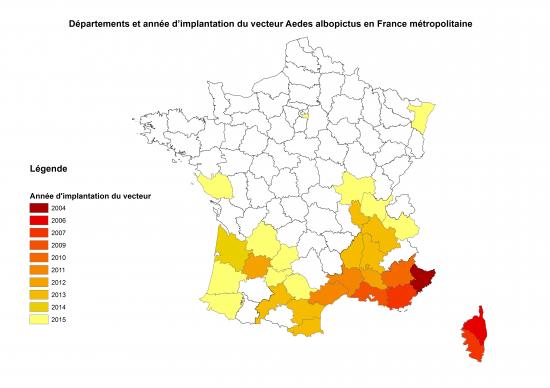
Department and year of establishment of the Aedes albopictus vector in metropolitan France
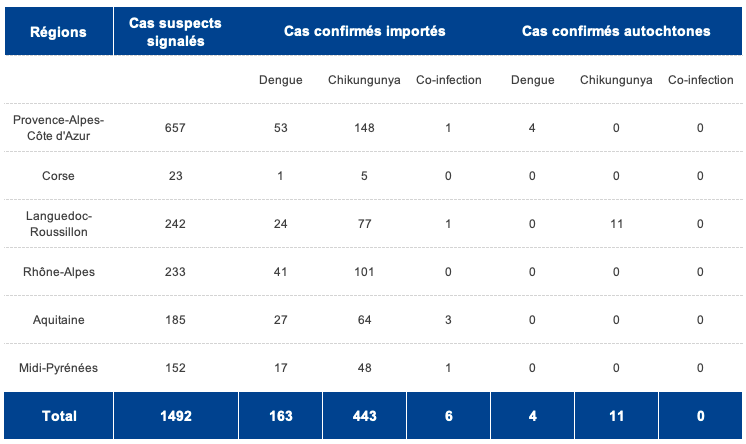
From May 1 to November 30, 2014 => 1,492 suspected cases of dengue or chikungunya were reported. Of these, the following were confirmed:
163 imported cases of dengue;
443 imported cases of chikungunya;
6 imported cases of co-infection;
4 locally acquired cases of dengue;
11 locally acquired cases of chikungunya.
Four locally transmitted cases of dengue were confirmed by the National Reference Center (CNR) for Arboviruses in the Provence-Alpes-Côte d’Azur region. The first two cases, confirmed on August 20 and September 11, occurred in the Var department. They are not linked because they involve different serotypes (serotype 1 and serotype 2). The third and fourth cases, confirmed on September 18 and October 3 in the Bouches-du-Rhône department, are linked and constitute an outbreak. The two patients live in the same neighborhood and have the same dengue serotype: serotype 2. They are not linked to the cases in the Var department.
The 11 autochthonous cases of chikungunya were identified in the same neighborhood of Montpellier (Hérault) and constitute a transmission cluster. The first five cases in this cluster were confirmed by the National Reference Center for Arboviruses on October 20 and 22. Epidemiological investigations identified 6 locally acquired cases linked to this cluster, bringing the total to 11 locally acquired cases.
In accordance with the national plan to “prevent the spread of chikungunya and dengue” and in order to limit the transmission of these viruses by the Aedes albopictus mosquito, epidemiological and entomological investigations, as well as mosquito control measures, were immediately implemented by the relevant Regional Health Agencies (ARS) and Regional Health Centers (CIRE), and the Interdepartmental Agreement for Mosquito Control on the Mediterranean Coast (EID Méditerranée) in response to the locally acquired cases of dengue and chikungunya.
Information was disseminated to healthcare professionals, medical laboratories, and healthcare facilities, as well as to city halls and local authorities in the affected areas.
The alert has been lifted in the departments of Var, Bouches-du-Rhône, and Hérault.
For more information, visit http://www.ars.paca.sante.fr/ and http://www.ars.languedocroussillon.sante.fr
The enhanced surveillance program for chikungunya and dengue ended on November 30, 2014.
Pending validation of the latest laboratory results, the cases are broken down as follows:
Number of suspected and confirmed cases of chikungunya and dengue, by enhanced surveillance region, from May 1 to November 30, 2014
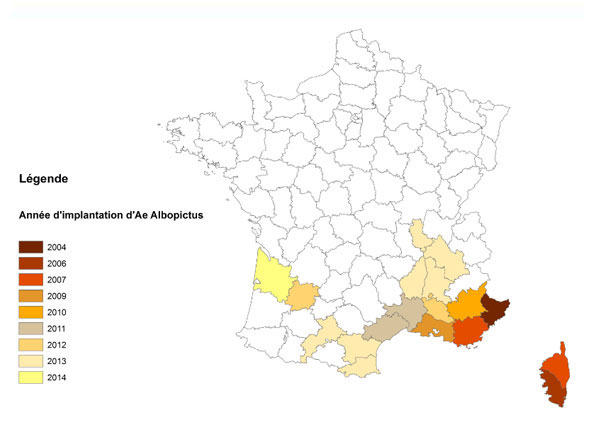
Department and year of establishment of the Aedes albopictus vector in metropolitan France
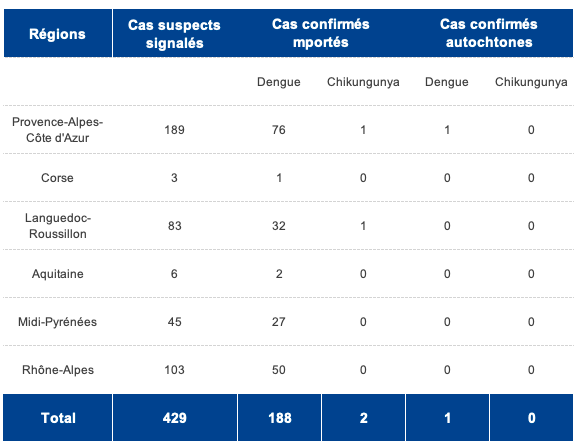
From May 1, 2013, to November 30, 2013, in the 17 departments of southern France under enhanced surveillance:
429 suspected cases of dengue or chikungunya were reported. Among them:
188 imported cases of dengue were confirmed;
2 imported cases of chikungunya were confirmed.
A single case of autochthonous dengue (locally transmitted) was diagnosed in the Bouches-du-Rhône department on October 21, 2013. The individual had not traveled to an area where dengue is endemic within the 15 days prior to the onset of symptoms.
Epidemiological, virological, and entomological investigations were immediately conducted by the ARS, the Cire, the National Reference Center for Arboviruses, and the Interdepartmental Mosquito Control Association (EID Méditerranée). Awareness campaigns targeting city halls, primary care physicians, and medical laboratories were carried out in the area surrounding the affected person’s residence. Active case finding in the area and among physicians and laboratories has not identified any other cases to date.
As a preventive measure, and although field investigations have shown a significant decrease in the mosquito population, vector control treatment has been applied in the field.
The risk of further autochthonous cases has been assessed as minimal, due to the low prevalence of the Aedes albopictus (tiger mosquito) in the area and the onset of winter. To date, investigations have not identified the precise source of this infection.
The cases are broken down as follows:
Number of suspected and confirmed cases of chikungunya and dengue, by enhanced surveillance region, from May 1 to November 30, 2013
The 17 departments where the Aedes albopictus mosquito was present in 2013
Alpes-Maritimes, Alpes-de-Haute-Provence, Var, Haute-Corse, Corse-du-Sud, Bouches-du-Rhône, Vaucluse, Gard, Hérault, Aude, Pyrénées-Orientales, Haute-Garonne, Lot-et-Garonne, Drôme, Ardèche, Isère, and Rhône.
In relation to

Chikungunya
thematic dossier
Chikungunya is a viral disease transmitted by mosquitoes of the genus Aedes. The most common symptoms are fever and joint pain.

Dengue
thematic dossier
Dengue fever is a viral disease transmitted by mosquitoes of the genus Aedes. The most common symptoms are fever and joint pain. Its complications can be severe.












