



The disease
A viral infectious disease
Zika is a disease caused by an arbovirus: the Zika virus.
This virus, of the genus Flavivirus, belongs to the Flaviviridae family, which includes the dengue, West Nile, and yellow fever viruses. It was first isolated in 1947 in Uganda, in the Zika Forest, from which it takes its name.
The Zika virus is primarily transmitted by mosquitoes of the genus Aedes. The infection is generally uncomplicated but can sometimes lead to severe embryo-fetal and neurological complications.
In this context, Santé publique France’s priorities are:
to define, manage, and coordinate epidemiological surveillance of Zika in France,
adapting surveillance to regional specificities and risks: enhanced surveillance measures in metropolitan departments where the vector mosquito is present, and specific measures for the various overseas departments in collaboration with regional intervention units and regional health agencies,
contributing to the information and awareness of healthcare professionals, local authorities, and the general public regarding the disease and prevention measures.
Several modes of Zika transmission
Vector-borne transmission
The Zika virus is transmitted primarily by mosquitoes of the genus Aedes, mainly Aedes aegypti. Aedes albopictus (also known as the “tiger mosquito”) is believed to be a competent but secondary vector of this virus. When a mosquito bites, it becomes infected by picking up the virus from the blood of an infected person and can, during another bite, transmit the virus to a new person.
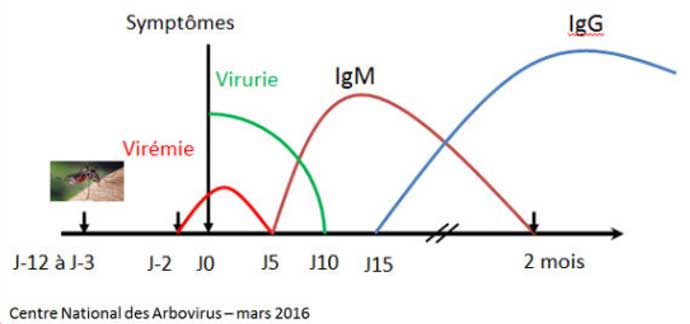
An infected person is "contagious to mosquitoes" while the virus is present in their blood. For Zika, the virus is present in the blood 1 to 2 days before symptoms appear and up to 7 days afterward. During this period, if an infected person is bitten, they can transmit the virus to other mosquitoes, which in turn become capable of transmitting the infection.
Sexual transmission
The Zika virus can be transmitted during unprotected sex:
from an infected man, more frequently during heterosexual intercourse than between men (for a few months after the onset of infection),
Sexual transmission of Zika from infected women is also possible but poorly documented.
Transmission from mother to fetus
The Zika virus can be transmitted directly from mother to child if the mother is infected during pregnancy.
Other possible modes of transmission
transfusion,
transplant,
the Zika virus has been isolated in saliva and breast milk, although transmission through these routes has not yet been formally proven.
Symptoms and complications
50 to 80% of people infected with the Zika virus do not show symptoms.
When symptoms do occur, they appear after an incubation period of 3 to 14 days. They typically include:
A rash (maculopapular exanthem), possibly accompanied by itching,
A mild fever, which may be absent,
Conjunctivitis, fatigue, muscle and joint pain, headaches, and retro-orbital pain. These symptoms last a few days and resolve on their own.
Complications are rare but possible, including:
Neurological complications: primarily Guillain-Barré syndrome,
In cases of Zika virus infection during pregnancy, the infection can be transmitted to the fetus in some cases (approximately 20 to 30%) and lead to complications in certain fetuses characterized by abnormalities in intrauterine neurological and cerebral development (including microcephaly, an abnormally small head size).
Diagnosis
Zika virus infection can be diagnosed through laboratory tests:
detection of the virus genome (RNA) in serum, blood, urine, semen, and other biological fluids (direct testing via RT-PCR),
serology on a blood sample (detection of Zika-specific antibodies (anti-Zika IgM and IgG)).
The recommended diagnostic approach is as follows:
Up to 5 days after the onset of symptoms (Day 5): RT-PCR in serum
Between D5 and D7: RT-PCR in serum and serology
After D7: serology only (IgG and IgM) with a second confirmatory sample taken no earlier than 10 days after the first sample
In addition to these tests, a PCR test can be performed on urine samples up to 10 days after the onset of symptoms. Therefore, it is essential to accurately identify the date of symptom onset (DDS) in order to select the appropriate tests.
Blood samples can be collected by any clinical laboratory. Each sample must be accompanied by a clinical information form. Laboratory confirmation of Zika is particularly important in the French overseas departments and metropolitan France where the vector (Aedes aegypti and Aedes albopictus, respectively) is established.
Dynamics of the virus and IgM and IgG antibodies during Zika virus infection
Treatment
There is no specific treatment for Zika. Treatment focuses on relieving symptoms and primarily involves taking pain relievers (such as acetaminophen). Salicylate-based medications (such as aspirin) should be avoided due to the coexistence of dengue fever in areas where the Zika virus circulates and the associated risk of bleeding.
Hospitalization may be necessary in complicated cases.
Pregnant women should consult a doctor if they experience symptoms suggestive of Zika upon returning from an area where the Zika virus is circulating, or should disclose that they have been exposed to the Zika virus if they have traveled to or had unprotected sex with someone who has been in a Zika-transmission area, given the potential complications for the fetus. In the event of Zika virus infection, they should be monitored in coordination with a Multidisciplinary Center for Prenatal Diagnosis (CPDPN).
Prevention
Currently, there is no vaccine against Zika.
Preventing mosquito bites relies on both individual and collective actions.
Individual Prevention
Individual prevention relies primarily on measures to protect against mosquito bites: repellents in spray or cream form, coils, electric diffusers, long clothing, and mosquito nets.
Protection is particularly necessary during the day, as Aedes mosquitoes—the primary vectors—bite mainly during daylight hours, primarily outdoors, with peak activity in the early morning and late afternoon.
Community Prevention and Vector Control
Community-based prevention and mosquito control also rely on vector control and community-based efforts.
The control of disease-carrying vectors, such as mosquitoes, is referred to as vector control. In its broadest sense, vector control encompasses both the control of and protection against these insects. Vector control relies on methods that vary depending on the vector and the epidemiological and socioeconomic contexts. It includes chemical control, biological control, genetic control, environmental interventions, health education, community mobilization, and the ongoing evaluation of all these methods.
Its objective is to contribute, alongside other public health initiatives, to reducing the risks of endemicity (the long-term establishment of a disease in a region) or epidemic outbreaks, to reducing the transmission of pathogens by vectors, and to managing outbreaks of vector-borne diseases, all within a formalized strategic framework.
Depending on the scale at which this mosquito control is carried out, a distinction is made between control at the territorial level (departments, municipalities) and that carried out at the individual level, which specifically targets mosquito breeding sites located in the immediate vicinity of homes.
Vector control at the regional level is carried out by public mosquito control agencies. Chemical control has two components:
larvicides, which specifically target mosquito larvae,
adulticide, which targets adult mosquitoes specifically.
Community-based control, which is everyone’s responsibility, relies on:
the elimination of potential larval breeding sites around homes (standing water in saucers, gutters, vases, buckets, trash, etc.),
personal protection against mosquito bites.
Prevention of sexual transmission
Practice safe sex for three to six months after returning from an area where the Zika virus is circulating or after the onset of symptoms in the case of symptomatic infection.
In case of pregnancy: if possible, postpone travel to areas where the Zika virus is circulating.
For women planning a pregnancy who are considering travel to a Zika epidemic area, contraception may also be recommended.
Use personal protection measures against mosquito bites.
Practice safe sex throughout the entire pregnancy if the partner has been exposed to the Zika virus.
Prevention of Zika virus infection based on mode of transmission (these recommendations apply to people living in areas where Zika is circulating and to travelers visiting such areas)
| Type of transmission | Recommended prevention |
|---|---|
| Vector-borne |
Community-based prevention: destruction of larval breeding sites, mosquito control Individual Learn more: list of repellents and insecticides available in the Weekly Epidemiological Bulletin, 2020 travel recommendations, and on the Ministry of Health website |
| Sexual | - Practice safe sex for up to six months after returning from an area where the Zika virus is circulating or after the onset of symptoms in the case of a symptomatic infection |
| Maternal-fetal | - Prevention against mosquito bites (be sure to use a suitable repellent while following specific precautions for pregnancy) |
Precautions to take upon returning from an endemic area:
Consult a doctor if you experience suggestive symptoms (these symptoms may appear up to 12 days after leaving an area where the Zika virus is circulating).
Protect yourself from mosquitoes as soon as symptoms appear, for 7 days, to prevent transmitting the virus to a mosquito in areas where Aedes mosquitoes are present and during their active season.
French territories affected to varying degrees
In the French West Indies and French Guiana, a Zika outbreak occurred in 2016, during the major epidemic that affected Latin America and the Caribbean. Approximately 80,000 people sought medical care in these regions for Zika virus infection. The vector is the Aedes aegypti mosquito.
In mainland France, the Aedes albopictus mosquito (tiger mosquito) is present in several departments, and Zika virus transmission is theoretically possible from late April or early May through winter (the period during which adult tiger mosquitoes do not survive).
In 2019, for the first time, a transmission likely caused by the tiger mosquito was identified in mainland France, with a cluster of two cases in the Var department.
In the Indian Ocean, in Mayotte, Aedes aegypti and Aedes albopictus are present; in Réunion, Aedes albopictus is by far the most common species (Aedes aegypti is present only in small numbers). There has been no local transmission of Zika in these two departments.
In relation to

Chikungunya
thematic dossier
Chikungunya is a viral disease transmitted by mosquitoes of the genus Aedes. The most common symptoms are fever and joint pain.

Dengue
thematic dossier
Dengue fever is a viral disease transmitted by mosquitoes of the genus Aedes. The most common symptoms are fever and joint pain. Its complications can be severe.












