Surveillance for dengue, chikungunya, and Zika is based on mandatory reporting. From May 1 to November 30 of each year, during the active season of mosquito vectors, this surveillance is intensified through investigations of each case and the implementation of prevention measures in collaboration with the Regional Health Agencies (ARS) and mosquito control operators (see surveillance system and partners).
Enhanced surveillance for chikungunya, dengue, and Zika ended on November 30, 2024.
Episodes of local transmission of dengue, chikungunya, and Zika
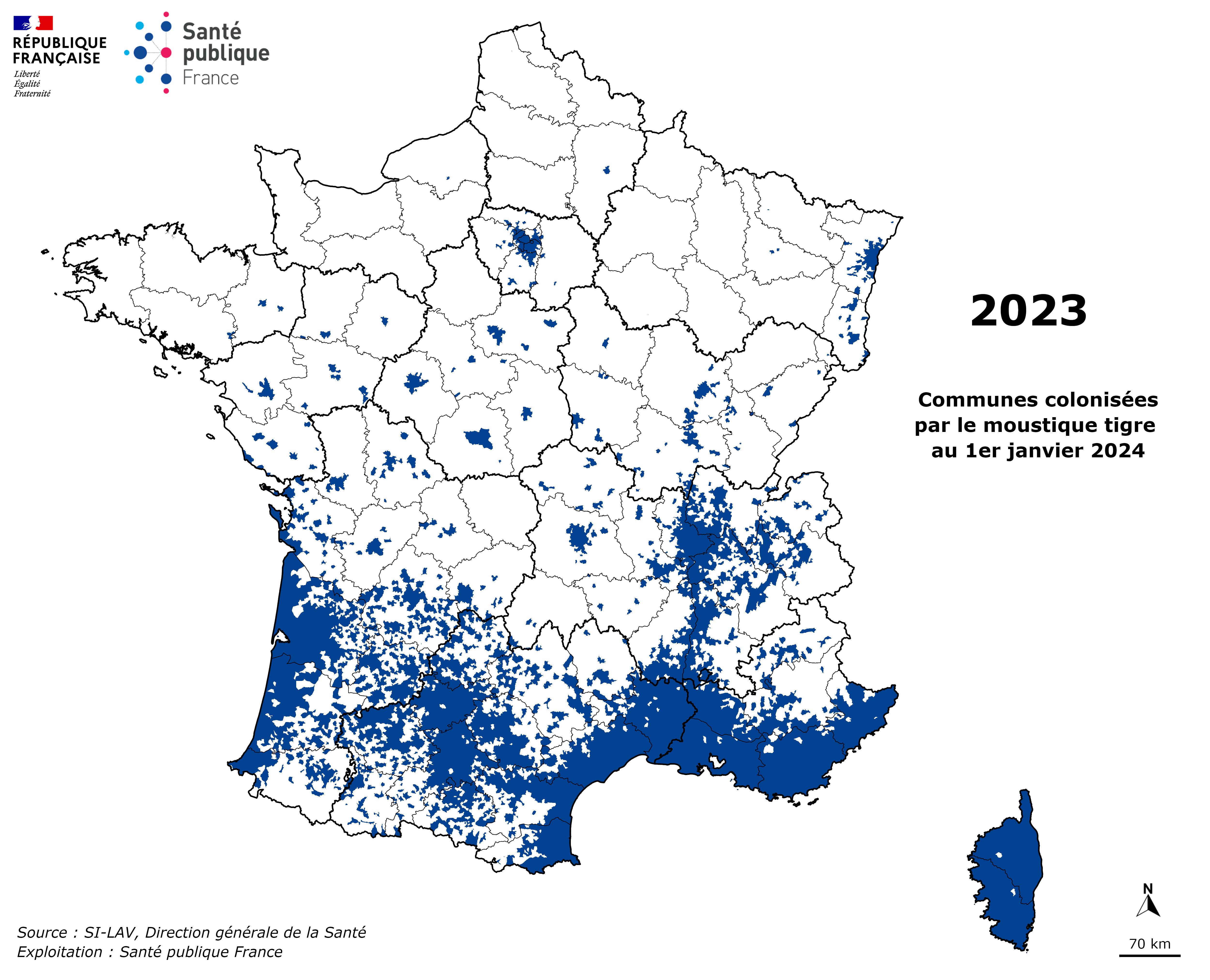
The dengue, chikungunya, and Zika viruses, transmitted by mosquitoes of the genus Aedes, and the West Nile virus, transmitted by Culex mosquitoes, are subject to surveillance in mainland France, which aims primarily to prevent and/or limit the establishment of a transmission cycle for these arboviruses. Since its initial introduction in 2004, the Aedes albopictus mosquito (tiger mosquito), a vector for these viruses, has spread to the vast majority of mainland France. Culex mosquitoes are ubiquitous.
This surveillance relies on mandatory reporting (MR) of all biologically confirmed cases, both imported and indigenous. It is reinforced, in particular, by the automated transfer of results from the main laboratories performing these diagnoses and by raising awareness among healthcare professionals during the mosquito activity period from May 1 to November 30 to address the risk of local transmission.
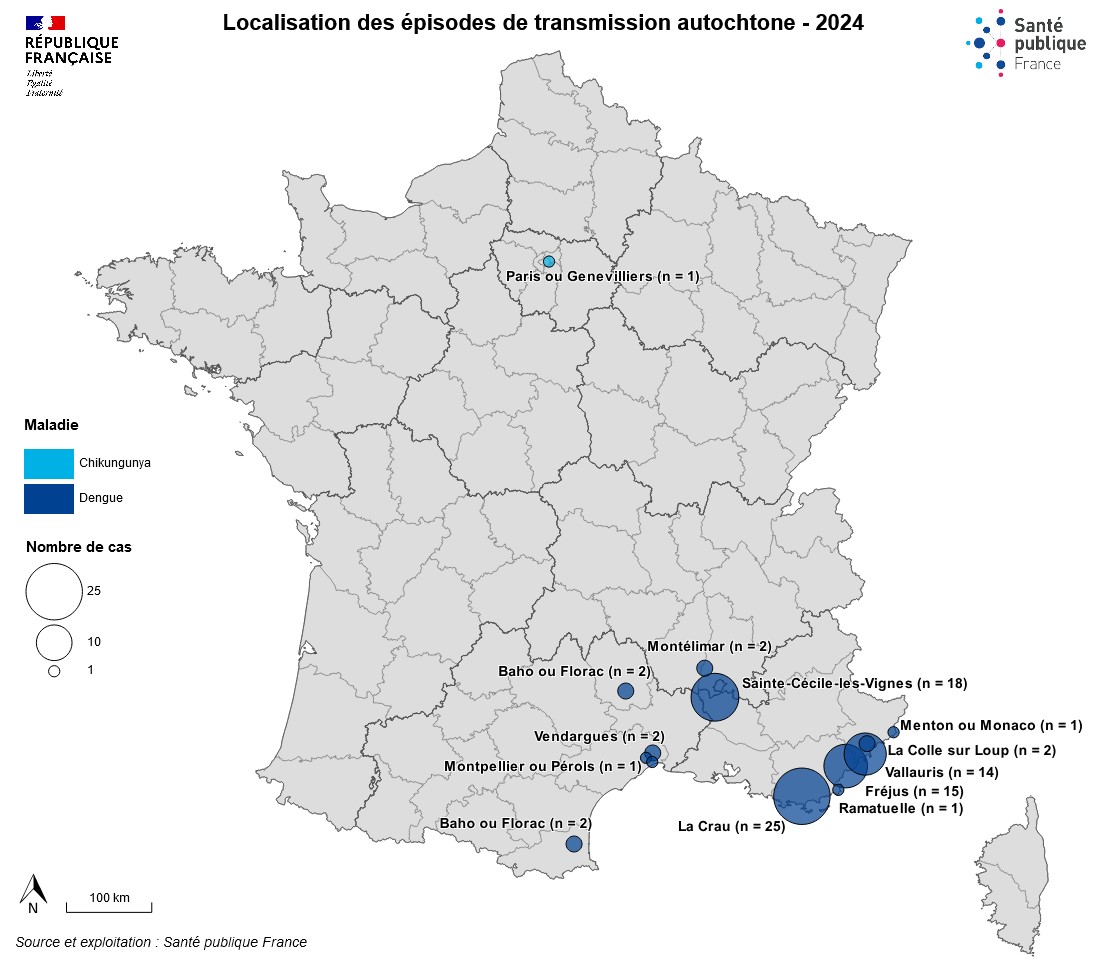
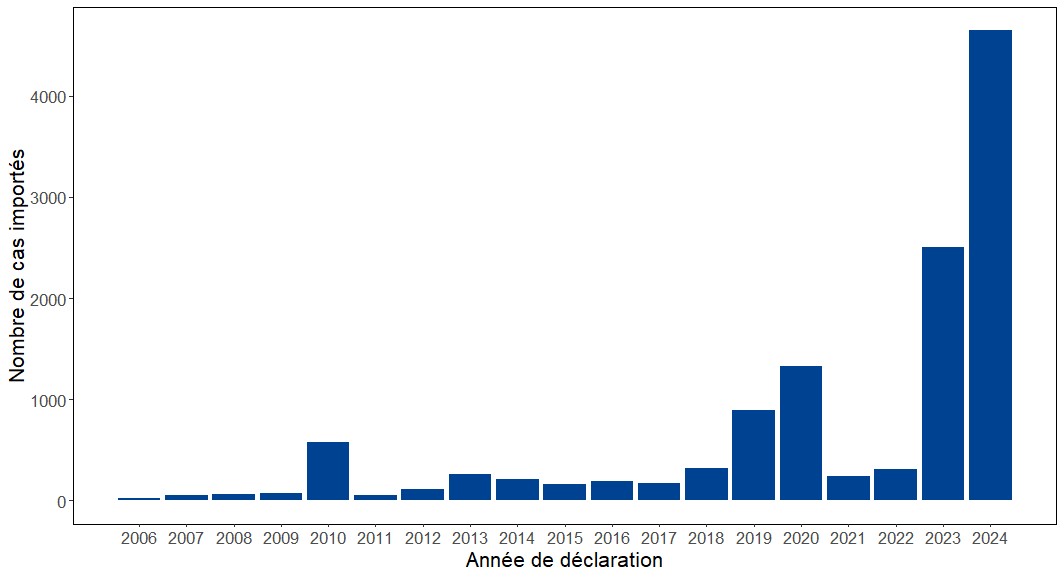
The preliminary report for the 2024 season indicates 11 outbreaks of local dengue transmission totaling 83 cases (Table 1). This represents the highest number of outbreaks and indigenous cases identified since the implementation of enhanced surveillance in 2006. These outbreaks occurred primarily in Provence-Alpes-Côte d’Azur and Occitanie (Figure 1). An autochthonous case of chikungunya was reported for the first time in Île-de-France, one year after the identification of the first autochthonous dengue transmission outbreak (3 cases) in that region. For each outbreak, entomological and epidemiological investigations were immediately launched, accompanied by vector control measures. Measures to secure products derived from the human body were also implemented, in accordance with the recommendations of the High Council for Public Health.
| Episodes of local dengue transmission in mainland France, 2024 season |
|---|
| Virus |
Region |
Department |
Municipality(ies) |
No. of locally transmitted cases |
Date of onset of symptoms for the first case |
Date of onset of symptoms in the last case |
Outbreak closed Y/N |
| Dengue |
Auvergne-Rhône-Alpes |
Drôme (26) |
Montélimar |
2 |
08/07/2024 |
08/10/2024 |
Yes |
| Dengue |
Occitanie |
Hérault (34) |
Montpellier or Pérols (2 possible transmission sites) |
1 |
06/17/2024 |
06/17/2024 |
Yes |
| Dengue |
Occitanie |
Hérault (34) |
Vendargues |
2 |
09/08/2024 |
09/09/2024 |
Yes |
| Dengue |
Occitanie |
Pyrénées-Orientales (66) or Lozère (48) |
Baho (66) or Florac (48) |
2 |
July 16, 2024 |
07/19/2024 |
Yes |
| Dengue |
Provence-Alpes-Côte d'Azur |
Alpes-Maritimes (06) |
La Colle-sur-Loup |
2 |
July 26, 2024 |
07/27/2024 |
Yes |
| Dengue |
Provence-Alpes-Côte d'Azur |
Vaucluse (84) |
Sainte-Cécile-les-Vignes |
18 |
July 19, 2024 |
August 25, 2024 |
Yes |
| Dengue |
Provence-Alpes-Côte d'Azur |
Var (83) |
La Crau |
25 |
08/05/2024 |
09/05/2024 |
Yes |
| Dengue |
Provence-Alpes-Côte d'Azur |
Var (83) |
Fréjus |
15 |
08/08/2024 |
10/11/2024 |
Yes |
| Dengue |
Provence-Alpes-Côte d'Azur |
Var (83) |
Ramatuelle |
1 |
09/25/2024 |
09/25/2024 |
Yes |
| Dengue |
Provence-Alpes-Côte d'Azur |
Alpes-Maritimes (06) |
Menton (or Monaco) |
1 |
08/06/2024 |
08/06/2024 |
Yes |
| Dengue |
Provence-Alpes-Côte d'Azur |
Alpes-Maritimes (06) |
Vallauris |
14 |
August 14, 2024 |
09/27/2024 |
Yes |
Episodes of local transmission of chikungunya in mainland France, 2024 season |
|---|
| Region |
Department |
Municipality(ies) |
No. of locally transmitted cases |
Date of onset of symptoms for the first case |
Date of onset of symptoms in the last case |
Outbreak closed |
| Île-de-France |
Paris (75) / Hauts-de-Seine (92) |
Paris (75) or Gennevilliers (92) |
1 |
07/18/24 |
|
Yes |
Thanks to the epidemiological investigations conducted, the imported case at the origin of the transmission was identified in 3 of the 11 outbreaks investigated. The imported primary cases had returned from French Guiana, Réunion, and Indonesia.
For 8 of the 11 local outbreaks, the dengue virus serotype was identified. Serotype 1 (DENV-1) was identified in 4 outbreaks, serotype 2 (DENV-2) in 3 outbreaks, and serotype 3 (DENV-3) in one outbreak.
The transmission zone within a single transmission cluster did not exceed a radius of 400 meters.