


Monkeypox Cases: Update as of January 24, 2023
Update as of January 24, 2023, on confirmed cases of monkeypox reported in France and around the world.
This tally includes cases that have been biologically confirmed by PCR as well as those that have not. The latter category includes probable cases (suggestive clinical symptoms and contact with a confirmed case) and possible cases (suggestive clinical symptoms and exposure to a potential source of infection).
Internationally, and due to differences in surveillance protocols across countries, biologically confirmed cases remain the benchmark for comparing epidemiological situations between countries.
In early May 2022, cases of monkeypox with no direct link to travel to Central or West Africa—where the virus is present—or to people returning from travel were reported in Europe and around the world. Since then, the disease has been subject to enhanced surveillance in France and across Europe, based on mandatory reporting, for which the form has been specifically updated.
Update on the Situation in France
As of January 24, 2023, at 12:00 p.m., 4,982 cases of Monkeypox virus infection have been reported in France, including 4,128 (83%) biologically confirmed cases—an increase of 13 cases since the December 20 update—and 854 (17%) probable or possible cases, not biologically confirmed—an increase of one case since the December 20 update.
The distribution of cases by region of residence (or by region of reporting when the region of residence is unknown) is shown in Figures 1 and 2. The Île-de-France region has the highest number of cases (3,119, or 63%), followed by Auvergne-Rhône-Alpes (355 cases), Provence-Alpes-Côte d’Azur (334 cases), and Occitanie (330 cases); 27 cases reside abroad.
The vast majority of adult cases reported to date are male, and 2.9% are women over the age of 15 (143 cases, including 113 biologically confirmed cases and 30 unconfirmed cases). The proportion of female cases reached 14.2% in Week 36/2022 (19 cases out of a total of 134), then decreased to around 10% between Weeks 37 and 40. This proportion subsequently increased again until Week 46, but with a low and declining number of cases (1 case in Week 46). The low case numbers and the lack of information on possible transgender status among these female cases did not allow for conclusions regarding a potential change in the dynamics of virus transmission. Since Week 47, only one case has been reported in a woman, in Week 02/2023 (unconsolidated data).
The median age of adult cases is 36 years; 25% of cases are under 29 years old and 25% are between 43 and 81 years old.
Twenty-four children under 15 years of age (0.5% of total cases) have been reported since May 2022 (12 biologically confirmed cases and 12 unconfirmed cases).
Biologically
unconfirmed cases have a profile similar to confirmed cases: 3.6% of adults are female (vs. 2.8% of confirmed adult cases), the median age of adults is 36 years, as in confirmed cases, and the majority reside in the Île-de-France region (72% vs. 61% of confirmed cases).
Among all cases for which information is available, 100 (3.2%) were hospitalized due to their Monkeypox infection; this proportion has remained stable over time.
No deaths have been reported to date.
The distribution of cases by date of symptom onset (when known) and case type (biologically confirmed or not) is shown in Figure 3. The date of symptom onset for cases ranges from May 7, 2022, to January 13, 2023. Due to reporting delays, data from the past few weeks have not been consolidated. The reports received do not always specify the date of symptom onset. As an alternative to this information, the distribution of cases by date of reporting is presented in Figure 4.
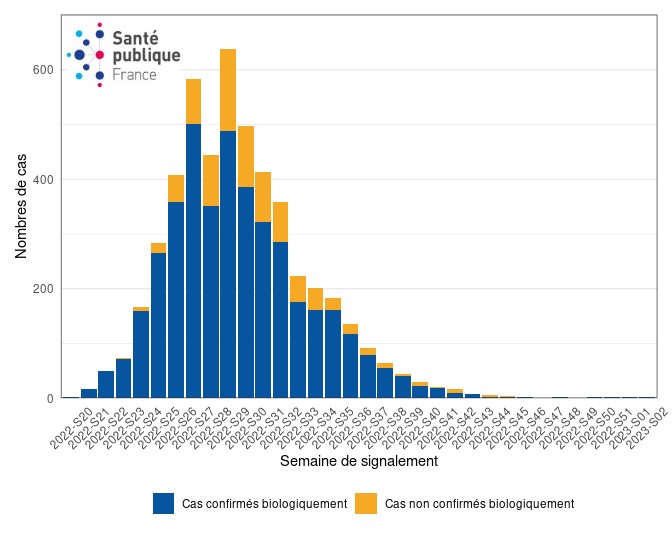
The interpretation of the epidemic’s dynamics remains unchanged whether the analysis focuses solely on confirmed cases or on all cases (confirmed, probable, and possible). Since the peak in infections reached in late June/early July, the number of cases has fallen sharply, whether biologically confirmed or unconfirmed. Currently, the weekly number of reported cases ranges from 1 to 3. Caution is nevertheless warranted, as improved knowledge of the disease may reduce the use of healthcare services among better-informed populations.
This significant decline in the number of cases is also observed globally. The number of new global cases decreased by 3% in Week 3 of 2023 compared to the previous week (https://worldhealthorg.shinyapps.io/mpx_global/). The majority of cases reported since Week 52 of 2022 were reported by countries in the Americas (78%) and the African region (14%).
Figure 1. Total monkeypox cases (n = 4,955) by region of residence (or by region of reporting when the region of residence is unknown), France, May 2022–January 2023 (data as of January 24, 2023 – 12:00 p.m.)
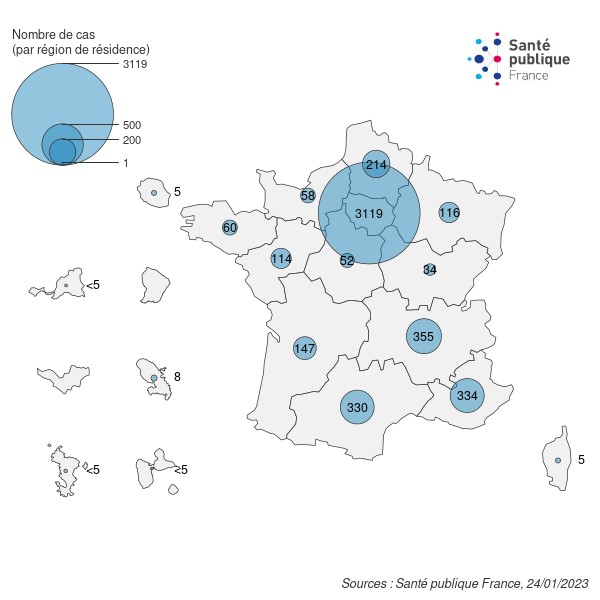
Figure 2. Biologically confirmed cases (n = 4,105) by region of residence (or by region of reporting when the region of residence is unknown), France, May 2022–January 2023 (data as of January 24, 2023 – 12:00 p.m.)
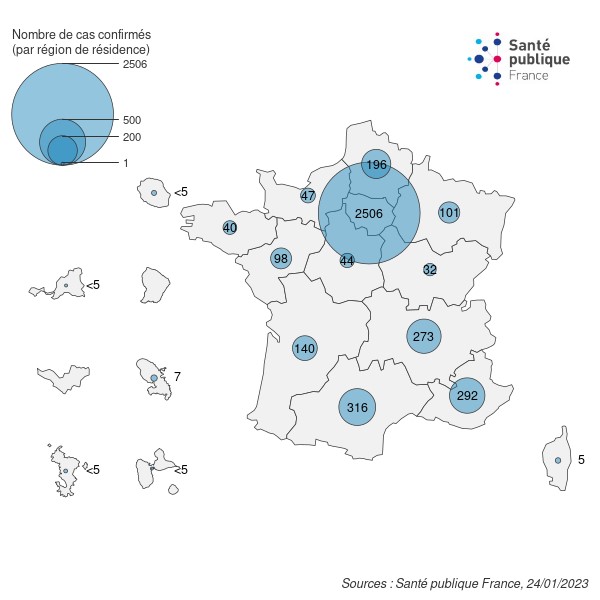
Figure 3. Monkeypox cases (n = 3,761 cases, number of missing data points = 1,221) by week of symptom onset and by case type (biologically confirmed or not), France, May 2022–January 2023 (data as of 01/24/2023 – 12:00 p.m.).
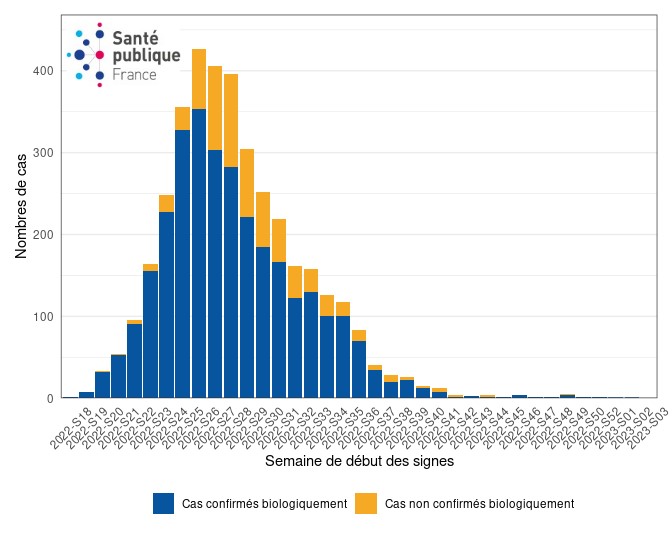
Figure 4. Monkeypox cases (n = 4,980 cases, number of missing data points = 2) by week of reporting and by case type (biologically confirmed or not), France, May 2022–January 2023 (data as of January 24, 2023 – 12:00 p.m.).
Monkeypox Cases: Update as of December 20, 2022 (News from December 21, 2022)
Monkeypox cases: update as of November 29, 2022 (news from 11/29/22)
Monkeypox cases: update as of November 15, 2022 (news from 11/16/22)
Monkeypox cases: update as of November 1, 2022 (news from 11/03/22)
Monkeypox cases: update as of October 25, 2022 (news from 10/26/22)
Monkeypox cases: update as of October 18, 2022 (news from 10/19/22)
Monkeypox cases: update as of October 11, 2022 (news from 10/12/22)
Monkeypox cases: update as of October 4, 2022 (news from 10/05/22)
Monkeypox cases: update as of September 27, 2022 (news from 09/28/22)
Monkeypox cases: update as of September 22, 2022 (news from 09/23/22)
Monkeypox cases: update as of September 20, 2022 (news from 09/21/22)
Monkeypox cases: update as of September 15, 2022 (news from 09/16/22)
Monkeypox cases: update as of September 12, 2022 (news from 09/13/22)
Monkeypox cases: update as of September 8, 2022 (news from 09/09/22)
Monkeypox cases: update as of September 6, 2022 (news from 09/07/22)
Monkeypox cases: update as of September 1, 2022 (news from 09/02/22)
Monkeypox cases: update as of August 29, 2022 (news from 08/30/22)
Monkeypox cases: update as of August 23, 2022 (news from 08/25/22)
Monkeypox cases: update as of August 18, 2022 (news from 08/19/22)
Monkeypox cases: update as of August 16, 2022 (news from 08/17/22)
Monkeypox cases: update as of August 11, 2022 (news from 08/12/22)
Monkeypox cases: update as of August 9, 2022 (news from 08/10/22)
Monkeypox cases: update as of August 4, 2022 (news from 08/05/22)
Monkeypox cases: update as of August 2, 2022 (news from 08/03/22)
Monkeypox cases: update as of July 28, 2022 (news from 07/29/22)
Monkeypox cases: update as of July 26, 2022 (news from 07/27/22)
Monkeypox cases: update as of July 21, 2022 (news from 07/22/22)
Monkeypox cases: update as of July 19, 2022 (news from 07/20/22)
Monkeypox cases: update as of July 12, 2022 (news from 07/13/22)
Monkeypox cases: update as of July 7, 2022 (news from 07/08/22)
Monkeypox cases: update as of July 5, 2022 (news from 07/05/22)
Monkeypox cases: update as of June 30, 2022 (news from 06/30/22)
Monkeypox cases: update as of June 28, 2022 (news from 06/28/22)
Monkeypox cases: update as of June 23, 2022 (news from 06/23/22)
Monkeypox cases: update as of June 21, 2022 (news from 06/21/22)
Monkeypox cases: update as of June 16, 2022 (news from 06/16/22)
Monkeypox cases: update as of June 14, 2022 (news from 06/14/22)
Monkeypox cases: update as of June 9, 2022 (news from 06/09/22)
Monkeypox cases: update as of June 7, 2022 (news from 06/07/22)
Monkeypox cases: update as of June 3, 2022 (news from 06/03/22)
Monkeypox cases: update as of June 1, 2022 (news from 06/01/22)
Monkeypox cases: update as of May 30, 2022 (news from 05/30/22)
Monkeypox cases: update as of May 28, 2022 (news from 05/29/22)
Monkeypox cases: update as of May 27, 2022 (news from 05/27/22)
Monkeypox cases: update as of May 25, 2022 (news from 05/25/22)
Monkeypox cases: update as of May 24, 2022 (news from 05/24/22)
Monkeypox cases: update as of May 23, 2022 (news from 05/23/22)
First confirmed case of Monkeypox in France (press release dated 05/20/22)
European Monkeypox cases: enhanced surveillance implemented (news update from 05/19/22)
In the region
Smallpox B (Mpox)
thematic dossier
Smallpox B (Mpox), formerly known as monkeypox, is a rare viral infectious disease caused by the monkeypox virus and transmitted primarily from rodents to humans, and then from person to person,...












