


Monkeypox Cases: Update as of August 4, 2022
Update as of August 4, 2022, following reports of monkeypox cases in France and around the world.
Smallpox B (Mpox)
thematic dossier
Smallpox B (Mpox), formerly known as monkeypox, is a rare viral infectious disease caused by the monkeypox virus and transmitted primarily from rodents to humans, and then from person to person,...
Cases of monkeypox with no direct link to travel to Central or West Africa or to people returning from travel have been reported in Europe and around the world since early May 2022. Since then, the outbreak has spread to a growing number of countries, and the disease is being subject to enhanced surveillance in both France and Europe.
On Saturday, July 23, the WHO Director-General announced that he was declaring this outbreak a Public Health Emergency of International Concern (PHEIC). This is the organization’s highest alert level, triggering a series of actions by member states.
In France, orthopoxvirus infections are subject to ongoing surveillance through the mandatory reporting system. Given the ongoing outbreak, surveillance of these infections has been strengthened by Santé publique France, and information and alert messages have been sent to healthcare professionals and the populations most at risk.
Update on the Situation in France
As of August 4, 2022, at 12:00 p.m., 2,423 confirmed cases had been reported in France. Cases were most frequently reported in Île-de-France (862 cases, or 49% of cases for which the region of residence is known), Occitanie (210 cases, or 12%), and Auvergne-Rhône-Alpes (181 cases, or 10%).
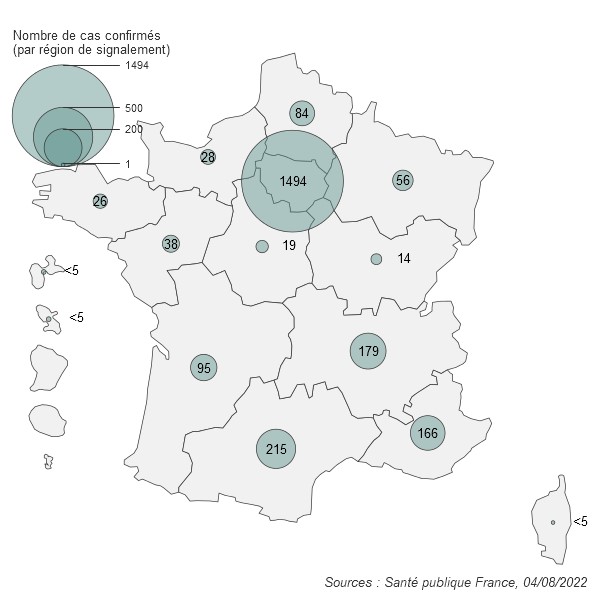
The distribution of cases by region of residence (when known) is shown in Figure 1 for cases residing in France. The distribution by region of reporting is shown in Figure 2.
The region of residence is unknown for 653 cases, and 8 cases reside abroad.
Figure 1. Confirmed cases of monkeypox (n=1,762 cases) by region of residence, France, May–August 2022 (data as of 08/04/2022 – 12:00 PM)
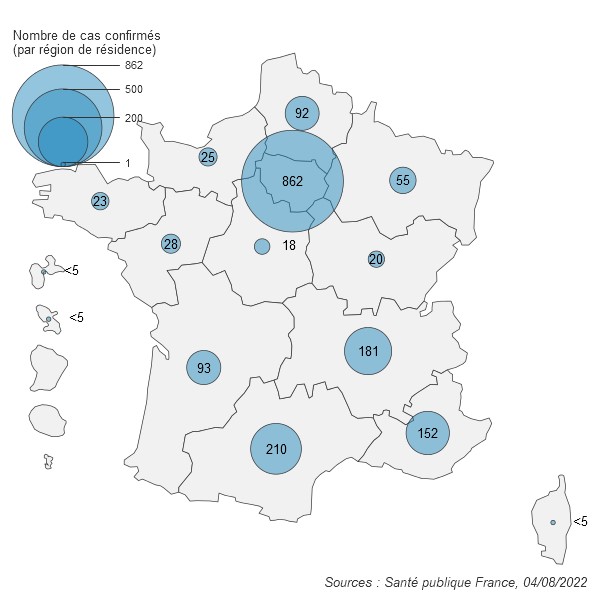
Figure 2. Confirmed cases of monkeypox (n=2,420 cases) by region of reporting, France, May–August 2022 (data as of August 4, 2022 – 12:00 PM)
The distribution of cases by date of symptom onset (when known) is shown in Figure 3. The date of symptom onset for these cases ranges from May 7, 2022, to July 30, 2022. They were diagnosed a median of 6 days (ranging from 0 to 36 days) after symptom onset; consequently, and given reporting delays, data from the past few weeks are not consolidated.
The reports received do not always mention the date of symptom onset or the date of diagnosis for the patient. As an alternative to this information, the distribution of cases by date of reporting is shown in Figure 4.
Figure 3. Confirmed cases of monkeypox (n=1,643 cases) by week of symptom onset, France, May–August 2022 (data as of 08/04/2022 – 12:00 PM). Data from the last few weeks (in gray) are not fully consolidated.
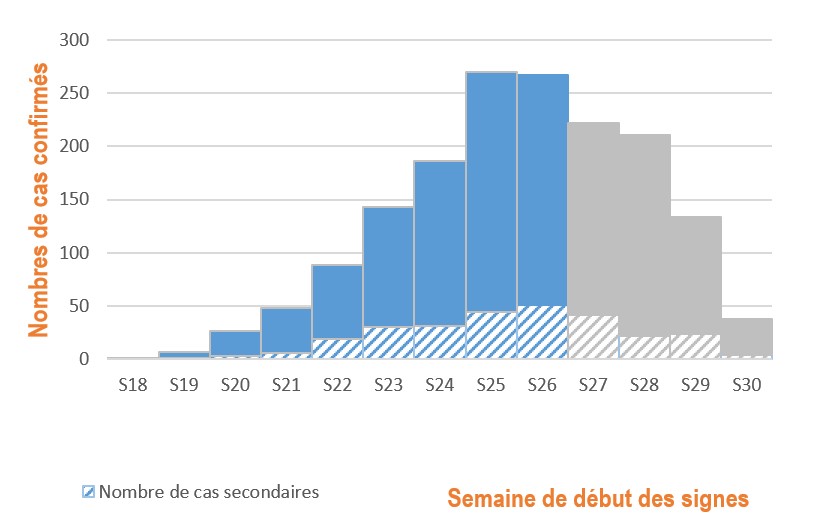
Figure 4. Confirmed cases of monkeypox (n=2,422 cases) by week of reporting, France, May–August 2022 (data as of August 4, 2022 – 12:00 PM). Data for the last week (in gray) are not fully consolidated.
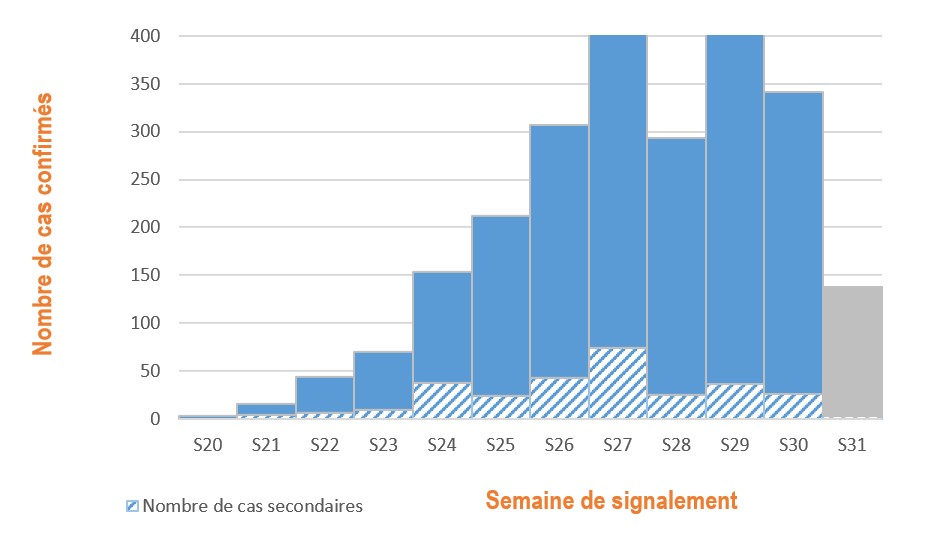
The dip in reporting observed in week 28 (July 11–17) can be explained by the public holiday (July 14).
All cases reported to date are adult males, except for 20 adult females and 2 children (under 15 years of age). Adult cases have a median age of 36 years; 25% of adult cases are under 30 years of age, and 25% are between 43 and 84 years of age.
Among the cases investigated, 75% presented with a genital-anal rash, 70% with a rash on another part of the body, 76% with a fever, and 72% with lymphadenopathy.
Forty-seven cases (2.9%) were hospitalized due to their Monkeypox virus infection, including 39 (2.6%) for complications related to this diagnosis. In France, no deaths have been reported to date.
The median time to testing from the onset of symptoms has been decreasing since the start of the outbreak: it dropped from 13 days in Week 18 of 2022 (May 2–8) to 5 days in Week 27 of 2022 (July 4–10).
Among the investigated cases, 69 are immunocompromised (5.0% of responding cases); 369 are HIV-positive (26% of cases aware of their HIV status). Among non-HIV-positive cases, 677 are on pre-exposure prophylaxis or “PrEP”* (representing 65% of non-HIV-positive cases who answered the question).
To date, in France, 96% of cases for which sexual orientation is reported occurred among men who have sex with men (MSM). Among cases for which information is available, 72% reported having had at least two sexual partners in the three weeks prior to the onset of symptoms.
Most of the cases surveyed report being unable to identify the person who may have infected them; 24% are secondary cases, meaning they report having been in contact with a monkeypox case within the three weeks prior to the onset of symptoms.
The next update to this report will be released on Wednesday, August 10.
*PrEP is a preventive treatment for HIV intended for people who do not have HIV but are at high risk of infection.
Information and Prevention Initiatives
Given what has been observed in Europe regarding the disease, targeted communication was quickly implemented for MSM. The website sexosafe.fr, dedicated to the sexual health of MSM, is regularly updated with a summary of current knowledge on the subject and prevention measures. Messages reminding people of the symptoms and what to do if symptoms appear were shared through a digital campaign. Since June 17, the digital campaign has generated nearly 547,199 clicks on banners and over 454,226 visits to the Sexosafe website.
This initiative was supplemented by a poster campaign in social gathering places, with nearly 1,350 display locations. And for the past few weeks, it has included the broadcast of spots on community radio stations. At the same time, posters, flyers, and informational leaflets have been distributed through community organizations, Regional Health Agencies (ARS), and Sexosafe teams on the ground, during Pride parades, and in MSM social spaces. To date, 2,842 posters and 93,850 flyers have been ordered.
A digital campaign on preventive vaccination began on July 25, and tools for field use will also be made available in the coming days, following the publication of the Haute Autorité de Santé’s advisory on July 7.
Prevention efforts are continuously adapted to the evolving situation and the current state of knowledge.
Access prevention materials
Monkeypox Information | Poster
Monkeypox Information | Flyer
In France, ongoing surveillance of monkeypox through the mandatory reporting system has been strengthened, and information and alert messages are being sent to healthcare professionals. Discussions are also continuing with other European countries, the WHO, and the ECDC.
Monkeypox Info Service: a hotline to answer questions about monkeypox
Since Wednesday, July 13, a hotline has been available to answer questions about monkeypox. Funded by Santé publique France and operated by SIS Association, the “Monkeypox Info Service” hotline is available daily from 8 a.m. to 11 p.m. at the toll-free number 0 801 90 80 69 (free calls and services; anonymous and confidential). This service is responsible for promoting prevention messages and protective measures, providing information on symptoms, treatments, and vaccination, and offering advice and referrals to care services.
Since the hotline opened, 4,393 calls have been handled by the Monkeypox Info Service.
Preventive vaccination against monkeypox
In response to the spread of the Monkeypox virus, the High Authority for Health, consulted by the Directorate General of Health, recommended in its opinion of July 7, 2022, that preventive vaccination be offered to groups most at risk of exposure to the virus.
Regarding the rollout of the vaccination, 53,232 doses of third-generation vaccine had been delivered by the Agency to the regions as of August 4, 2022.
Since July 11, 2022, in addition to individuals who have had high-risk contact with an infected person, individuals meeting the criteria established by the HAS may schedule an appointment to be vaccinated throughout the country:
Men who have sex with men and report having multiple sexual partners.
Transgender individuals reporting multiple sexual partners.
Sex workers.
Professionals working in venues where sexual services are provided.
Vaccination may also be considered on a case-by-case basis for healthcare professionals who care for infected individuals.
To learn more about vaccination and access to vaccination sites:
What is monkeypox?
Monkeypox is an infectious disease caused by an Orthopoxvirus. This zoonotic disease is usually transmitted to humans in the forested areas of Central and West Africa by wild rodents or primates, but human-to-human transmission is also possible, particularly within households or in healthcare settings.
How is it transmitted?
The monkeypox virus can be transmitted through direct contact with skin lesions or mucous membranes of an infected person, as well as through droplets (saliva, sneezing, spittle, etc.). Sexual intercourse, with or without penetration, meets these conditions for transmission, and having multiple partners increases the risk of exposure to the virus. In particular, direct contact with broken skin during sexual intercourse facilitates transmission.
Transmission can also occur through contact with the infected person’s environment (bedding, clothing, dishes, bath towels, etc.). It is therefore important for infected individuals to remain in isolation for the entire duration of the illness (until the last scabs have fallen off, usually 3 weeks).
In Central or West Africa, humans can also become infected through contact with animals—wild or captive, dead or alive—such as rodents or monkeys.
What are the symptoms?
Infection with the monkeypox virus can cause a vesicular rash, consisting of fluid-filled blisters that dry out, form scabs, and eventually heal. Itching may occur. The blisters tend to concentrate on the face, the anogenital area, the palms of the hands, and the soles of the feet, though they may also appear on the trunk and limbs. The mucous membranes are also affected, particularly in the mouth and genital region. This rash may be accompanied by fever, headache, body aches, and fatigue. Lymph nodes may be swollen and tender under the jaw, in the neck, or in the groin. Sore throat has also been reported.
The incubation period for the disease can range from 5 to 21 days. The fever phase lasts about 1 to 3 days. The disease usually resolves spontaneously after 2 to 3 weeks, but sometimes takes up to 4 weeks.
Is monkeypox serious?
The disease is more severe in children and in immunocompromised individuals. It can lead to complications such as secondary infections of the skin lesions or respiratory, digestive, ophthalmological, or neurological involvement.
In Europe, 2 deaths (in Spain) have been reported to date.
Monkeypox Cases: Update as of August 2, 2022 (News from 08/03/22)
Monkeypox cases: update as of July 28, 2022 (news from 07/29/22)
Monkeypox cases: update as of July 26, 2022 (news from 07/27/22)
Monkeypox cases: update as of July 21, 2022 (news from 07/22/22)
Monkeypox cases: update as of July 19, 2022 (news from 07/20/2022)
Monkeypox cases: update as of July 12, 2022 (news from 07/13/2022)
Monkeypox cases: update as of July 7, 2022 (news from 07/08/22)
Monkeypox cases: update as of July 5, 2022 (news from 07/05/22)
Monkeypox cases: update as of June 30, 2022 (news from 06/30/22)
Monkeypox cases: update as of June 28, 2022 (news from 06/28/22)
Monkeypox cases: update as of June 23, 2022 (news from 06/23/22)
Monkeypox cases: update as of June 21, 2022 (news from 06/21/22)
Monkeypox cases: update as of June 16, 2022 (news from 06/16/22)
Monkeypox cases: update as of June 14, 2022 (news from 06/14/22)
Monkeypox cases: update as of June 9, 2022 (news from 06/09/22)
Monkeypox cases: update as of June 7, 2022 (news from 06/07/22)
Monkeypox cases: update as of June 3, 2022 (news from 06/03/22)
Monkeypox cases: update as of June 1, 2022 (news from 06/01/22)
Monkeypox cases: update as of May 30, 2022 (news from 05/30/22)
Monkeypox cases: update as of May 28, 2022 (news from 05/29/22)
Monkeypox cases: update as of May 27, 2022 (news from 05/27/22)
Monkeypox cases: update as of May 25, 2022 (news from 05/25/22)
Monkeypox cases: update as of May 24, 2022 (news from 05/24/22)
Monkeypox cases: update as of May 23, 2022 (news from 05/23/22)
First confirmed case of Monkeypox in France (press release dated 05/20/22)
European Monkeypox cases: enhanced surveillance implemented (news update from 05/19/22)












