



Monkeypox Cases: Update as of June 14, 2022
Update as of June 14, 2022, following reports of monkeypox cases in France and around the world.
Cases of monkeypox with no direct link to travel in Central or West Africa or to travelers returning from those regions have been reported in Europe and around the world; suspected cases are currently being evaluated in many countries, and the situation is therefore evolving very rapidly. In France, infections with this virus are subject to ongoing surveillance through the mandatory reporting system. Given the current alerts, surveillance of these infections has been stepped up by Santé publique France, and information and alert messages are being sent to healthcare professionals.
Monkeypox Cases: Update on the Situation in France
As of June 14, 2022, at 2:00 p.m., 125 confirmed cases of monkeypox have been reported in France: 91 in Île-de-France, 11 in Occitanie, 9 in Auvergne-Rhône-Alpes, 3 in Normandy, 3 in Hauts-de-France, 1 in Centre-Val de Loire, 3 in Provence-Alpes-Côte d’Azur, 1 in Bourgogne-Franche-Comté, and 3 in Nouvelle-Aquitaine.
Of the 111 confirmed cases as of June 13, 2022, at 2:00 p.m., 108 have been investigated, one remains unreachable, and 2 are currently under investigation.
All investigated cases are men, aged between 20 and 63 years (median age: 35 years).
The dates of symptom onset range from May 7, 2022, to June 9, 2022 (figure). Cases are diagnosed a median of 7 days (ranging from 0 to 17 days) after symptom onset; therefore, data from the last week are not consolidated.
Figure - Confirmed cases of monkeypox, by date of symptom onset, France, May–June 2022 (data as of 06/13/2022)
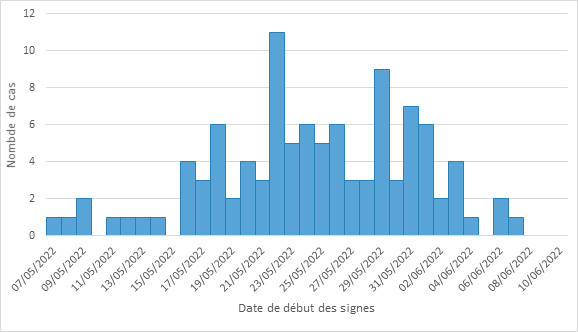
Among the investigated cases, 77% presented with a genitoanal rash, 76% with a rash on another part of the body, 68% with fever, 62% with lymphadenopathy, 14% with odynophagia, and 5% with a cough. Among the investigated cases, 7 are immunocompromised; none have died.
To date, as in other European countries, these cases have occurred predominantly, though not exclusively, among men who have sex with men (MSM), with no direct link to individuals returning from endemic areas. The majority of cases report having multiple sexual partners.
Most of the investigated cases report being unable to identify the person who infected them.
Finally, 9 of the investigated cases are secondary cases who were unvaccinated.
Among the investigated cases, 41 had traveled, stayed, or worked abroad before the onset of their symptoms, some of them in several different countries: 19 trips were reported to Spain, 7 to Belgium, 5 to Germany, 1 to Portugal, 1 to the United Kingdom, 1 to the Netherlands, 1 to Denmark, 1 to Luxembourg, 1 to India, 2 to Switzerland, 1 to the United States, 2 to Mali, and 1 to Colombia. These trips do not necessarily constitute the source of infection, and the list of countries cited may change as data is consolidated.
Given what has been observed regarding the disease in Europe, targeted communication was quickly implemented for MSM. The messages highlight transmission routes, symptoms, and what to do if symptoms appear. They are currently being shared digitally on the Sexosafe website dedicated to MSM and via social media. At the same time, on the ground, posters, flyers, and advice sheets have been distributed through community organizations, Regional Health Agencies (ARS), and Sexosafe teams working in the field. Prevention efforts will be adapted as the situation evolves.
Access the documents:
Monkeypox Info - Poster
Monkeypox Info - Flyer
Given the usual absence of monkeypox in Europe and the lack of reported links between identified cases and a high-risk area, the current European context constitutes an alert and suggests local transmission in Europe. This is why, in France, ongoing surveillance of monkeypox through the mandatory reporting system has been strengthened, and information and alert messages are being sent to healthcare professionals. Discussions are also continuing with other European countries, the WHO, and the ECDC.
What is monkeypox?
Monkeypox is an infectious disease caused by an Orthopoxvirus. This zoonotic disease is usually transmitted to humans in the forested areas of Central and West Africa by wild rodents or primates, but human-to-human transmission is also possible, particularly within households or in healthcare settings.
How is it transmitted?
The monkeypox virus can be transmitted through direct contact with the skin lesions or mucous membranes of an infected person, as well as through droplets (saliva, sneezing, spittle, etc.). Sexual intercourse, with or without penetration, creates conditions conducive to transmission, and having multiple partners increases the risk of exposure to the virus.
Transmission can also occur through contact with the patient’s environment (bedding, clothing, dishes, bath linens, etc.). It is therefore important for patients to remain in isolation for the entire duration of the illness (until the last scabs have fallen off, usually 3 weeks).
In Central or West Africa, humans can also become infected through contact with animals—wild or captive, dead or alive—such as rodents or monkeys.
Infection with the monkeypox virus is not classified as an STI, but direct contact with broken skin during sexual intercourse facilitates transmission.
What are the symptoms?
Infection with the monkeypox virus can cause a vesicular rash, consisting of fluid-filled blisters that dry out, form scabs, and eventually heal. Itching may occur. The blisters tend to concentrate on the face, the anogenital area, the palms of the hands, and the soles of the feet, though they may also appear on the trunk and limbs. The mucous membranes are also affected, particularly in the mouth and genital region. This rash may be accompanied by fever, headache, body aches, and fatigue. Lymph nodes may be swollen and tender under the jaw, in the neck, or in the groin. Sore throat has also been reported.
The incubation period for the disease can range from 5 to 21 days. The fever phase lasts about 1 to 3 days. The disease usually resolves spontaneously after 2 to 3 weeks, though sometimes it takes 4 weeks.
Is monkeypox serious?
The disease is more severe in children and in immunocompromised individuals. It can lead to complications such as secondary infections of the skin lesions or respiratory, digestive, ophthalmological, or neurological complications.
In Europe, and particularly in France, no deaths have been reported.
See previous updates:
Monkeypox cases: update as of June 9, 2022 (news from 06/09/22)
Monkeypox cases: update as of June 7, 2022 (news from 06/07/22)
Monkeypox cases: update as of June 3, 2022 (news from 06/03/22)
Monkeypox cases: update as of June 1, 2022 (news from 06/01/22)
Monkeypox cases: update as of May 30, 2022 (news from 05/30/22)
Monkeypox cases: update as of May 28, 2022 (news from 05/29/22)
Monkeypox cases: update as of May 27, 2022 (news from 05/27/22)
Monkeypox cases: update as of May 25, 2022 (news from 05/25/22)
Monkeypox cases: update as of May 24, 2022 (news from 05/24/22)
Monkeypox cases: update as of May 23, 2022 (news from 05/23/22)
First confirmed case of Monkeypox in France (press release dated 05/20/22)
European Monkeypox cases: enhanced surveillance implemented (news update from 05/19/22)
Smallpox B (Mpox)
thematic dossier
Smallpox B (Mpox), formerly known as monkeypox, is a rare viral infectious disease caused by the monkeypox virus and transmitted primarily from rodents to humans, and then from person to person,...












