



Monkeypox Cases: Update as of December 20, 2022
Update as of December 20, 2022, on confirmed cases of monkeypox reported in France and worldwide. The next update will be released on January 24, 2023.
In addition to cases biologically confirmed by PCR, this report includes biologically unconfirmed cases (probable and possible cases) to provide a more comprehensive picture of the epidemic at the national level. At the international level, and due to differences in surveillance protocols across countries, biologically confirmed cases remain the benchmark indicator for comparing epidemiological situations between countries.
Probable cases of Monkeypox virus infection (suggestive clinical signs + high-risk contact with a confirmed case) are not subject to systematic laboratory confirmation. In exceptional cases, diagnostic testing may not be performed for possible cases (suggestive clinical signs + exposure to a risk of infection) if the clinical signs are sufficiently suggestive and there is no other differential diagnosis or signs of severity.
In early May 2022, cases of monkeypox with no direct link to travel to Central or West Africa—where the virus is present—or to travelers returning from those regions were reported in Europe and around the world. Since then, the disease has been subject to enhanced surveillance in France and across Europe, based on mandatory reporting, for which the form has been specifically updated.
Situation Update in France
As of December 20, 2022, at 12:00 p.m., 4,967 cases of Monkeypox virus infection had been reported in France, including 4,114 (83%) biologically confirmed cases—an increase of 5 cases since the November 29 update—and 853 (17%) probable or possible cases, which are not biologically confirmed.
The distribution of cases by region of residence (or by region of reporting when the region of residence is unknown) is shown in Figures 1 and 2. The Île-de-France region has the highest number of cases (3,115, or 63.0%), followed by Auvergne-Rhône-Alpes (354 cases), Provence-Alpes-Côte d’Azur (330 cases), and Occitanie (327 cases); 27 cases reside abroad.
The vast majority of adult cases reported to date are male, and 2.9% are women over the age of 15 (142 cases, including 112 biologically confirmed cases and 30 unconfirmed cases). The proportion of female cases peaked in week 36 (19 out of 134 cases, or 14.2%) and then decreased to around 10% between weeks 37 and 40. This proportion subsequently increased again through week 46, but with a low and declining number of cases (1 case in week 46). The small sample size and the lack of information on possible transgender status among these female cases do not allow for conclusions regarding a potential change in the dynamics of virus transmission. No cases were reported in women between S47 and S50 (unconsolidated data).
The median age of adult cases is 36 years; 25% of cases are under 29 years old and 25% are between 43 and 81 years old.
Twenty-four children under 15 years of age (0.5% of total cases) have been reported since May 2022 (12 biologically confirmed cases and 12 unconfirmed cases).
Biologically unconfirmed cases have a profile similar to confirmed cases: 3.7% of adults are female (vs. 2.7% of confirmed adult cases), the median age of adults is 36 years, as in confirmed cases, and the majority reside in the Île-de-France region (72% vs. 61% of confirmed cases).
Among all cases for which information is available, 100 (3.2%) were hospitalized due to their Monkeypox infection; this proportion has remained stable over time.
No deaths have been reported to date.
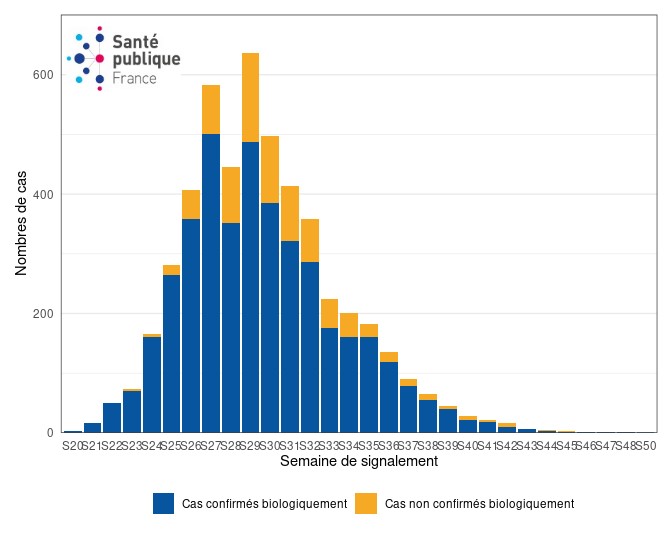
The distribution of cases by date of symptom onset (when known) and case type (biologically confirmed or not) is shown in Figure 3. The date of symptom onset for cases ranges from May 7 to December 10, 2022. Given reporting delays, data from the last few weeks are not yet consolidated. The reports received do not always mention the date of symptom onset. As an alternative to this information, the distribution of cases by date of reporting is presented in Figure 4.
The interpretation of the epidemic’s dynamics remains unchanged whether the analysis focuses solely on confirmed cases or on all cases (confirmed, probable, and possible). Since the peak in infections reached in late June/early July, the number of cases has fallen sharply, whether biologically confirmed or unconfirmed. To date, the weekly number of reported cases ranges from 1 to 2. Caution is nevertheless warranted, as improved knowledge of the disease may reduce healthcare-seeking behavior among better-informed populations.
This significant decline in the number of cases is also observed globally. The number of new global cases decreased by 49% in Week 50 compared to the previous week. The majority of cases in Week 50 were reported by countries in the Americas (91%) and the European region (5%).
Figure 1. Total monkeypox cases (n = 4,940) by region of residence (or by region of reporting when the region of residence is unknown), France, May–December 2022 (data as of December 20, 2022 – 12:00 p.m.)
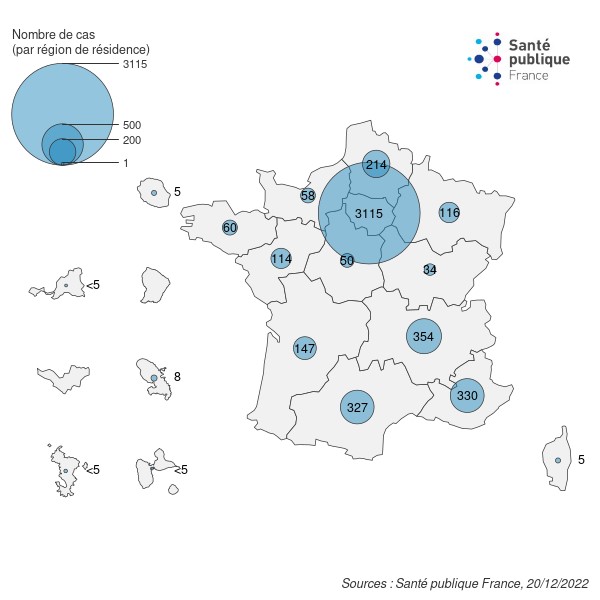
Figure 2. Biologically confirmed cases of monkeypox (n = 4,092) by region of residence (or by region of reporting when the region of residence is unknown), France, May–December 2022 (data as of December 20, 2022 – 12:00 p.m.)
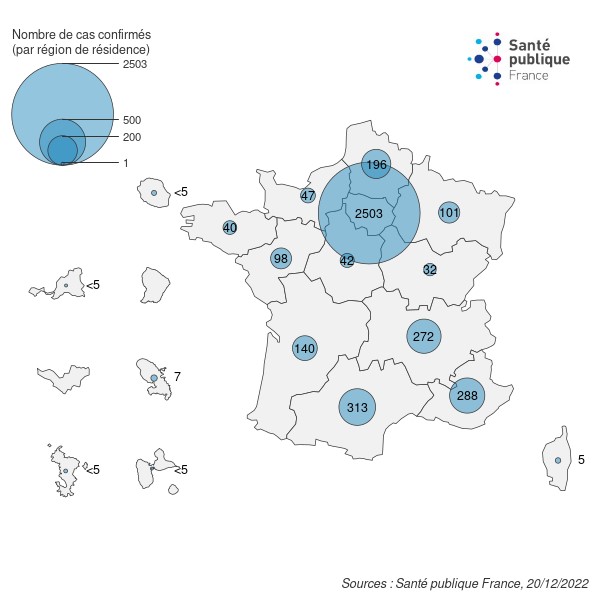
Figure 3. Monkeypox cases (n = 3,747 cases, number of missing data points = 1,220) by week of symptom onset and by case type (biologically confirmed or unconfirmed), France, May–December 2022 (data as of December 20, 2022 – 12:00 p.m.)
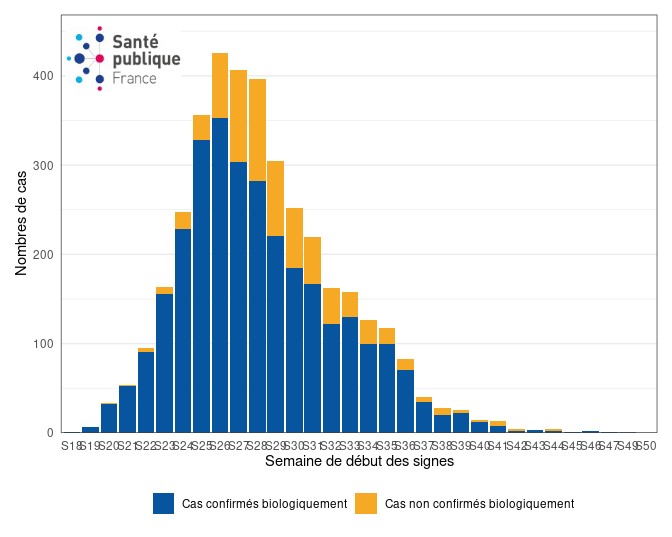
Figure 4. Monkeypox cases (n = 4,967) by week of reporting and by case type (biologically confirmed or unconfirmed), France, May–December 2022 (data as of December 20, 2022 – 12:00 p.m.).
Preventive vaccination against monkeypox
Regarding the rollout of the vaccination campaign, as of December 20, 2022, 175,052 doses of the third-generation vaccine had been delivered by the Agency to the territories.
As of December 19, 2022, the total number of doses administered is 141,049.
Since July 11, 2022, in addition to individuals who have had high-risk contact with an infected person, individuals meeting the criteria established by the HAS may schedule an appointment to get vaccinated throughout the country:
Men who have sex with men and report having multiple sexual partners.
Transgender individuals reporting multiple sexual partners.
Sex workers.
Professionals working in venues where sexual services are provided.
Vaccination may also be considered on a case-by-case basis for healthcare professionals who care for infected individuals.
To learn more about vaccination and access to vaccination sites:
Monkeypox Info Service: A helpline to answer questions about monkeypox
The “Monkeypox Info Service” hotline is available daily from 8 a.m. to 11 p.m. at the toll-free number 0 801 90 80 69 (free calls and services; anonymous and confidential). This service is responsible for supporting prevention messages and protective measures, providing information on symptoms, treatments, and vaccination, and offering advice and referrals to care services.
Since the hotline opened in mid-July, 8,468 calls have been handled by the Monkeypox Info Service:
81 calls were handled between November 28 and December 18 (compared to 64 during the previous two-week period).
The decline in the number of calls to the Monkeypox Info Service continues.
The number of inquiries from women has increased by 4 percentage points over the past three weeks, rising from 15% to 19%. Their concerns primarily relate to symptoms (60%) and their loved ones (33%).
Calls from those aged 40–54 have decreased slightly (23% vs. 27% in the previous two-week period), while those from people over 55 have increased (27% vs. 24% in the previous two-week period).
Prevention measures remain the most frequently discussed topic (49%). Symptoms, down 4 percentage points from the previous two weeks (19% vs. 23%), rank second, just ahead of testing, which is up 2 percentage points (18% vs. 16%).
Monkeypox Cases: Update as of November 29, 2022 (News from 11/29/22)
Monkeypox cases: update as of November 15, 2022 (news from 11/16/22)
Monkeypox cases: update as of November 1, 2022 (news from 11/03/22)
Monkeypox cases: update as of October 25, 2022 (news from 10/26/22)
Monkeypox cases: update as of October 18, 2022 (news from 10/19/22)
Monkeypox cases: update as of October 11, 2022 (news from 10/12/22)
Monkeypox cases: update as of October 4, 2022 (news from 10/05/22)
Monkeypox cases: update as of September 27, 2022 (news from 09/28/22)
Monkeypox cases: update as of September 22, 2022 (news from 09/23/22)
Monkeypox cases: update as of September 20, 2022 (news from 09/21/22)
Monkeypox cases: update as of September 15, 2022 (news from 09/16/22)
Monkeypox cases: update as of September 12, 2022 (news from 09/13/22)
Monkeypox cases: update as of September 8, 2022 (news from 09/09/22)
Monkeypox cases: update as of September 6, 2022 (news from 09/07/22)
Monkeypox cases: update as of September 1, 2022 (news from 09/02/22)
Monkeypox cases: update as of August 29, 2022 (news from 08/30/22)
Monkeypox cases: update as of August 23, 2022 (news from 08/25/22)
Monkeypox cases: update as of August 18, 2022 (news from 08/19/22)
Monkeypox cases: update as of August 16, 2022 (news from 08/17/22)
Monkeypox cases: update as of August 11, 2022 (news from 08/12/22)
Monkeypox cases: update as of August 9, 2022 (news from 08/10/22)
Monkeypox cases: update as of August 4, 2022 (news from 08/05/22)
Monkeypox cases: update as of August 2, 2022 (news from 08/03/22)
Monkeypox cases: update as of July 28, 2022 (news from 07/29/22)
Monkeypox cases: update as of July 26, 2022 (news from 07/27/22)
Monkeypox cases: update as of July 21, 2022 (news from 07/22/22)
Monkeypox cases: update as of July 19, 2022 (news from 07/20/22)
Monkeypox cases: update as of July 12, 2022 (news from 07/13/22)
Monkeypox cases: update as of July 7, 2022 (news from 07/08/22)
Monkeypox cases: update as of July 5, 2022 (news from 07/05/22)
Monkeypox cases: update as of June 30, 2022 (news from 06/30/22)
Monkeypox cases: update as of June 28, 2022 (news from 06/28/22)
Monkeypox cases: update as of June 23, 2022 (news from 06/23/22)
Monkeypox cases: update as of June 21, 2022 (news from 06/21/22)
Monkeypox cases: update as of June 16, 2022 (news from 06/16/22)
Monkeypox cases: update as of June 14, 2022 (news from 06/14/22)
Monkeypox cases: update as of June 9, 2022 (news from 06/09/22)
Monkeypox cases: update as of June 7, 2022 (news from 06/07/22)
Monkeypox cases: update as of June 3, 2022 (news from 06/03/22)
Monkeypox cases: update as of June 1, 2022 (news from 06/01/22)
Monkeypox cases: update as of May 30, 2022 (news from 05/30/22)
Monkeypox cases: update as of May 28, 2022 (news from 05/29/22)
Monkeypox cases: update as of May 27, 2022 (news from 05/27/22)
Monkeypox cases: update as of May 25, 2022 (news from 05/25/22)
Monkeypox cases: update as of May 24, 2022 (news from 05/24/22)
Monkeypox cases: update as of May 23, 2022 (news from 05/23/22)
First confirmed case of Monkeypox in France (press release dated 05/20/22)
European Monkeypox cases: enhanced surveillance implemented (news update from 05/19/22)
In the region
Smallpox B (Mpox)
thematic dossier
Smallpox B (Mpox), formerly known as monkeypox, is a rare viral infectious disease caused by the monkeypox virus and transmitted primarily from rodents to humans, and then from person to person,...












