Monkeypox Cases: Update as of September 8, 2022

Update as of September 8, 2022, following reports of monkeypox cases in France and around the world.

In early May 2022, cases of monkeypox with no direct link to travel to Central or West Africa—where the virus is present—or to people returning from such trips were reported in Europe and around the world. Since then, the disease has been subject to enhanced surveillance in both France and Europe.

Information: Updates to the mandatory Cerfa reporting form and guidelines for handling monkeypox cases (learn more)

Situation Update in France

As of September 8, 2022, at 12:00 p.m., 3,785 confirmed cases of locally acquired Monkeypox infections had been reported in France. The breakdown of cases by region of residence (or by region of reporting when the region of residence is unknown) is as follows: 2,311 in Île-de-France, 305 in Occitanie, 257 in Provence-Alpes-Côte d’Azur, 244 in Auvergne-Rhône-Alpes, 182 in Hauts-de-France, 135 in Nouvelle-Aquitaine, 92 in Grand Est, 80 in Pays de la Loire, 44 in Normandy, 37 in Centre-Val de Loire, 37 in Brittany, 29 in Bourgogne-Franche-Comté, and 7 in Martinique. For Corsica, Guadeloupe, Mayotte, and Saint Martin, each of these regions reported fewer than 5 cases. 20 cases reside abroad.

The vast majority of confirmed adult cases recorded to date are male, and 73 cases (1.9%) are female. Nine children under the age of 15 have been reported. Adult cases have a median age of 36; 25% of adult cases are under 29 years old, and 25% are between 43 and 81 years old.

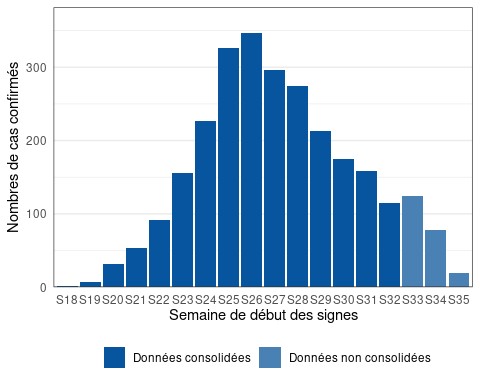
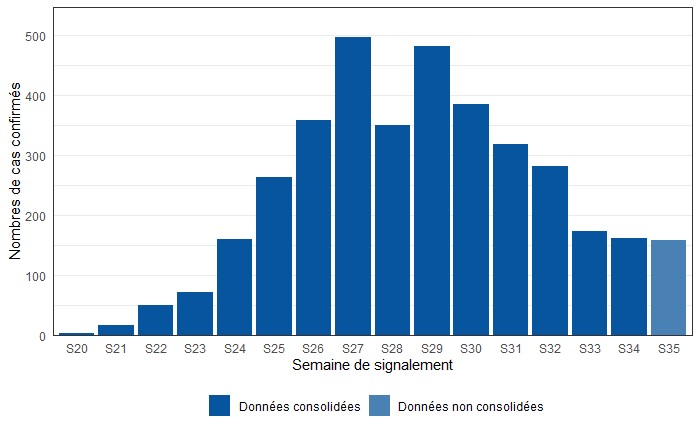
The distribution of cases by date of symptom onset (when known) is shown in Figure 1. Due to reporting delays, data from the past few weeks are not consolidated. Reports received do not always include the date of symptom onset. As an alternative to this information, the distribution of cases by date of reporting is shown in Figure 2.

Figure 1. Confirmed cases of monkeypox (n=2,693 cases, number of missing data points: 1,092) by week of symptom onset, France, May–September 2022 (data as of September 8, 2022 – 12:00 p.m.).

Figure 1. Cas confirmés de variole du singe (n=2 693 cas, nombre de données manquantes : 1 092) par semaine de début des symptômes, France, mai-septembre 2022 (données au 08/09/2022 – 12h00).
The data for the past few weeks (in light blue) is not yet fully finalized.

Figure 2. Confirmed cases of monkeypox (n=3,785 cases) by week of reporting, France, May–September 2022 (data as of September 8, 2022 – 12:00 p.m.).

Figure 2. Cas confirmés de variole du singe (n=3 785 cas) par semaine de signalement, France, mai-septembre 2022 (données au 08/09/2022 – 12h00).
The data for the past week (in light blue) is not yet fully consolidated.

Information and Prevention Initiatives

Given what has been observed in Europe regarding the disease, targeted communication was quickly implemented for MSM. The website sexosafe.fr, dedicated to the sexual health of MSM, is regularly updated with a summary of current knowledge on the subject and prevention measures. Poster, radio, and digital campaigns provide information to the public, complementing on-the-ground efforts. Since June 17, the digital campaign has generated nearly 862,335 clicks on banners and over 770,623 visits to the Sexosafe website.

All information on vaccination is updated weekly on the page for the general public and the page for healthcare professionals (accessible without a login) on the Vaccination-info-service website.

Prevention efforts are continuously adapted to the evolving situation and the current state of knowledge.

To facilitate access to information for vulnerable people in precarious situations, a visual tool, translated into 6 languages and developed with professionals working with these individuals, is available on Santé Publique France

The MOBCO Newsletter No. 7, developed in collaboration with frontline workers, compiles a series of questions and answers on the topic of monkeypox. It is intended for professionals or volunteers in contact with people in precarious situations.

In France, ongoing surveillance of monkeypox through the mandatory reporting system has been strengthened, and information and alert messages are being sent to healthcare professionals. Discussions are also continuing with other European countries, the WHO, and the ECDC.


Monkeypox Info Service: A helpline to answer questions about monkeypox

The “Monkeypox Info Service” hotline is available daily from 8 a.m. to 11 p.m. at the toll-free number 0 801 90 80 69 (free calls and services; anonymous and confidential). This service is responsible for supporting prevention messages and protective measures, providing information on symptoms, treatments, and vaccination, and offering advice and referrals to care services.

Since the hotline opened in mid-July, 7,332 calls have been handled by the Monkeypox Info Service.

Preventive Vaccination Against Monkeypox

In response to the spread of the Monkeypox virus, the High Authority for Health, following a referral from the Directorate General for Health, recommended in its opinion dated July 7, 2022, that preventive vaccination be offered to groups most at risk of exposure to the virus.

Regarding the rollout of the vaccination, as of September 8, 2022, 152,732 doses of the third-generation vaccine had been delivered by the Agency to the regions. Deliveries are primarily made on a weekly basis.

As of September 7, 2022, the total number of doses administered was 84,740 (source: Ministry of Health and Prevention).

Since July 11, 2022, in addition to individuals who have had high-risk contact with an infected person, individuals meeting the criteria established by the HAS may schedule an appointment to be vaccinated throughout the country:

  • men who have sex with men and report having multiple sexual partners;

  • transgender individuals reporting multiple sexual partners;

  • sex workers;

  • professionals working in venues where sexual services are provided.

Vaccination may also be considered on a case-by-case basis for healthcare professionals who care for infected individuals.

To learn more about vaccination and access to vaccination sites:

Information: Updates to the mandatory Cerfa reporting form and guidelines for handling monkeypox cases

Cerfa form

Monkeypox is a notifiable disease (orthopoxviruses) and must be reported by physicians and heads of clinical laboratories to the regional health agency. To address the current Monkeypox outbreak and surveillance needs, the mandatory reporting Cerfa form has been updated.

The form now includes:

  • the reasons and any complications that led to hospitalization

  • the nature of the link to the index case(s): family, friends, work, healthcare setting, or sexual

  • any history of preventive vaccination

  • any history of infection

  • rapid diagnostic tests (TROD) and serology among biological confirmation methods, as a precaution

Recommended actions

As data collected through mandatory reporting evolves, the guidelines for managing Monkeypox cases issued by Santé publique France and the Ministry of Health and Prevention now include the following updates:

  • Revision of the recommended actions for at-risk contacts

  • clarification on investigations involving female and pediatric cases, and cases occurring in a community comprising vulnerable individuals or those at risk of severe disease

  • changes to data collection regarding cases

Smallpox B (Mpox)

thematic dossier

Smallpox B (Mpox), formerly known as monkeypox, is a rare viral infectious disease caused by the monkeypox virus and transmitted primarily from rodents to humans, and then from person to person,...

Safe Sex

HIV and STI prevention, testing, and sexual orientation—the Sexosafe website addresses issues related to sexuality among men.