



Data
Incidence and mortality rates have been declining since the 1990s
In mainland France, cervical cancer is the 11th most common cancer among women.
An estimated 3,159 new cases are projected for 2023
Three-quarters of cases occur in women aged 25–64
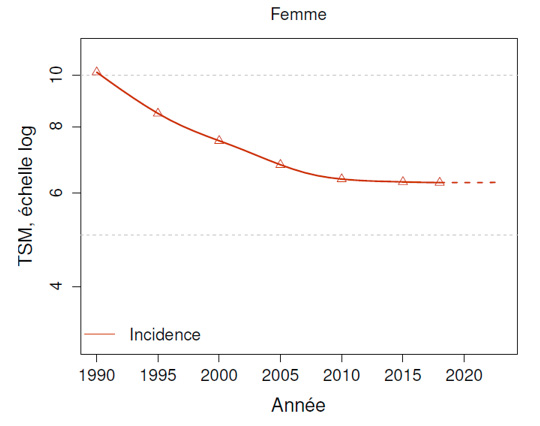
The incidence rate (world-standardized) is 6.3 per 100,000 women in 2023
It has decreased significantly since 1990 (by an average of 1.4% per year); the rate has been stable since 2010
Incidence rate of cervical cancer in mainland France between 1990 and 2023 (World Standardized Rate) – Logarithmic scale
Download

article
30 June 2023
Incidence of the most common cancers in mainland France in 2023 and trends since 1990
This study examines the incidence of the 19 most common cancers, including cervical cancer, as well as the incidence of all cancers.
For information on the incidence of other types of cancer and cancer mortality, please refer to the report on National Estimates of Cancer Incidence and Mortality in Metropolitan France between 1990 and 2018.
In metropolitan France, cervical cancer is the 12th leading cause of cancer-related death among women
1,117 deaths were recorded in 2018;
Half of the deaths occur in women aged 25–64;
The mortality rate (world-standardized rate) was 1.7 per 100,000 women in 2018. It has declined sharply since 1990 (by an average of 2.1% per year), although this decline has slowed since the early 2000s.
Learn more

rapport/synthèse
18 September 2019
National Estimates of Cancer Incidence and Mortality in Metropolitan France, 1990–2018 - Volume 1: Solid Tumors: A Study Based on Cancer Registries from the Francim Network
In the European Union, an estimated 32,700 new cases and 14,200 deaths were reported in 2018. France has the 8th lowest incidence rate, behind Spain, the Netherlands, and Finland, among others, as well as the 15th lowest mortality rate.
Globally, an estimated 570,000 new cases and 266,000 deaths occurred in 2018. The highest incidence and mortality rates (world-standardized rates) are observed in Africa and Melanesia, and the lowest in Australia/New Zealand and Western Asia. Western Europe also has one of the lowest mortality rates in the world.
Geographical Heterogeneity in Incidence
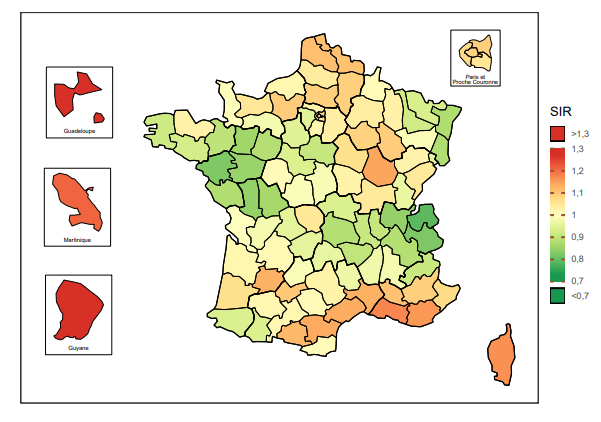
In metropolitan France, there is geographical heterogeneity in cervical cancer incidence across departments. An excess incidence exceeding 10% compared to the national average is observed along the Mediterranean coast (Bouches-du-Rhône, Var, Gard, Hérault) and in Côte d’Or. The incidence is generally below the national average in the Pays de la Loire region (Loire-Atlantique, Maine-et-Loire, Mayenne) and in Auvergne-Rhône-Alpes (Haute-Savoie, Savoie, Ain, Isère). In total, 10 departments have an estimated incidence at least 10% below the national average.
An excess incidence is also observed in France’s overseas regions, particularly pronounced in French Guiana.
Regional and departmental estimates of incidence and mortality can be viewed here.
Smoothed standardized incidence ratios (SIR) by department in mainland France (2007–2016), and observed incidence rates in Guadeloupe (2008–2014), Martinique (2007–2014), and French Guiana (2010–2014)
A 5-year survival rate that tends to decline over time
More than 6 in 10 women (net survival: 63%) diagnosed in France with cervical cancer survive their cancer after 5 years (women diagnosed in 2010–2015). Survival is highest among younger women: nearly 9 out of 10 women (88%) aged 30 at diagnosis survive their cancer after 5 years, compared to fewer than 4 out of 10 women (37%) for those diagnosed at age 80 (2010–2015).
Five-year survival rates tend to decline over time (from 66% in 1990 to 62% in 2015). This decline is most pronounced among women over 60 at diagnosis, whereas among younger women, net five-year survival is improving.
The primary goal of organized cervical cancer screening is to diagnose and treat precancerous lesions and prevent their progression to invasive cancer, thereby reducing the number of invasive cancers. Screening also allows for the detection of cancers at an early, curable stage and improves the chances of recovery. This should result in improved survival, which is observed among women under 50 but not among older women. Screening appears to have a paradoxical effect on survival due to a selection bias. Indeed, due to the decrease in the number of invasive cancers diagnosed, the proportion of cancers diagnosed at advanced stages—or aggressive cancers with a poorer prognosis—is likely to increase over time, particularly among older women, who receive less gynecological follow-up after menopause and are therefore more often undiagnosed and diagnosed at advanced stages.

enquêtes/études
14 October 2021
Cancer Survival in Metropolitan France, 1989–2018 – Summary of Results: Solid Tumors and Malignant Hematologic Diseases
enquêtes/études
20 October 2021
Survival of People with Cancer in Metropolitan France, 1989–2018—Materials and Methods
enquêtes/études
9 June 2021
Survival Rates for People with Cancer in Metropolitan France, 1989–2018 - Cervical Cancer
Survival Rates in the Overseas Departments and Regions
Survival rates for women with cervical cancer were estimated using data from the general cancer registries of Guadeloupe, Martinique, and Réunion.
The 5-year net survival rate is estimated at 57% for Guadeloupe, 59% for Martinique, and 62% for Réunion among women diagnosed between 2008 and 2015. It does not differ from the estimated survival rate for mainland France (63%).
Prevalence of cervical cancer
The 5-year partial prevalence of cervical cancer is estimated at approximately 11,000 women in 2017. This figure represents individuals diagnosed over the past five years, whether they are in complete remission, cured, or under ongoing surveillance.
Learn more

HPV vaccination coverage is very low
Vaccination against human papillomavirus (HPV) infections has been recommended in France since 2007, primarily for young girls. Since January 1, 2021, the recommendations have also applied to all boys. When administered before the onset of sexual activity, the vaccine is nearly 100% effective at preventing infection with the HPV types included in the vaccine.
HPV vaccination coverage among adolescent girls has been increasing for several years but remains insufficient. In 2020, it was estimated at 41% for a single dose at age 15 (vs. 35% in 2019) and 33% for the full series at age 16 (vs. 28% in 2019).
Low Participation in the National Cervical Cancer Screening Program
View regional and departmental indicators for the screening program for the year 2024 and their trends since 2017.
Estimates of cervical cancer screening coverage, based on data from the Health Insurance system, indicate a standardized national participation rate of 60.9% among the target population for the year 2024. These data are available in Odissé by age group and by region.


bulletin national
13 November 2025
Participation in the organized cervical cancer screening program. Year 2024 and trends since 2017.
In relation to

Human papillomavirus infections
thematic dossier
Human papillomavirus (HPV) infection is a sexually transmitted infection caused by the human papillomavirus (HPV). The infection is usually asymptomatic and clears up within a few months. In some...












