



The disease
A cancer caused by the sexually transmitted HPV virus
Each year, nearly 3,000 women develop cervical cancer, and 1,000 women die from it.
In the vast majority of cases, cervical cancer is caused by a persistent infection with a high-risk human papillomavirus (HPV), a very common infection transmitted through sexual contact.
There are 12 HPV genotypes (known as high-risk) for which carcinogenesis has been established, and a 13th genotype considered a probable carcinogen. The genotypes most frequently associated with cervical cancer are HPV 16 and 18.
A persistent infection with high-risk HPV is a necessary but not sufficient condition for the development of cervical cancer. Other risk factors may act in conjunction with HPV: tobacco use, HIV infection, long-term use of oral contraceptives, and having had multiple pregnancies.
A Preventable Cancer
Cervical cancer can be prevented through two complementary interventions: HPV vaccination (primary prevention) and screening, which allows for the detection of precancerous lesions and their treatment before they develop into cancer (secondary prevention).
Key Statistics on Cervical Cancer
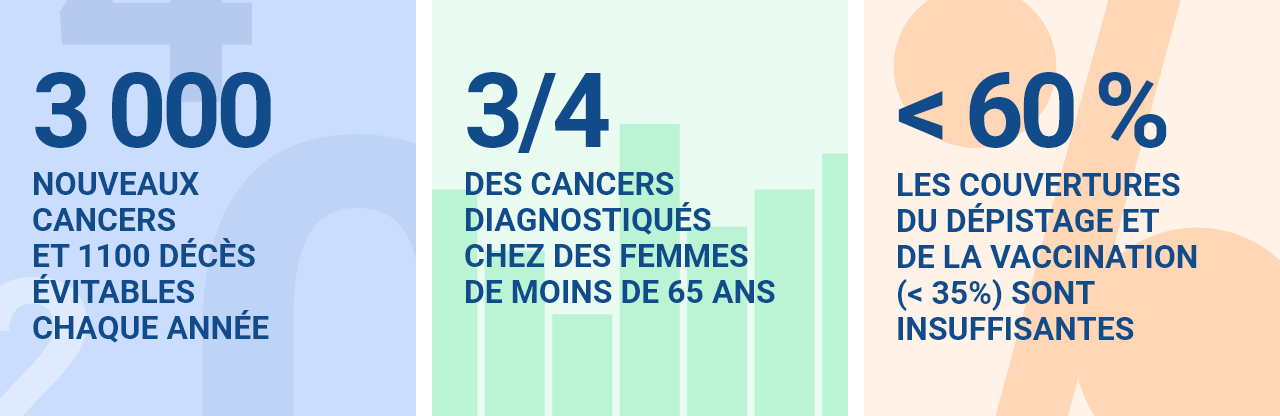
Key figures provided by the agency and its partners:
(Francim Cancer Registry Network, Hospices Civils de Lyon, National Cancer Institute, Regional Cancer Screening Coordination Centers)
Incidence |
Mortality |
Prevalence |
Prevention: vaccination and screening |
|
3,159 new cases per year |
1,117 deaths per year |
63% at 5 years |
11,000 cases diagnosed in the last 5 years and still alive |
33% of 16-year-old girls vaccinated with the HPV vaccine |
France as a whole, | ||||
58.8% of women aged 25–65 screened over 3 years | ||||
Metropolitan France, |
Metropolitan France, |
Metropolitan registry area, diagnosed cases, |
Metropolitan France, |
All of France, 2018–2020 |
In relation to

Human papillomavirus infections
thematic dossier
Human papillomavirus (HPV) infection is a sexually transmitted infection caused by the human papillomavirus (HPV). The infection is usually asymptomatic and clears up within a few months. In some...












