




Data
The hypertension surveillance system established by Santé publique France makes it possible to study epidemiological trends in hypertension.
16 Key Statistics on High Blood Pressure in France
1 in 3 adults has high blood pressure.
1 in 2 people with high blood pressure does not know they have it.
17 million people over the age of 18 have hypertension in France.
22% of untreated people with high blood pressure have stage 2 or 3 hypertension.
Care: 10 visits per year to a primary care physician for people with high blood pressure.
1 in 2 people with high blood pressure is treated with medication.
1.6 million French people start anti-hypertension treatment each year.
60% of patients with hypertension receiving pharmacological treatment were on monotherapy.
93% of patients expressed reservations when an antihypertensive treatment was prescribed.
57% of patients with hypertension report not having received lifestyle or dietary advice in the past year.
1 in 4 people with hypertension has their blood pressure under control.
Average blood pressure: 126/77 mm Hg (average for the French population).
84% of the population had their blood pressure measured within the past year.
11% of people with hypertension are followed by a cardiologist.
40% of treated hypertensive patients adhere to their treatment.
59% of people with hypertension who are receiving treatment own a home blood pressure monitor.
Higher prevalence among men regardless of age
In 2015, the Esteban survey estimated the prevalence of hypertension in France.
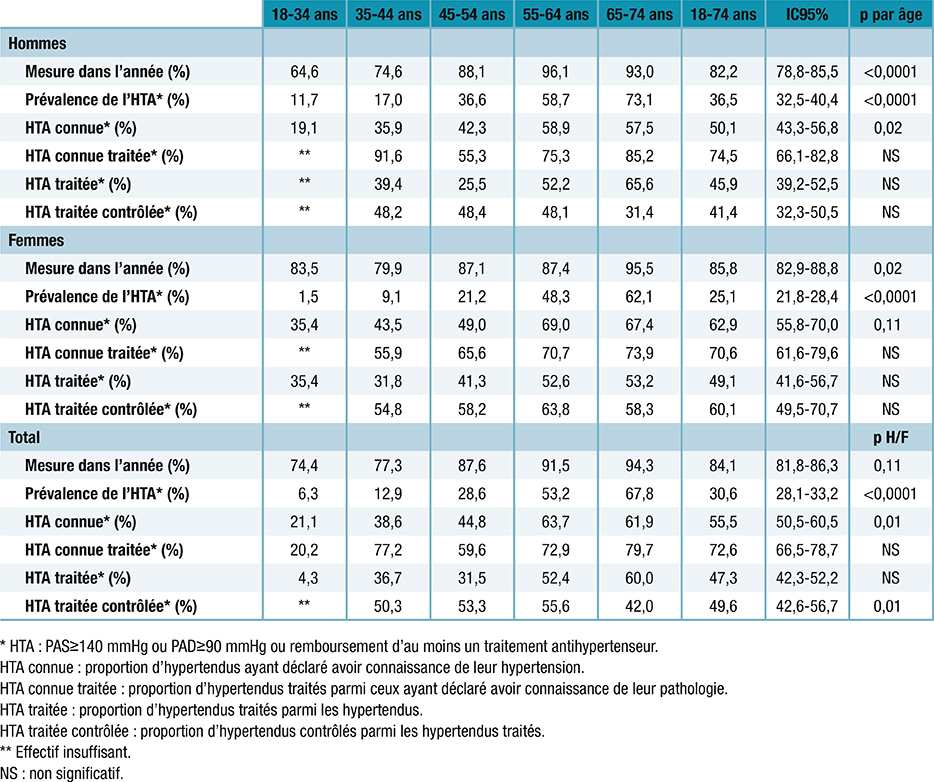
Thus, the prevalence of hypertension, defined as a systolic blood pressure (SBP) ≥140 mmHg and/or a diastolic blood pressure (DBP) ≥90 mmHg or reimbursement for at least one antihypertensive medication, was 30.6% (36.5% among men and 25.1% among women, p=0.0001). It increased significantly with age, rising from 6.3% among those aged 18–34 to 67.8% among those aged 65–74. Men had a higher prevalence of hypertension than women in all age groups.
Furthermore, among those with hypertension, only 1 in 2 was aware of their condition (55%). This proportion was higher among women (62.9%) than among men (50.1%).
Prevalence of Hypertension, Treatment, and Control: Esteban 2015
The prevalence of hypertension has remained stable since 2006, but the proportion of people receiving treatment has declined
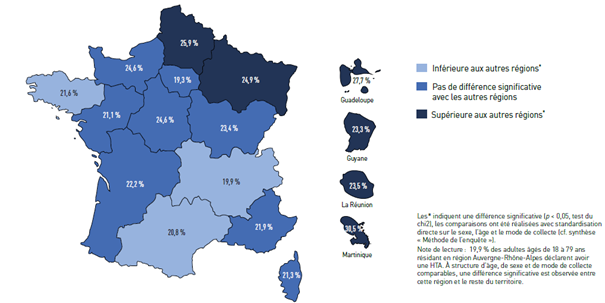
While the prevalence of hypertension has not changed since the ENNS survey (30.6% vs. 31%), the proportion of people with known hypertension receiving treatment decreased significantly between the two studies (72.6% vs. 82.0% in the ENNS survey). This decrease was entirely attributable to women, among whom the proportion of people with known hypertension receiving treatment fell from 86.6% in the ENNS survey to 70.7% in the Esteban survey. Similarly, the proportion of women with treated hypertension (regardless of awareness of the condition) decreased significantly between 2006 and 2015, particularly among older women (65–74 years) (53.2% vs. 72.3% in the ENNS survey). Among men, the proportion of individuals with treated hypertension did not change significantly between the two surveys (45.9% vs. 45.4% in the ENNS survey).
Changes in awareness (a) and the proportion of hypertension (HTN) that is treated and controlled (b) among people with hypertension between the ENNS 2006 and Esteban 2015 surveys, by sex
Prevalence of Self-Reported Hypertension: Significant Regional and Social Disparities
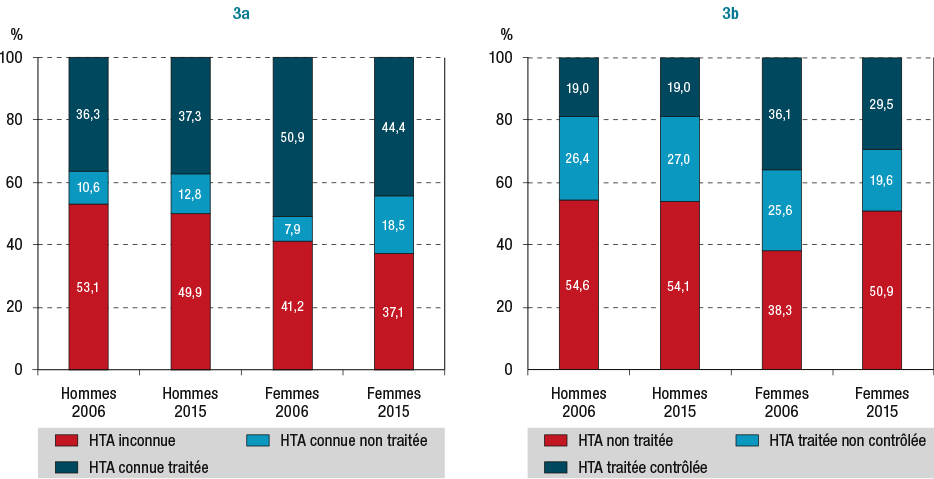
Results from the 2024 Santé publique France Health Barometer, conducted in mainland France and the overseas departments and regions (DROM) excluding Mayotte, show that among adults aged 18 to 79, one in five reports having high blood pressure. This proportion increases gradually with age, ranging from 4.3% among 18- to 29-year-olds to more than half of adults aged 70 to 79. The proportion of reported hypertension is marked by a strong socioeconomic gradient. It is twice as high among adults without a degree as among those with a higher education degree.
Disparities by socio-professional category are observed only among women, among whom 16% of managers and professionals report having high blood pressure, compared to 29% of manual workers. In mainland France, the Hauts-de-France and Grand Est regions have a prevalence of reported hypertension higher than the national average. This prevalence is also higher in the overseas departments and regions (DROM), particularly in Martinique and Guadeloupe, where it reaches 30% of adults.
Percentage of adults aged 18–79 reporting high blood pressure by region, Santé publique France Health Barometer, 2024
Among adults who report having high blood pressure, one in four reports not having taken any antihypertensive medication in the past 12 months.
Significant consequences
High blood pressure (HBP) remains very common in France, with rates of awareness, treatment, and control still insufficient. This epidemiological situation leads to numerous cardiovascular, cerebrovascular, and renal complications and highlights the significant burden of HBP in France.
Thus, it was estimated in 2021 that 36% of hospitalizations for cardiovascular, cerebrovascular, or renal diseases were attributable to HTN, representing nearly 400,000 inpatient stays and 6.2 million hospital days (including inpatient stays, outpatient visits, and dialysis sessions). The burden was particularly high among men and people aged 55 to 74.
Hypertension is also responsible for chronic complications:
1.15 million people were living with ischemic heart disease attributable to hypertension (2.9% of the population over 35)
1.26 million with chronic kidney disease attributable to hypertension (3.2% of those over 35)
358,000 with heart failure attributable to hypertension (0.9% of those over 35)
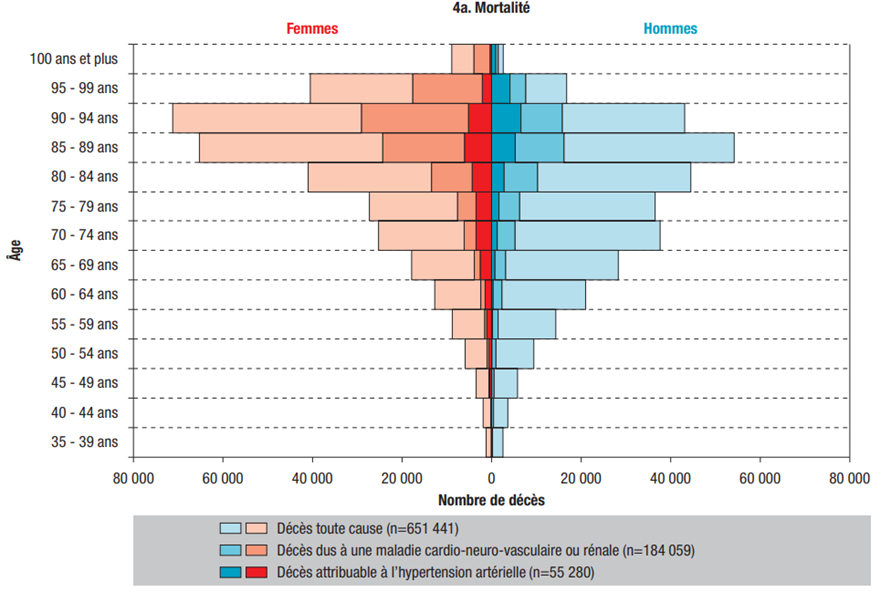
Finally, in 2021, hypertension was responsible for more than 55,000 deaths—8.5% of all deaths in France—and nearly 500,000 years of life lost.
Deaths attributable to high blood pressure, France, 2021
Years of life lost due to high blood pressure, France, 2021
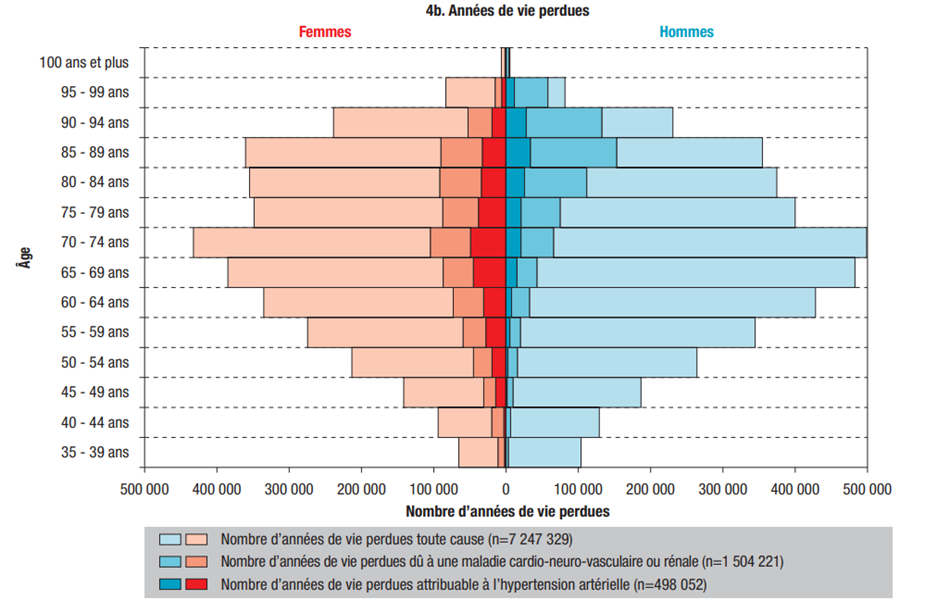
Figures from the BEH Grave C, Bonaldi C, Carcaillon-Bentata L, Gabet A, Halimi JM, Tzourio C, et al. The burden of hypertension in France in 2021. Bull Epidemiol Hebd. 2025;(12):196-206.
Hypertensive disorders of pregnancy
Hypertensive disorders of pregnancy, particularly preeclampsia and eclampsia, remain one of the leading causes of maternal and fetal morbidity and mortality.
The Conception study, based on data from the National Health Data System (SNDS), provided new French data on the epidemiology of these disorders and the burden they impose. Of the 6 million pregnancies studied between 2010 and 2018, 7% were affected by a hypertensive disorder, representing approximately 62,000 pregnancies per year. Pre-existing
chronic hypertension (HTN), gestational hypertension, and preeclampsia affected 1.7%, 4.2%, and 2% of pregnancies, respectively, with prevalence increasing significantly with maternal age. Regarding preeclampsia, which is the most feared hypertensive disorder, nearly 20% of cases occurred early, that is, before 34 weeks of amenorrhea, and 40% of preeclampsia cases were severe.
Women who have developed a pregnancy-related hypertensive disorder are at higher risk of developing chronic hypertension, diabetes, or cardiovascular, cerebrovascular, or renal diseases starting in the first few years following pregnancy and throughout their lives. This risk is further increased when preeclampsia was early-onset or severe.
In relation to

Alcohol
thematic dossier
Alcohol is deeply rooted in French culture. Its consumption remains a major cause of death and illness in France.

Nutrition and Physical Activity
thematic dossier
Nutrition and physical activity are two major determinants of health that contribute to improving the health of the population and are key priorities in public health policy.

Tobacco
thematic dossier
Despite a slight decrease compared to 2015, tobacco remains responsible for more than 68,000 premature deaths in 2023—accounting for 11% of total mortality—making it still the leading cause of...











