



Data
In this article
- Skin cancers: rising incidence and prevalence
- A steadily rising incidence of skin melanoma and a relatively stable mortality rate
- Geographical Variation in the Incidence and Mortality of Skin Melanoma
- Skin melanomas and social inequalities
- A 5-year survival rate that tends to decline over time, with prospects for improvement
- Prevalence of skin melanoma
- The significance of known risk factors
Skin Cancers: Rising Incidence and Prevalence
If the incidence observed locally (Doubs, Haut-Rhin) were extrapolated to mainland France, between 127,200 and 226,500 new cases of non-melanoma skin cancer would be diagnosed in 2018. All skin cancers combined would account for between 141,000 and 243,500 new cases, making them the leading cause of cancer in mainland France and representing nearly 30% of newly diagnosed invasive cancers per year, as observed in Europe and other developed countries.
Learn more:
A steadily rising incidence of skin melanoma and a relatively stable mortality rate
Skin melanomas rank among the 10 most common cancers
In mainland France, with nearly 17,900 new cases in 2023 and 1,975 deaths in 2018, skin melanoma is one of the 10 most common cancers (6th among men and 4th among women in 2023) in terms of incidence:
Skin melanomas are very rare among children under 15 years of age.
Skin melanoma is one of the most common cancers among people aged 20 to 50 for both sexes: it is the third leading cause of cancer among young adults aged 20–24 and the second leading cause among those aged 40–44.
Between 1990 and 2023, the number of new cases of skin melanoma per year increased 5.4-fold among men and 3.4-fold among women.
Incidence rate of skin melanoma in mainland France by year (WSR, World Standardized Rate) – Logarithmic scale
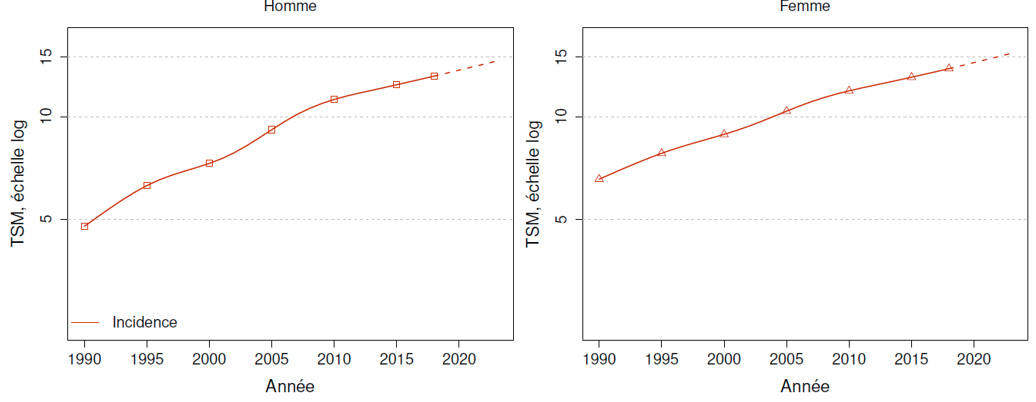
Within the European Union, France ranks 13th among the countries with the highest incidence of skin melanoma. In Europe, in the few cancer registries where all skin cancers are recorded, they represent the most common cancers in terms of both incidence and prevalence. There were 16,744 new cases of melanoma and 155,985 new cases of non-melanoma skin cancer (NMSC) per year in 2016–2018 [UKCancer, 2023] in the United Kingdom and 22,890 new cases of MC and 199,430 new cases of NMSC in 2018 in Germany [Zentrum für Krebsregisterdaten, 2021]. Skin cancers are the leading cause of new cancer cases in these countries, and cutaneous melanomas account for nearly 11% of skin cancers there.
Worldwide, nearly 1.2 million cases of non-melanoma skin cancer (excluding basal cell carcinomas) and 325,000 cases of cutaneous melanoma occurred in 2020. The number of deaths is estimated at approximately 63,000 for non-melanoma skin cancers and 57,000 for skin melanomas [Globocan 2020].
The study below covers the incidence of the 19 most common cancers (17 solid tumors and 2 malignant hematological diseases) and all cancers. For the incidence of other cancer sites and cancer mortality, see the report on national estimates of cancer incidence and mortality in metropolitan France between 1990 and 2018.
Learn more: Incidence of the most common cancers in metropolitan France in 2023 and trends since 1990
See also:
Geographical Variations in the Incidence and Mortality of Cutaneous Melanoma
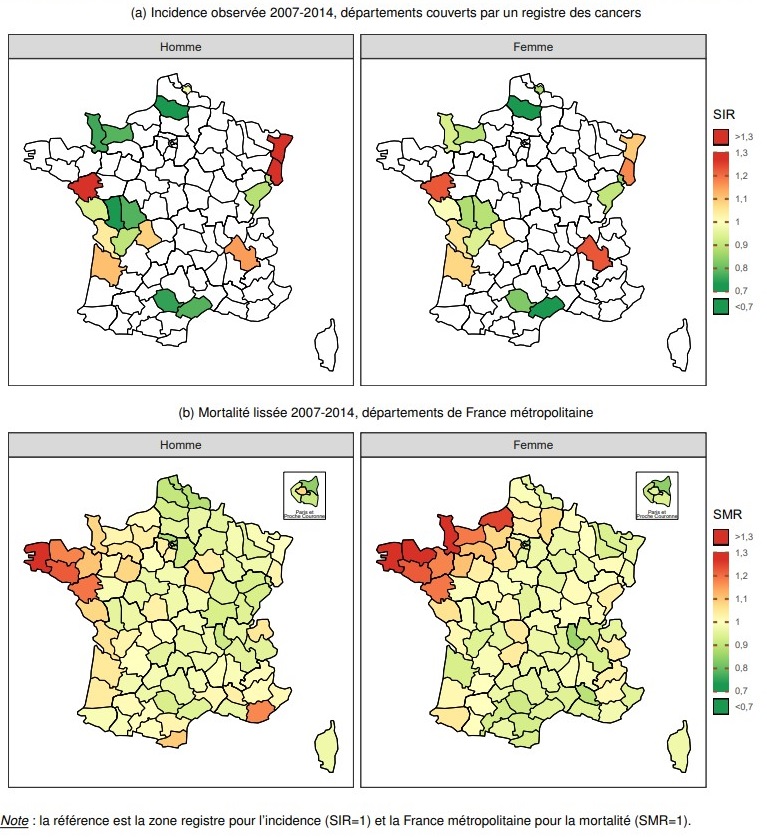
In metropolitan France, there are regional disparities in the incidence of skin melanoma, with higher rates in the departments of Alsace, Loire-Atlantique, and Isère.
It should be noted that, to date, it is not possible to estimate the incidence of skin melanoma for departments not covered by a cancer registry.
Regarding mortality, significant variation in skin melanoma mortality is observed across departments. Excess mortality exceeding 10% compared to the national average is observed in the Northwest among women in 8 departments (Côtes d’Armor, Finistère, Manche, Seine-Maritime, Morbihan, Loire-Atlantique, Calvados, Ille-et-Vilaine). Among men, excess mortality exceeding 10% is observed in 5 departments (Finistère, Morbihan, Loire-Atlantique, Côtes d’Armor, Var), most of which are located on the western coast of the country. Mortality rates at least 10% below the national average are observed in the Rhône department for women, in the Nord and Val-d’Oise departments for men, and in Seine-Saint-Denis for both sexes.
Regional and departmental estimates of cancer incidence and mortality can be viewed here.
Standardized incidence ratios (SIR) and mortality ratios (SMR) for cutaneous melanoma
See also

dossier thématique
Regional and departmental estimates of cancer incidence and mortality in France, 2007–2016
Skin melanomas marked by social inequalities
Analyses of incidence based on social deprivation factors conducted in 2016 for the period 2006–2009 reveal a social gradient, with a higher incidence among the most affluent populations, among both men and women.
Mortality is also higher among the most affluent populations, for reasons that remain difficult to explain (a combined effect of exposure prevalence, a higher incidence of primary invasive tumors, etc.).
Regarding survival, excess mortality from skin melanoma is observed among men, with an excess up to twice as high among those in the most disadvantaged areas.

article
11 May 2021
The Influence of the Social Environment on the Survival of Cancer Patients in France: A Study by the Francim Network
A 5-year survival rate that tends to decline over time, with prospects for improvement
More than 9 out of 10 patients diagnosed with cutaneous melanoma between 2010 and 2015 survive their cancer after 1 year (net survival of 97% for men and 99% for women) or after 5 years (net survival of 89% for men and 93% for women).
For those over 60, the 5-year net survival rate decreases with age at diagnosis, falling from 92% for men aged 60 to 85% for those aged 80, and from 95% for women aged 60 to 87% for those aged 80.
Five-year survival has improved over time, rising from 82% for those diagnosed in 1990 to 93% for those diagnosed in 2015.

enquêtes/études
14 October 2021
Cancer Survival in Metropolitan France, 1989–2018 – Summary of Results: Solid Tumors and Malignant Hematologic Diseases
enquêtes/études
20 October 2021
Survival of People with Cancer in Metropolitan France, 1989–2018—Materials and Methods
enquêtes/études
23 August 2021
Survival Rates for People with Cancer in Metropolitan France, 1989–2018 - Skin Melanoma
Prevalence of Skin Melanomas
The latest publication reports a 5-year partial prevalence* of 66,000 people (including 33,000 men and 33,000 women) and a 15-year prevalence** of 139,000 people (including 65,000 men and 74,000 women) in 2017. The observed prevalence rates increased between 2010 and 2017, primarily due to rising incidence and stable survival rates.
Furthermore, INCa has developed an algorithm for identifying cases of cancers treated in hospitals. Using this algorithm, it was determined that in 2011, primary skin cancers ranked 10th among all cancers, with 163,747 patients (representing 2.6% of total hospital stays, including both hospitalizations and outpatient visits), of which 46,968 were cutaneous melanomas (representing 0.8% of total hospital stays). These hospital stays for skin cancers involved more men (55.8%) than women (44.2%).
* Individuals diagnosed (in complete remission, cured, or under follow-up) within the five years following the year of diagnosis.
** The number of people who have or have had cancer and are alive on a given date, regardless of when they were diagnosed.
Learn more

Weight of known risk factors
To determine the weight of each of these risk factors, it is possible to estimate the attributable risk fraction for known risk factors when a causal relationship is established. Thus, the IARC estimated that in mainland France for the year 2015 [IARC, 2018]:
83.5% of skin melanomas in people over the age of 30 (78.5% in women and 88.6% in men) were attributable to excessive exposure to natural (solar) UV radiation, representing nearly 10,340 cases;
3.1% of skin melanomas in people over the age of 30 (4.6% in women and 1.5% in men) were attributable to excessive exposure to artificial UV radiation, amounting to more than 380 cases;
0.05% of skin melanomas in men over the age of 30 were attributable to exposure to polychlorinated biphenyls (PCBs), or fewer than 5 cases.
Learn more:
In relation to

UV
thematic dossier
Ultraviolet radiation, which is everywhere, is emitted naturally by the sun or by artificial sources. It is responsible for various health conditions, including certain types of skin cancer.

Extreme heat, heat wave
thematic dossier
Heat waves can have a significant impact on health. It is therefore essential to take proper precautions. Certain measures must be put in place, especially for those most at risk.

thematic dossier
The First 1,000 Days
The period from conception through the first two years of life is critical for a child’s development and the health of the adult they will become. That is why it is essential to prioritize the...












