



Diseases
In this article
- The different types of skin cancer: carcinomas and melanomas
- Risk factors for skin cancer
- Which groups are at the highest risk of developing skin cancer?
- Skin Cancer Screening
- Cancers that can be prevented by limiting excessive exposure to ultraviolet rays
- Key figures from Santé publique France and its partners
The Different Types of Skin Cancer: Carcinomas and Melanomas
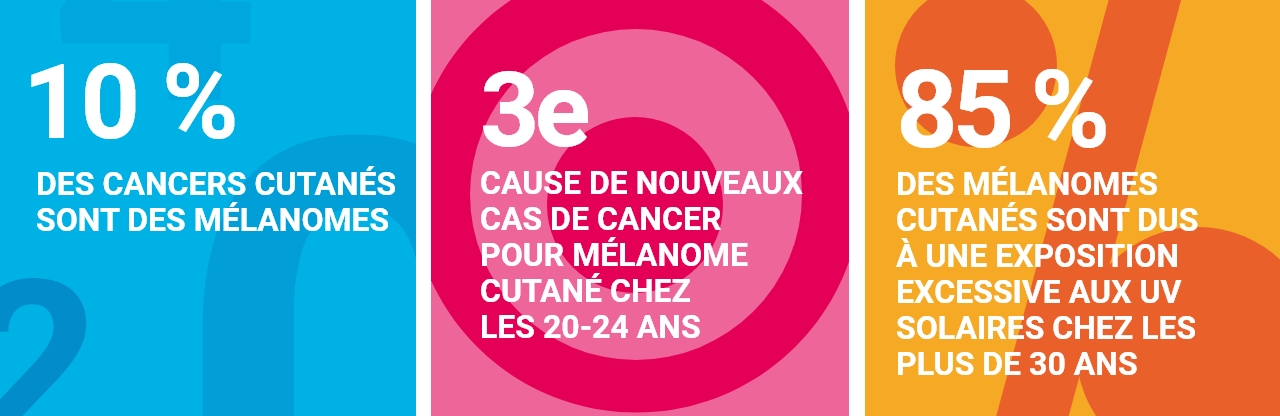
There are two types of skin cancer: carcinomas (basal cell and squamous cell) and melanomas. In France, between 141,200 and 243,500 cases of skin cancer are diagnosed each year. Skin cancers are among the most common types of cancer. Nearly 85% of these cases are caused by excessive exposure to UV radiation. UVA and UVB rays increase the risk of skin cancer.
Skin carcinomas
Skin carcinomas (also known as non-melanoma or non-melanocytic cancers) develop in the cells of the epidermis:
either in the deepest layer of the epidermis, in the case of basal cell skin carcinomas;
or in the upper layers of the epidermis, in the case of squamous cell carcinomas, also known as spinocellular carcinomas.
90%
of skin cancers are skin carcinomas
Skin carcinomas account for 90% of skin cancers (approximately 75% are basal cell carcinomas and 20% are squamous cell carcinomas). They appear as a small bump or a white scab and develop mainly on the face but also on other parts of the body exposed to UV radiation (head, neck, shoulders, forearms, hands). They most often occur after the age of 50.
These are lesions with a good prognosis, meaning they rarely tend to metastasize within the body. However, they can recur, which requires follow-up after an initial diagnosis of precancerous or cancerous lesions, in accordance with the recommendations of the French National Authority for Health (HAS) and the National Cancer Institute (INCa).
Other types of skin cancer exist and account for less than 1% of all skin cancers. These include adnexal carcinomas, Merkel cell carcinoma, Kaposi’s sarcoma, and cutaneous lymphoma… Only Merkel cell carcinoma carries a high risk of developing life-threatening metastases.
Skin Melanomas
Cutaneous melanomas are the most serious forms of skin cancer. They are lesions that arise from cells of the pigmentary system called melanocytes. These cells, naturally present in the epidermis, produce melanin, which is responsible for the pigmentation of human skin—that is, tanning.
In more than 90% of cases, melanomas are located on the skin. These are lesions that generally have a good prognosis. In rare cases, melanomas can develop in mucous membranes or other parts of the body where melanocytes are also found (eye, mouth, vagina, anus, and under the nails). Melanomas can occur at any age.
Cutaneous melanomas encompass a group of lesions with different clinical and biological forms, which may progress slowly or rapidly to a metastatic stage that is life-threatening. Depending on the type of melanoma and its progression, management varies in accordance with the recommendations of the HAS and the INCa.
Risk Factors for Skin Cancer
Multifactorial cancers, primarily attributable to excessive exposure to ultraviolet radiation…
Skin cancers are multifactorial cancers. Risk factors can be external (related to the environment, lifestyle, and living conditions) or internal (inherent to the individual).
83.5%
of skin melanomas in people over 30 were attributable to excessive exposure to solar UV radiation in 2015 (source: IARC, 2018).
However, most cases can be attributed to excessive exposure to natural or artificial ultraviolet (UV) radiation. Individual susceptibility due to phototype or history (family, medical, etc.) increases the risk of developing skin cancer; nevertheless, this factor accounts for only a small proportion of skin cancer cases.
What are the risk factors?
Known risk factors include:
Excessive exposure to UV radiation, whether natural (from the sun) or artificial (from tanning beds, etc.);
Personal, medical, or family history:
the presence of numerous moles, freckles, or xeroderma pigmentosum (also known as “moon children’s disease”)…;
Sunburns during childhood;
the appearance of actinic (or solar) keratoses, keratoacanthoma, or xeroderma pigmentosum (known as “moon children’s disease”)…;
skin cancers;
immunosuppressive treatment…
Skin type: people with fair skin (phototype I or II) are at higher risk than those with dark skin (phototype V or VI), for whom the risk is lower but still present;
Certain medications (azathioprine, cyclosporine, methoxsalen, etc.) or therapeutic procedures (PUVA therapy, diagnostic or therapeutic radiation therapy) or viruses (Merkel cell polyomavirus, HIV) can increase the risk either by sensitizing the skin to UV radiation or by weakening the immune system;
Certain environmental exposures: arsenic and inorganic compounds in drinking water; radiation therapy (ionizing X-rays and gamma rays);
Certain occupational exposures: arsenic, polychlorinated biphenyls (PCBs), chimney soot, shale oils, coal-tar pitch, and coal-tar distillation.
According to the International Agency for Research on Cancer (IARC), probable risk factors include:
certain medications (hydrochlorothiazide, nitrogen mustard…) or viruses (human papillomavirus types 5 and 8 [HPV] in patients with epidermodysplasia verruciformis);
certain occupational exposures: creosotes, etc.
Other risk factors with less compelling evidence are still under investigation and require further studies to confirm or refute these hypotheses, some of which could be explained by socioeconomic factors.
Key Statistics on Skin Cancer
See also:
The Known Health Effects of UV Radiation | World Health Organization
12 ways to reduce your risk of cancer | European Code Against Cancer
Skin cancer | World Cancer Research Fund International (English only)
Report on melanoma and non-melanoma skin cancers (carcinoma) | Léon Bernard Cancer Center
Which groups are at the highest risk of developing skin cancer?
Everyone is at risk for skin cancer, whether they have fair skin or olive, dark, or black skin.
Since excessive UV exposure is the main risk factor, the following groups are particularly at risk for skin cancer:
Children, regardless of their skin type, should avoid sun exposure between noon and 4 p.m., as their skin is thinner and more delicate than that of an adult. Excessive sun exposure during childhood is the leading cause of melanoma in adulthood.
People of any age whose fair skin does not tolerate the sun, who burn easily, and who do not tan or tan very little.
People of any age with numerous moles (more than 50).
People with congenital moles (present from birth) or atypical moles (large, irregular).
People with a large number of freckles and/or red hair.
People who have had severe sunburns, especially during childhood.
People who have spent time in regions or countries with high sun exposure.
Pregnant women, whose skin is more sensitive to UV rays during pregnancy and who are more prone to sunburn.
People with a personal or family history of skin melanoma, other skin cancers, or actinic keratoses.
People who have undergone blue LED phototherapy to treat neonatal jaundice or multiple sessions of ionizing radiation during childhood or adolescence.
People undergoing medical treatment or taking “immunosuppressive” medications that weaken or suppress the immune system.
People with a health condition that could be aggravated by exposure to sunlight or artificial UV light.
People undergoing medical treatment or taking medications (certain antibiotics, diuretics, nonsteroidal anti-inflammatory drugs—NSAIDs—etc.) that can make them “photosensitive,” meaning more sensitive to the sun. It is best to consult your prescribing physician or pharmacist.
Professionals working outdoors: farmers, ranchers, foresters, gardeners, sports staff, or staff at ski resorts or seaside resorts, construction workers, etc.
People who use artificial UV light (tanning beds), who are particularly exposed to intense sources of UVA (much stronger than natural light), and especially pregnant women, for whom tanning bed use is not recommended and is also prohibited for those under 18 years of age.
Exposure to artificial UV radiation increases the risk of developing skin cancer because the UV doses received in tanning beds are in addition to those from natural UV radiation. This risk increases by 15% among people who have used artificial UV radiation at least once in their lifetime, and by 59% when exposure begins before the age of 35.
Skin Cancer Screening
In France, as in other countries with equivalent or higher incidence rates, it is not recommended to implement an organized screening program similar to those in place for breast, colorectal, or cervical cancer. This is because mortality rates for these cancers are very low, and the 1- and 5-year survival rates are favorable (see the “Data” tab).
Currently, skin cancer screening, in accordance with HAS recommendations, relies on spontaneous screening (also called individual screening or opportunistic screening), meaning it is performed at the doctor’s request within the doctor-patient relationship or, in some cases, at the patient’s initiative when a suspicious lesion is present.
However, everyone is advised to regularly check their skin, particularly those with an identified risk factor, and to consult a doctor or dermatologist if they notice a skin lesion that is changing, bleeding, or not healing, or a mole that appears and changes rapidly, or that differs from others based on at least one of the ABCDE criteria (Asymmetry, Irregular Borders, Uneven Color, Increasing Diameter, and Rapid Change in size, shape, color, or thickness).
It is important to remember that after a first skin cancer, regular monitoring is necessary according to HAS recommendations, as the risk of developing a new skin cancer is increased.
Cancers That Can Be Prevented by Limiting Excessive Exposure to Ultraviolet Rays
Most skin cancers can be prevented through two complementary measures:
limiting excessive UV exposure (primary prevention) to reduce incidence;
detecting lesions at an early stage (secondary prevention) to treat them before they develop into metastatic cancer.
Currently, only self-monitoring for skin melanomas (the ABCDE rule) is recommended, along with medical follow-up for those at highest risk.
How to Recognize the Warning Signs of Melanoma
The “ABCDE rule” can help you recognize the warning signs of melanoma:
A for Asymmetry: the mole is not regular, round, or oval, and its features are not evenly distributed around its center,
B for Irregular borders: its borders are irregular and poorly defined,
C for Color: it has multiple colors: black, blue, brown, red, or white,
D for Diameter: it is large (more than 6 mm),
E for Evolution: it changes and grows, altering in thickness and color.
Download

Skin Cancer: Learn About the Risks and Protect Yourself (INCa)
Learn more:
Better Protection from the Sun - Exposure to UV Radiation (e-cancer.fr) | INCa
Melanoma screening | Améli
Strategy for early diagnosis of melanoma | Haute Autorité de Santé
Key figures from Santé publique France and its partners
| Incidence | Mortality | Survival | Prevalence | Prevention |
|---|---|---|---|---|
| ALL SKIN CANCERS | ||||
| 141,200 to 243,500 new cases per year | Very few deaths (excluding melanomas) | Not available | 140,100 cases requiring hospitalization | Check the UV index before going outside |
| Mainland France, 2018 | IARC GCO, 2022 | CNAM-INCa, 2017 | WHO | |
|
SKIN
MELANOMAS In collaboration with its partners for skin melanomas (Francim Network of Cancer Registries, Biostatistics and Bioinformatics Department of the Hospices Civils de Lyon, National Cancer Institute) | ||||
17,922 new cases per year |
1,980 deaths per year | 92% 5-year survival rate |
40,112 skin melanomas diagnosed in the last 5 years and still alive [a] 31,700 cases requiring hospitalization [b] |
More than 85% could be prevented in people over 30 by limiting excessive UV exposure Self-examination recommended (ABCDE rule) for people at risk |
| Mainland France, 2023 |
Metropolitan France, 2018 |
Metropolitan registry area, diagnosed cases, 2010–2015 | [a] Metropolitan France, 2008 [b] CNAM-INCa, 2017 |
Metropolitan France, 2015 |
In relation to

UV
thematic dossier
Ultraviolet radiation, which is everywhere, is emitted naturally by the sun or by artificial sources. It is responsible for various health conditions, including certain types of skin cancer.

Extreme heat, heat wave
thematic dossier
Heat waves can have a significant impact on health. It is therefore essential to take proper precautions. Certain measures must be put in place, especially for those most at risk.

thematic dossier
The First 1,000 Days
The period from conception through the first two years of life is critical for a child’s development and the health of the adult they will become. That is why it is essential to prioritize the...












