



What We Do
In this article
- Epidemiological surveillance of skin cancers
- Monitor the population's behaviors and knowledge regarding the main risk factors
- Assessing the significance of risk factors in the development of skin melanoma
- Promote best practices and health guidelines regarding UV exposure
- Promoting an environment that helps limit excessive UV exposure
Since more than 85% of cases are attributable to excessive UV exposure, skin melanomas can be prevented by adopting sensible UV exposure practices.
In this context, Santé publique France’s efforts focus on epidemiological surveillance, behavioral analysis, and promoting simple measures to ensure safe sun exposure.
Epidemiological surveillance of skin cancers
Skin cancer surveillance supports the management and evaluation of public policies for the prevention and treatment of these cancers.
Surveillance of cutaneous melanomas
The surveillance of cutaneous melanomas is carried out through a scientific and financial partnership between the Francim cancer registry network, the Biostatistics and Bioinformatics Department of the Hospices Civils de Lyon (HCL), Santé publique France, and the National Cancer Institute (INCa).
The work program defined within the framework of this partnership aims in particular to:
develop initiatives to facilitate the recording of cancers in registries (access to data sources) as well as the systematic collection of new variables;
regularly produce and make available essential epidemiological indicators (incidence, mortality, survival, prevalence);
develop thematic projects (e.g., the PRISME project…).
Map of the departments covered by a general cancer registry (registries whose data are used for the surveillance of skin melanoma, June 2021)
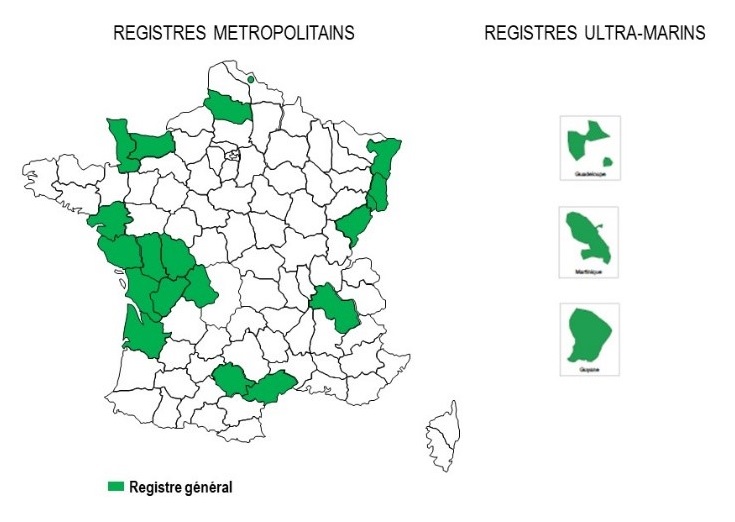
The data regularly compiled on skin melanomas include:
the national incidence in mainland France;
the incidence observed in departments covered by a cancer registry, in mainland France and in the overseas departments and regions (DROM);
the prevalence observed in departments covered by a cancer registry;
survival rates in departments covered by a cancer registry;
mortality in mainland France;
mortality at the subnational level (regional and departmental), in metropolitan France and in the DROMs.
Ad hoc studies complement the ongoing surveillance of cutaneous melanomas, such as:
skin melanomas and histoprognostic factors;
incidence or survival by stage at diagnosis;
incidence, survival, and social inequalities;
the impact of key risk factors…
The results of these various studies are presented in the “Data” section.
Surveillance of other skin cancers
Surveillance of other skin cancers is conducted in two departmental cancer registries covering the Doubs, the Territoire de Belfort, and the Haut-Rhin. These registries are the only ones that record carcinomas.
Hospital care for skin melanomas and other skin cancers is tracked using data from the National Health Data System (SNDS).
Monitoring the public’s behaviors and knowledge regarding key risk factors
Santé publique France conducts population surveys to identify and measure the knowledge, opinions, perception of information, as well as the attitudes and behaviors of the French population:
the Cancer Barometer,
These surveys provide data useful for developing and evaluating public health policies, which can help assess current or past actions and guide the development of future initiatives.
Assessing the contribution of risk factors to the development of skin melanoma
To document the relative importance of a risk factor, the number of cancer cases attributable to that risk factor can be estimated; this is referred to as the attributable risk fraction.
The fraction attributable to a risk factor represents approximately the proportion of cancers that could have been prevented if the population had not been exposed to that risk factor. The aim is to provide an order of magnitude for the number of cases that could be prevented by eliminating or modifying exposure to that risk factor in order to document the importance of the risk factor under study in the occurrence of the cancer in question. This estimate can be made using, in particular, data on incidence in the population and the prevalence of exposure for risk factors for which a causal relationship has been documented.
For UV radiation, Santé publique France collaborated and provided data for the following studies:
Cancers attributable to lifestyle and the environment in France in 2015, conducted by the IARC in 2018, which focuses in particular on the proportion attributable to exposure to UV radiation, whether natural or artificial;
Exposure to artificial ultraviolet radiation in France in 2010.
Promoting preventive measures and health guidelines regarding UV exposure
Santé publique France emphasizes the importance of protecting young children from UV exposure during the first 1,000 days of life.
Learn more: 1000-premiers-jours.fr
Check the UV index before going outside using:
the Météo-France website or app (Forecast > UV)
the Recosanté website
the WHO’s SunSmart Global UV app, especially when traveling abroad
Simple steps to protect yourself from excessive UV exposure and enjoy the sun safely
Check the UV index before going outside at:
the Météo-France website or app (Forecasts > UV)
the Recosanté website
the WHO’s SunSmart Global UV app, especially when traveling abroad
If the UV index is below 3
No sunscreen needed
If the UV index is 3 or higher
Wear light, covering clothing
Wear sunglasses (note: some sunglasses, even with dark lenses, do not protect against UV rays)
Wear a wide-brimmed hat
If skin is exposed, apply sunscreen generously (minimum SPF 30) every 2 hours when skin cannot be covered
If the UV index is 7 or higher
Stay in the shade during peak hours (between noon and 4 p.m. in summer)
Avoid sun exposure between 12 p.m. and 4 p.m.
Do not expose children under 2 years of age
If you must go outside, in this case, it is recommended that you:
Wear lightweight, covering clothing
Wear a wide-brimmed hat
Wear sunglasses (note: some glasses, even with dark lenses, do not protect against UV rays)
If skin is exposed, apply sunscreen generously (minimum SPF 30) every 2 hours when the skin cannot be covered.
If the UV index is 11 or higher
If possible, avoid exposure
Learn more:
Promoting an environment conducive to limiting excessive UV exposure
To promote environments conducive to limiting excessive UV exposure, Santé publique France has identified health promotion initiatives related to sun protection. Following an evaluation, these initiatives have been included in the agency’s catalog of evidence-based or promising interventions in prevention and health promotion:
CAPSCA "Cancer Prevention Study in Children and Adolescents"
PREVENCANADOL (pilot study of an online cancer prevention intervention for adolescents)
In relation to

UV
thematic dossier
Ultraviolet radiation, which is everywhere, is emitted naturally by the sun or by artificial sources. It is responsible for various health conditions, including certain types of skin cancer.

Extreme heat, heat wave
thematic dossier
Heat waves can have a significant impact on health. It is therefore essential to take proper precautions. Certain measures must be put in place, especially for those most at risk.

thematic dossier
The First 1,000 Days
The period from conception through the first two years of life is critical for a child’s development and the health of the adult they will become. That is why it is essential to prioritize the...












