



Carpal Tunnel Syndrome
Access incidence data for the general population and the proportions of risk attributable to occupations and economic sectors
Key Statistics on Carpal Tunnel Syndrome
Among employees, the prevalence of carpal tunnel syndrome was estimated by a study in the Pays de la Loire region at 3.8% among women and 2.3% among men.
Surgical procedures for this condition affected approximately 124,000 people in France in 2022, corresponding to incidence rates in the general population of 216 per 100,000 women and 147 per 100,000 men.
Among both male and female manual laborers, it is estimated that 73% of cases of carpal tunnel syndrome requiring surgery could be prevented if being a manual laborer did not increase the risk of carpal tunnel syndrome surgery.
Carpal tunnel syndrome is the second most commonly recognized occupational disease (after rotator cuff disorders), with 12,289 cases recognized as occupational diseases under the general social security system that resulted in initial compensation in 2019. However, underreporting of occupational diseases was estimated at 43% in 2015.
This program combines several complementary approaches to describe the situation of carpal tunnel syndrome, selected as an epidemiological marker for musculoskeletal disorders of the upper limb: estimation of the incidence and the proportion of cases attributable to occupational activity in the general population, and estimation of prevalence among the active working population.
Surgical Cases of Carpal Tunnel Syndrome: Incidence in the General Population Between 2007 and 2022
Surveillance of surgical cases of carpal tunnel syndrome (CTS) in the general population is based on the Medical Information Systems Program (PMSI). Its objective is to produce incidence rates for the entire population and for those aged 20–64 (working-age population) using a marker for this condition. Median nerve release at the carpal tunnel, the surgical treatment for CTS, is used here as the CTS indicator. The compilation of hospital stays involving CTS surgery allows for the estimation of the national incidence rate per 100,000 person-years of surgically treated CTS in the general population, for the most recent year available in the PMSI at the time of the study (2022) for the entire population, and then by age and sex. It also highlights regional and departmental variations in the incidence rate in 2022 for all of France, excluding Mayotte. Finally, surveillance of surgical SCC cases allows for the observation of trends in the annual incidence rate in mainland France between 2007 and 2022 and, based on available data, trends in the overseas regions over various periods.
Surgical Cases of Carpal Tunnel Syndrome: Key Points
Surgery for carpal tunnel syndrome was performed on 124,011 people in France in 2022.
Women accounted for 61% of these patients.
The incidence rate of CTS is higher in the working-age population (191 per 100,000 person-years among those aged 20–64) than in the general population (183 per 100,000 person-years among those aged 0–99).
The incidence of surgical cases of SCC increases with age.
The age groups with the highest incidence rates are:
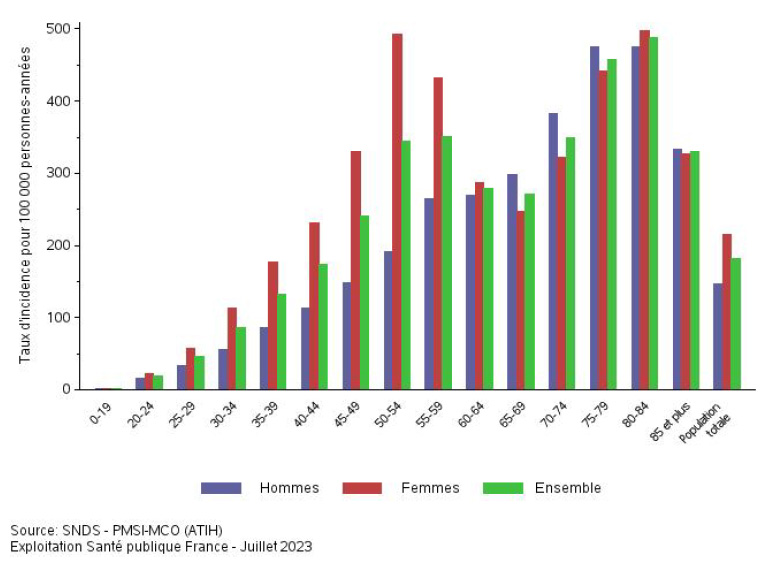
50–59 years among women;
75–84 years among women and men.
Between 2007 and 2022, the incidence rate of surgical SCC cases in mainland France saw:
an average annual decrease of 2.1% among women;
an average annual increase of 0.6% among men.
There are significant geographic variations in age-standardized incidence rates between regions, ranging in 2022 from 36 per 100,000 person-years in Réunion to 242 per 100,000 person-years in the Grand Est region.
Crude incidence rates of surgical cases of carpal tunnel syndrome in France by age and sex in 2022
Crude incidence rates of surgical cases of carpal tunnel syndrome in mainland France by sex, in the general population and among those aged 20–64, 2007–2022

The two procedure codes in the Common Classification of Medical Procedures corresponding to surgical treatment of SCC make it possible to identify all anonymous standardized discharge summaries from hospital stays—whether in public or private facilities—that include SCC surgery in the Medical Information Systems Program (PMSI):
AHPA009: Median nerve release in the carpal tunnel via direct approach
AHPC001: Median nerve release in the carpal tunnel via video-assisted surgery
These procedure codes were selected in collaboration with orthopedic surgeons and the medical information department at Angers University Hospital and private clinics in Nantes and Angers, as part of the pilot network for monitoring musculoskeletal disorders in the Pays de la Loire region.
The geographic criterion used (region/department) is the patient’s place of residence.
Incidence rates (expressed per 100,000 person-years) are calculated for the entire population and for the 20–64 age group, which corresponds to the working-age population.
Departmental and regional incidence rates are standardized to the age structure of the French population for that year and are compared to the national incidence rate using the comparative morbidity figure.
Trend tests were performed to interpret the temporal evolution of the incidence of surgical SCC cases for each sex.
Calculation of incidence rates
The numerators are the numbers of incident cases calculated from PMSI data for the year in question. The denominators, broken down by age and/or sex like the numerators, correspond to estimates of the number of person-years for the year, derived from INSEE’s localized population estimates. Estimates of person-years are calculated using age in completed years, defined as the age in years at the time of the event or age on the last birthday.
A surgical case of SCC is defined as incident in a given year if it was not preceded within 365 days by a hospitalization with a procedure classified as SCC, whether the procedure was unilateral or bilateral. Regional and departmental incidence rates are age-standardized to the French population in 2022.
Calculation of the Comparative Morbidity Figure
To compare each regional (or departmental) incidence rate standardized to the national incidence rate, the ratios between these two rates (Comparative Morbidity Figure) were calculated, along with their 95% confidence intervals.
CMFregion x = STDInc region x / NationalInc
Caution in Interpreting the Data
Data collection in the PMSI has an initial medico-economic objective rather than an epidemiological one. The results of this surveillance should therefore be interpreted with caution. Since not all SCCs undergo surgery (e.g., symptomatic treatments such as corticosteroid injections), the tracer does not allow for the calculation of the overall incidence of the disease but is limited to the incidence of surgically treated cases. The regional or departmental differences observed may thus reflect differences in the incidence of the condition (varying distributions of high-risk sectors and professions across regions, varying frequencies of high-risk endocrine conditions, etc.), but also sometimes heterogeneity in the coding practices for surgical procedures or differences in medical practice (choice of surgical treatment versus medical treatment) despite the existence of medical guidelines, or even differences in access to care.
Epidemiological Situation in France in 2022
The crude incidence rates of surgical SCC cases, by age and sex, in France in 2022 are presented in Figure 1 and Table 1. The incidence rate rises sharply with age up to age 59, then shows a slight decline at retirement age (60–69 years) before rising again among older adults up to ages 80–84. The incidence rate of surgical cases is higher among women and peaks among them between the ages of 50 and 59, corresponding to the age of menopause onset.
Trends in mainland France in the incidence rates of surgical cases of SCC
The trend between 2007 and 2022 in national incidence rates (mainland France) of surgical intervention for SCC, by sex, for all ages combined, and for those aged 20–64, is shown in Figure 2. The incidence rate of surgical cases of SCC (combined men and women) decreased significantly between 2007 and 2022, with an average annual decline of 1.1% (1.8% among those aged 20–64). This reflects a significant downward trend in the incidence rate among women, with an age-adjusted average annual decrease of 2.1% (2.6% among those aged 20–64), in contrast to men, among whom the incidence rate showed a significant upward trend during this period, with an age-adjusted average annual increase of 0.6%. Among men aged 20–64, incidence rates remained stable. Age-specific incidence rates were calculated for mainland France for the various years of surveillance (2007 to 2022), first for the total population and then for each sex (Tables 2–4). Regardless of gender or age group, a one-time drop in incidence rates occurred in 2020, corresponding to reduced healthcare utilization due to the COVID-19 health crisis. Among men, the increase in rates between 2007 and 2022 was observed among those aged 55 and older, and more specifically among those aged 70 and older. Among women, incidence rates are observed to increase starting at age 70 over the period1.
1 Trends by age group not tested.
| Figures and tables to download | ||
|---|---|---|
| Figure 1 - Incidence rate (per 100,000) of surgical cases of carpal tunnel syndrome in France by age and sex in 2022 | PDF format | |
| Table 1 - Incidence rates of surgical cases of CTS, by age and sex, in France, in 2022 | xls format | PDF format |
| Figure 2 - Incidence rate of surgical cases of CTS in mainland France by sex, general population, and among those aged 20–64, 2007–2022 | PDF format | |
| Table 2 - Trends in the incidence rate of surgically treated SCC in mainland France by age for all genders, between 2007 and 2022 | xls format | PDF format |
| Table 3 - Trends in the incidence rate of surgically treated SCC in mainland France by age among men, between 2007 and 2022 | XLS format | PDF format |
| Table 4 - Trends in the incidence rate of surgically treated SCC in mainland France by age among women, between 2007 and 2022 | XLS format | PDF format |
Regional incidence rates in 2022
The incidence rate of surgical cases of SCC varies significantly from one region to another: standardized rates ranging from 242 per 100,000 person-years (PY) in the Grand-Est and 240 per 100,000 PY in Normandy to 36 per 100,000 PY in Réunion. Regional incidence rates and their comparison with the national incidence rate, presented as a Comparative Morbidity Figure (CMF), are shown by sex for the entire population (Tables 5–6) and for the 20–64 age group (Tables 7–8).
Maps 1 and 2 show the CMF for each region, by sex, for all ages. Maps 3 and 4 show the CMF for each region, by sex, among those aged 20–64. The regions are divided into five CMF classes with thresholds (0.7 / 0.9 / 1.1 / 1.3) corresponding respectively to variations of -30%, -10%, +10%, and +30% relative to the national incidence rate.
| Tables and maps to download | ||
|---|---|---|
| Table 5 - Regional crude and age-standardized incidence rates, by sex, all ages combined, in 2022 | xls format | PDF format |
| Table 6 - Comparative Morbidity Figure by region by sex, all ages combined, in 2022 | xls format | PDF format |
| Table 7 - Regional crude and age-standardized incidence rates by sex among 20-64-year-olds in 2022 | xls format | PDF format |
| Table 8 - Comparative Morbidity Figure by region by sex, among people aged 20–64, in 2022 | xls format | PDF format |
| Map 1 - Regional Morbidity Figures for surgical cases of SCC in men, all ages combined, in 2022 | View map | |
| Map 2 - Regional Morbidity Figures for SCC Surgical Cases Among Women, All Ages Combined, in 2022 | View map | |
| Map 3 - Regional comparative morbidity figures for surgical cases of SCC in men, ages 20–64, in 2022 | View map | |
| Map 4 - Regional comparative morbidity figures for surgical cases of SCC in women, ages 20–64, in 2022 | View map | |
Departmental incidence rates in 2022
The incidence rate of surgical cases of SCC also varies from one department to another. Departmental incidence rates and their comparison with the national incidence rate, presented as a comparative morbidity figure (CMF), are shown for the entire population (Tables 9–10) and for the 20–64 age group (Tables 11–12). Maps 5 and 6 show the CMF for each department, by sex, for all ages. Maps 7 and 8 show the CMF for each department, by sex, among those aged 20–64. The departments are divided into five CMF categories with thresholds (0.7 / 0.9 / 1.1 / 1.3) corresponding respectively to variations of -30%, -10%, +10%, and +30% relative to the national incidence rate. For the same age structure, the northern half of France, with the exception of the Brittany and Île-de-France regions, generally has higher incidence rates of SCC surgical cases than the southern half (maps 5 to 8). This north-south difference is less pronounced among people aged 20–64.
| Tables and maps to download | ||
|---|---|---|
| Table 9 - Crude and age-standardized incidence rates by department, by sex, all ages combined, in 2022 | Excel format | PDF format |
| Table 10 - Comparative Morbidity Figure by department by sex, all ages combined, in 2022 | Excel format | PDF format |
| Table 11 - Crude and age-standardized incidence rates by department, by sex, among people aged 20–64, in 2022 | Excel format | PDF format |
| Table 12 - Comparative Morbidity Figure by department by sex, among people aged 20–64, in 2022 | Excel format | PDF format |
| Map 5 - Comparative Morbidity Figures by Department for SCC Surgical Cases Among Men, All Ages Combined, in 2022 | View map | |
| Map 6 - Comparative Morbidity Figures by Department for SCC Surgical Cases Among Women, All Ages Combined, in 2022 | View map | |
| Map 7 - Comparative departmental morbidity figures for surgical cases of SCC in men, ages 20–64, in 2022 | View map | |
| Map 8 - Comparative departmental morbidity figures for surgical cases of SCC in women, ages 20–64, in 2022 | View map | |
Epidemiological Situation in the Overseas Departments in 2022
Incidence data are presented for all overseas departments except Mayotte (due to the very low number of observed cases, which is incompatible with statistical confidentiality). In the overseas departments, the age-standardized incidence rates for the French population in the year of surgical cases of carpal tunnel syndrome are lower than in mainland France, with the exception of rates in Martinique, which nevertheless remain low as well (Table 7). As in mainland France, incidence rates are higher among women than among men.
Crude incidence rates were higher in 2022 among those aged 20–64 than in the population of all ages, except in Guadeloupe and Martinique among men (Table 13). This holds true for the various years of the follow-up (Tables 16, 18, 20, 22). Standardized incidence rates and their comparison to the national incidence rate, presented as a comparative morbidity figure (CMF), are shown for the entire population and for the 20–64 age group, which comprises the majority of the working-age population (Table 14). Among men, age-standardized incidence rates are between four and five times lower in Réunion and French Guiana than for France as a whole. Among women, the age-standardized incidence rate is also between four and five times lower in Réunion compared to the national rate (CMF=0.21), and twice as high as that of men (Tables 13 and 14). In contrast, the age-standardized incidence rate among women in Martinique is close to that of France.
| Tables and maps to download | ||
|---|---|---|
| Table 13 - Crude and age-standardized incidence rates for each Overseas Department (DOM), by sex, for all ages and for those aged 20–64, in 2022 | Excel format | PDF format |
| Table 14 - Comparative Morbidity Figure for each French overseas department by sex, all ages combined, in 2022 | Excel format | PDF format |
| Map 5 - Comparative Morbidity Figures by Department for SCC Surgical Cases in Men, All Ages Combined, in 2022 | View map | |
| Map 6 - Comparative Morbidity Figures by Department for SCC Surgical Cases in Women, All Ages Combined, in 2022 | View map | |
| Map 7 - Comparative departmental morbidity figures for surgical cases of SCC in men, ages 20–64, in 2022 | View map | |
| Map 8 - Comparative departmental morbidity figures for surgical cases of SCC in women, ages 20–64, in 2022 | View map | |
Detailed results by French Overseas Department in 2022 and incidence trends
Guadeloupe – 971
Guadeloupe is among the departments with the lowest standardized incidence rates of surgical SCC cases in 2022 (Table 9) for men (60 per 100,000 men), along with Réunion, French Guiana, and Paris. The standardized incidence is also low among women (126 per 100,000 women), but higher than in Réunion, French Guiana, Paris, Hauts-de-Seine, and Haute-Corse.
Incidence rates in Guadeloupe increase gradually with age among men. Among women, a peak in the incidence rate is observed at ages 50–59, corresponding to the age of menopause; the incidence then decreases and rises again until the 70–79 age group (Figure 3 and Table 15).
| Figure and table available for download | ||
|---|---|---|
| Figure 3 - Incidence rates of surgical SCC cases in Guadeloupe by age and sex, in 2022 | PDF format | |
| Table 15 - Incidence rate of surgical SCC cases in Guadeloupe by age and sex, in 2022 | Excel format | PDF format |
Incidence rates (crude rates), which were relatively stable among women in Guadeloupe between 2007 and 2009, declined between 2010 and 2020 before rising again starting in 2021, as observed among women in mainland France (with a more significant decline in Guadeloupe). Among men, rates are stable, unlike in mainland France, where they are increasing. However, a dip in incidence was observed for both sexes in Guadeloupe in 2017. The same trends are observed in the general population and in the working-age population (Figure 4 and Table 16). Analysis of the age-adjusted trend in the general population shows an average annual decrease between 2007 and 2022 of -7.0% among women and -2.0% among men.
| Figure and table available for download | ||
|---|---|---|
| Figure 4 - Incidence rate of SCC surgical cases in Guadeloupe by sex, general population and those aged 20–64, 2007–2022 | PDF format | |
| Table 16 - Incidence rate of surgical SCC cases in Guadeloupe by sex, general population, and those aged 20–64, 2007–2022 | Excel format | PDF format |
Martinique – 972
In 2022, the age-standardized incidence rate of surgical cases of carpal tunnel syndrome (Table 9) among men in Martinique (86 per 100,000 men) is among the lowest in France, comparable to those of other French overseas departments, certain departments in the Île-de-France region (Hauts-de-Seine, Paris, Seine-Saint-Denis), and Haute-Corse. Among women, the standardized incidence rate is close to the incidence rate for France (210 per 100,000 women in Martinique versus 209 per 100,000 women) (Table 13).
In Martinique, incidence rates increase gradually with age among men. Among women, a peak in the incidence rate is observed at ages 50–59, corresponding to the age of menopause; the incidence then decreases and rises again, as at the national level, but only up to the 70–79 age group (Figure 5 and Table 17).
| Figure and table available for download | ||
|---|---|---|
| Figure 5 - Incidence rates of surgical SCC cases in Martinique by age and sex, in 2022 | PDF format | |
| Table 17 - Incidence rate of surgical SCC cases in Martinique by age and sex, in 2022 | Excel format | PDF format |
The incidence (crude rates) of surgical SCC cases increased in Martinique between 2007 and 2022, among men (where rates more than tripled) as well as among women (an increase of approximately 50%), and among those aged 20–64 as well as for the general population (Figure 6 and Table 18). This trend differs from that observed in mainland France, where a downward trend in incidence was noted. Analysis of the age-adjusted trend in the general population shows an average annual increase between 2007 and 2022 of +1.0% among women and +3.9% among men.
| Figure and table available for download | ||
|---|---|---|
| Figure 6 - Incidence rate of surgical SCC cases in Martinique by sex, general population and those aged 20–64, 2007–2022 | PDF format | |
| Table 18 - Incidence rate of surgical cases of SCC in Martinique by sex, general population, and among those aged 20–64, 2007–2022 | Excel format | PDF format |
French Guiana – 973
The age-standardized incidence rates of surgical SCC cases in French Guiana in 2022 are among the lowest in France (45 per 100,000 men and 102 per 100,000 women), comparable to those of other overseas departments (except among women in Martinique), certain departments in the Île-de-France region (Hauts-de-Seine, Paris, Seine-Saint-Denis) and Haute-Corse (Table 9).
French Guiana has the largest difference between crude and age-standardized rates among the French overseas departments, with age-standardized rates nearly twice as high as crude rates, reflecting the youthfulness of the Guianese population. Incidence rates increase with age up to the 50–59 age group among women, corresponding to menopause. Incidence rates also increase with age among men (Figure 7 and Table 19).
| Figure and table available for download | ||
|---|---|---|
| Figure 7 - Incidence rates of surgical SCC cases in French Guiana by age and sex, in 2022 | PDF format | |
| Table 19 - Incidence rates of surgical SCC cases in French Guiana by age and sex, in 2022 | Excel format | PDF format |
Incidence rates were calculated in French Guiana between 2010 and 2022. For both women and men, the crude rates are relatively stable. A more significant temporary increase in incidence was observed for both sexes between 2014 and 2016 and again in 2019 (Figure 8 and Table 20).
| Figure and table available for download | ||
|---|---|---|
| Figure 8 - Incidence rates of surgical SCC cases in French Guiana by sex, general population, and among those aged 20–64, 2010–2022 | PDF format | |
| Table 20 - Incidence rate of surgical SCC cases in French Guiana by sex, general population, and among those aged 20–64, 2010–2022 | Excel format | PDF format |
Réunion – 974
The age-standardized incidence rates of surgical SCC cases in Réunion in 2022 are the lowest in France (27 per 100,000 men and 45 per 100,000 women), comparable to those in the other French overseas departments (except among women in Martinique) (Table 9).
An INSEE study found that residents of Réunion sought hospital care less frequently than those in mainland France, particularly among those aged 40 to 69. This study also noted that the density of private specialist practitioners was lower than in mainland France and that travel times to see specialists were longer than for general practitioners (INSEE Analyses No. 19 – November 2016). In 2021, the density of orthopedic surgeons and traumatologists was 1.7 per 100,000 inhabitants in Réunion, whereas it was 4.1 per 100,000 inhabitants in mainland France (learn more). This contrast was not observed for general practitioners, whose density was higher in Réunion (96.1 per 100,000 inhabitants) than in mainland France (77.3 per 100,000). Nearly half of carpal tunnel syndrome cases (51% among men and 45% among women) are believed to be attributable to occupational activities. The low employment rate among 15- to 64-year-olds in Réunion (50.4% among men and 41.9% among women) compared to France as a whole (66.6% among men and 60.9% among women) may also partly explain the low incidence rates of surgical cases of CTS observed. The occupational categories of women in Réunion may, to a small extent, explain the low incidence observed. Indeed, in 2020, the percentage of female manual workers in Réunion was 5.0% among employed women, compared to 8.1% in France as a whole (learn more), yet the risk of undergoing surgery for SCC is higher in this occupational category (C. Ha et al. 2009).
Among men in Réunion in 2022, the incidence rate increases with age up to the 80+ age group, as seen nationally (up to 80–84 years), despite a slight decline among those aged 60–69. Among women in Réunion, a first peak in the incidence rate is observed at menopause (ages 50–59), followed by a second, smaller peak among those aged 70–79 (Figure 9 and Table 21).
| Figure and table available for download | ||
|---|---|---|
| Figure 9 - Incidence rate of surgical SCC cases in Réunion by age and sex, in 2022 | PDF format | |
| Table 21 - Incidence rate of surgical SCC cases in Réunion by age and sex, in 2022 | Excel format | PDF format |
Crude incidence rates were measured in Réunion between 2007 and 2022, among men and women, for those aged 20–64 and in the general population (Figure 10 and Table 22). A decrease in the incidence of surgical SCC cases was observed from 2007 to 2011 (more pronounced among women). Between 2012 and 2018, the incidence gradually increased again in Réunion (except for a more significant temporary decrease in 2013–2014) among both men and women, but incidence rates remained low, and among women, lower than those in 2007. Since 2018, incidence rates have tended to decrease slightly. We do not have sufficient data regarding the practices and movements of surgeons performing carpal tunnel syndrome surgeries in Réunion over this entire period to explain these changes in incidence.
| Figure and table available for download | ||
|---|---|---|
| Figure 10 - Incidence rates of surgical cases of CTS in Réunion by sex, general population, and those aged 20–64, 2007–2022 | PDF format | |
| Table 22 - Incidence rate of surgical cases of CTS in Réunion by sex, general population, and among those aged 20–64, 2007–2022 | Excel format | PDF format |
Risk fractions attributable to occupations and industries
CTS is used as an epidemiological marker for work-related musculoskeletal disorders of the upper extremities. Identifying the industries and occupations with the highest occupational risk fractions for carpal tunnel syndrome allows for the targeting of these industries—and within them, the high-risk occupations and jobs—so that occupational risk prevention efforts can be prioritized in these areas. Indeed, occupational health and safety professionals in occupations and sectors with a significantly elevated risk of CTS must logically incorporate the issue of MSDs into their priorities for action.
Santé publique France conducted two comparable studies in Maine-et-Loire¹ (in 2002–2003, in collaboration with the Occupational Health Epidemiology and Ergonomics team at Inserm - UMR 1085 - and the University of Angers) and in Bouches-du-Rhône2 (in 2008–2009) among patients who had undergone surgery for carpal tunnel syndrome. Based on employment data from patients in these two studies, the risk fractions for CTS attributable to occupational activity within high-risk occupations and/or sectors were determined for both men and women³.
Among the employed population, 51% [36–62] of men who underwent surgery for CTS and 45% [39–51] of women who underwent surgery for CTS were attributable to being employed at the time of the procedure. The lack of data on the proportion of cases attributable to a specific occupation or sector does not necessarily mean that this proportion is zero; it may be due to the size of the occupation or sector being too small to calculate this proportion with sufficient precision.
Proportion Attributable to Occupations
Among male and female manual workers, 73% of SCC cases are attributed to the excess risk associated with this occupation. Three-quarters of cases in this socio-occupational category could be prevented if being a manual worker did not represent an excess risk of SCC. The proportion of SCC cases attributable to occupation is 53% among female farm operators, while it is 34% among female employees. Men in these occupational categories do not exhibit an excess risk. Executive and professional occupations, as well as intermediate occupations, have a significantly reduced risk of SCC for both sexes.
The proportions or fractions of SCC risk attributable to specific occupations are particularly high (≥90%) for blue-collar occupations:
for men: skilled roofers, unskilled production workers in textiles and apparel, tanning and leather goods, butchers, unskilled production workers in meat processing, industrial boilermakers and sheet metal workers, skilled forge operators, skilled forming equipment operators, skilled patternmakers, and livestock workers;
among women: agricultural workers in market gardening, horticulture, viticulture, or fruit tree cultivation; unskilled production workers in meat processing; unskilled workers in the electrical and electronics sectors, as well as unskilled production workers in textiles and apparel, tanning and leather goods, and leatherworking.
Proportion attributable to sectors of activity
The proportion of risk attributable to an industry sector among workers exposed to that sector is greater than 65%:
for men, in the leather and footwear industry and the metalworking sector,
and among women, in the automotive industry, the leather and footwear industry, the manufacture of radio, television, and communication equipment, the manufacture of furniture and miscellaneous industries, agriculture, the clothing and fur industry, and household activities as employers of domestic staff.
Certain specific jobs (sector-occupation combinations) within both high-risk and non-high-risk sectors are associated with particularly high proportions of attributable cases, such as, among women, personnel in direct services to individuals within the education sector.
For more information: Chazelle E, Fouquet N, Roquelaure Y. Proportion of carpal tunnel syndrome cases attributable to occupational activity among high-risk occupations and sectors in France. Weekly Epidemiological Bulletin. 2021, No. 11, pp. 186–195.
1 Ha C, Fouquet N, Roquelaure Y, Raimbeau G, Leclerc A, Goldberg M, et al. Carpal tunnel syndrome. Estimates of incidence, prevalence, and the role of occupational factors in its occurrence in the Pays de la Loire region, France, 2002–2004. Special Issue - Work-Related Musculoskeletal Disorders. A Major Concern. Bull Epidemiol Hebd. 2010;5–6:37–40.
2 Sillam F, Souarès Y, Malfait P, Plaine J, Ha C. Carpal tunnel syndrome: estimates of incidence, prevalence, and the role of occupational activity in its occurrence in the Pays de la Loire region, France, 2002–2004. Special issue. Epidemiological surveillance of occupational risks: what’s new? Bull Epidemiol Hebd. 2012; 22–23: 272–5.
3 Chazelle E, Fouquet N, Roquelaure Y. Proportion of carpal tunnel syndrome cases attributable to occupational activity among high-risk occupations and sectors in two French departments. Bull Epidemiol Hebd. 2021;(11):186-95.
4 Bouyer J, Hémon D, Cordier S, Derriennic F, Stücker I, Stengel B, et al. Epidemiology: Principles and Quantitative Methods. Lavoisier; 2009. 515 p.
In relation to

Occupational diseases
thematic dossier
Occupational diseases are defined as any illness that may be work-related but is not recognized as an occupational disease by a social security system.












