



The disease
Musculoskeletal Disorders
Musculoskeletal disorders (MSDs) encompass a wide range of musculoskeletal conditions that may be caused or exacerbated by occupational activities.
They primarily manifest as pain and functional impairment of varying severity but are often experienced on a daily basis.
Key statistics on musculoskeletal disorders
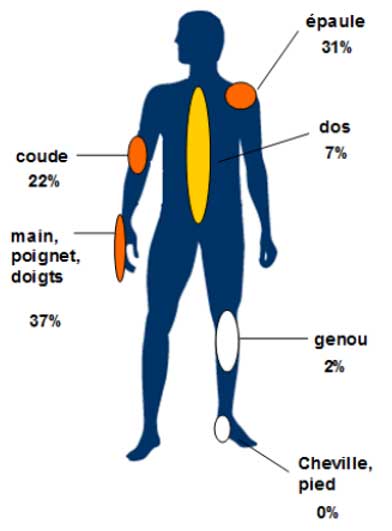
Tendons and tendon sheaths, muscles, nerves, ligaments, joint capsules, bursae, and blood vessels may be affected. These conditions often involve muscle pain, tendinitis (inflammation of one or more tendons or tendon sheaths), or entrapment syndromes (compression of a nerve or nerve root within an anatomical passageway). Low back pain, neck pain, carpal tunnel syndrome in the wrist, rotator cuff syndrome in the shoulder, and lateral epicondylitis in the elbow are among the most common MSDs. Less common, MSDs of the lower extremities also occur, such as knee hygroma, shown in the diagram below. This diagram shows the distribution by location of MSDs recognized as occupational diseases
Breakdown by location of musculoskeletal disorders recognized as occupational diseases
Multifactorial conditions with a significant occupational component
Musculoskeletal disorders are conditions with diverse and often multiple causes that can sometimes arise without work being a factor (endocrine diseases, pregnancy, non-work-related activities, etc.), but they are primarily a widespread problem of work-related morbidity. While there are individual risk factors (advancing age, diabetes, obesity, hypothyroidism, inflammatory rheumatism, etc.), the role of occupational factors is clearly established, whether in the onset, persistence, or worsening of symptoms.
The occupational stressors that contribute to the onset of MSDs include:
Physical in nature: notably biomechanical stresses, such as forceful movements, extreme postures (working with arms raised above shoulder level), movements placing high stress on joints (twisting of the wrist or trunk, etc.), and highly repetitive motions (repeated flexion and extension of the elbow or wrist); but also other types of stressors such as the use of vibrating tools, working in cold conditions, etc.
Psychosocial and organizational factors: high psychological demands, low social support at work (from supervisors or colleagues), lack of or insufficient individual and collective autonomy, working under time pressure, lack of or insufficient recovery time...
The leading cause of compensation for occupational diseases
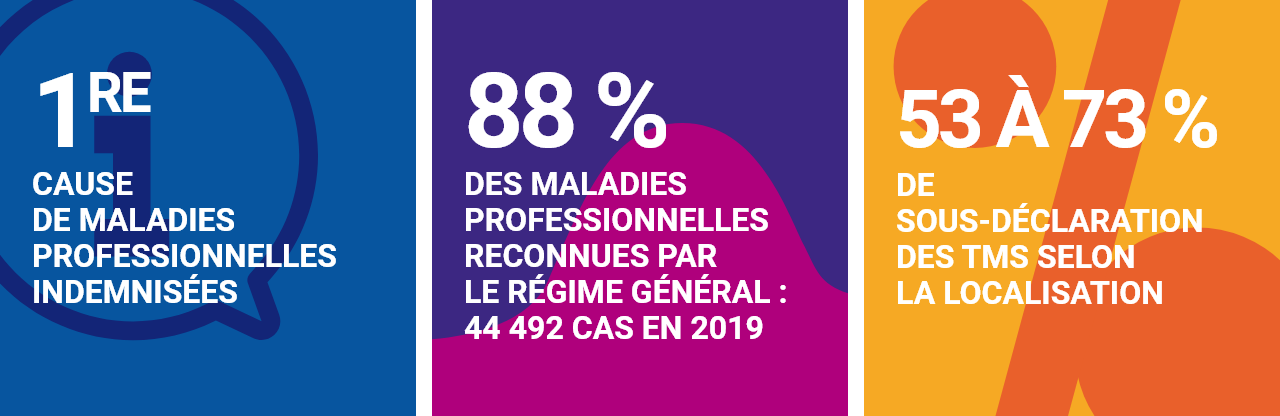
MSDs are by far the leading cause of compensated occupational diseases. The first signs of this "epidemic" emerged in France in the early 1990s with a steady increase in compensated occupational diseases under both the general Social Security system and the agricultural system.
In 2017, musculoskeletal disorders of the limbs and low back pain accounted for 87% of occupational diseases recognized by the general scheme*, with 42,349 cases. Table 57 of the general social security system (“periarticular conditions caused by certain movements and postures”) alone accounted for more than three-quarters of recognized occupational diseases (1).
MSDs are also the leading cause of lost workdays due to sick leave, with the loss, in 2015, of more than ten million workdays for recognized occupational MSDs alone. They rank second among medical causes of disability, after psychiatric conditions, and first among causes of first-category disability (disabled individuals “capable of performing paid work”).
This phenomenon, which is largely underestimated by occupational disease statistics—due in particular to significant underreporting—is not unique to France. The 6th European Working Conditions Survey (2) shows that in 2015, back pain and muscle pain in the neck and upper limbs were the top two health problems experienced by European workers (44% and 42% of workers, respectively) over the previous 12 months (28 EU countries, 5 candidate countries, Norway, and Switzerland). Muscle pain in the lower limbs also affected 30% of them. MSDs rank first among recognized occupational diseases in several European countries. The underreporting rate for MSDs in France in 2011 was estimated at 53% for lumbar spine MSDs, 60% for carpal tunnel syndrome, 62% for shoulder MSDs, and 73% for elbow MSDs.
See also

article
6 September 2019
Estimating Underreporting of Musculoskeletal Disorders: An Update for 2011 Across Eleven French Regions
Social and Economic Impacts
Due to their frequency and their functional consequences in terms of quality of life and work performance (absenteeism, reduced work capacity or even inability to perform job duties, and the risk of career disruption), MSDs are one of the most pressing occupational health issues in industrialized countries. MSDs have significant economic and social repercussions due to absenteeism, compensation costs, and indirect costs for companies (decreased productivity and quality, absenteeism, difficulties in recruitment and re-employment of affected workers, damage to the company’s image, etc.) (3). This issue of work-related morbidity also affects less industrialized countries, although the situation there remains poorly documented.
* who received an initial cash benefit payment during the year (due to temporary disability or permanent disability)
1. 2017 Annual Report. Health Insurance – Occupational Risks.
2. Sixth European Working Conditions Survey – Overview report
3. Roquelaure Y, Bodin J, Descatha A, Petit A. Work-related musculoskeletal disorders. Update. Revue du praticien. Vol. 68. Jan. 2018
In relation to

Occupational diseases
thematic dossier
Occupational diseases are defined as any illness that may be work-related but is not recognized as an occupational disease by a social security system.












