


What is syndromic surveillance?
Syndromic surveillance is used to collect, analyze, interpret, and disseminate data through a specific system established between Santé publique France and networks of professionals capable of providing daily updates on the population’s health status.
Subscribe to our mailing list
Would you like to receive the SOS Médecins newsletter?
Syndromic surveillance: definition
Syndromic surveillance is defined as the collection, analysis, interpretation, and dissemination of health data in real time or near real time, with the aim of early identification of the impact (or lack thereof) of a potential threat to human or animal health, the management of which may require the implementation of public health measures.
What indicators are involved?
Unlike most health surveillance systems, which rely on biologically confirmed diagnoses, syndromic surveillance is based on nonspecific health indicators (clinical signs, symptoms, “proxy” indicators such as absenteeism, and drug sales) that constitute a provisional diagnosis or “syndrome.”
How is the data collected?
The data collected is generally not generated primarily for the purpose of health surveillance. Whenever possible, data collection is automated to avoid placing an additional workload on professionals, particularly healthcare professionals.
This surveillance is intended to be non-specific, sensitive, and responsive, and it complements the information available through other surveillance systems1.
The example of the 2003 heat wave in France
In France, the exceptional consequences of the 2003 heat wave led to a reevaluation of the health monitoring and alert systems then in place, which were based almost exclusively on disease-specific systems.
The initial goal was to develop the capacity to detect new threats to public health, ranging from environmental phenomena to emerging infectious diseases.
With this in mind, Santé publique France developed a surveillance system centered on structures capable of providing daily information on the population’s health status: the SurSaUD® system (health surveillance of emergencies and deaths).
The SurSaUD® syndromic surveillance system
Multiple and complementary sources of information
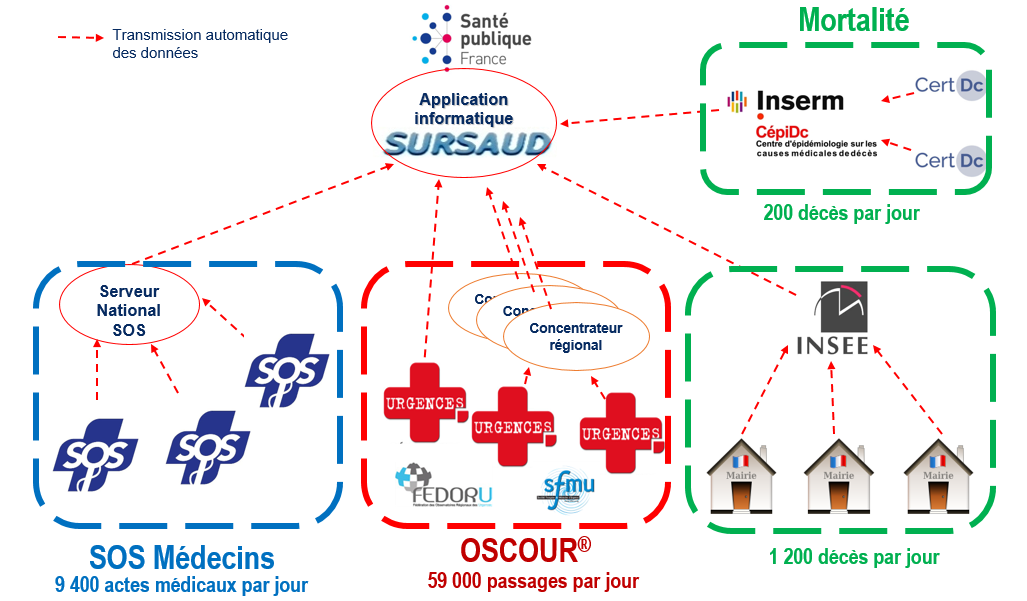
SurSaUD® (health surveillance of emergencies and deaths) is a surveillance system established in 2004. It relies on several networks of professionals and includes four sources of information:
data from hospital emergency departments participating in the OSCOUR® network (Organization for Coordinated Emergency Surveillance),
data from SOS Médecins associations that are members of the SOS Médecins France Federation,
mortality data from municipal civil registry offices transmitted electronically to INSEE,
data from electronic death certificates.
As part of the SurSaUD® surveillance system, data from each network is analyzed and published weekly in a bulletin posted on our website. These bulletins are intended for health authorities, network partners, and the general public.
What are the objectives of the SurSaUD® surveillance system?
Since its inception, the objectives of the SurSaUD® surveillance system have expanded beyond health monitoring and alerts. Today, they are part of a broader public health framework designed to guide public policy and support decision-making by health authorities.
The objectives are:
to identify an unusual health event as part of daily health surveillance,
to detect the early onset of a known or emerging health event, such as an epidemic, and to track its spatio-temporal dynamics,
to assess, in a responsive manner, the short-term impact of an event (extreme environmental phenomenon, industrial accident, large gathering, terrorist attack, etc.),
to monitor trends in various conditions (cardiovascular diseases, mental health issues, drowning incidents, etc.) outside of any unexpected events (long-term trends, evaluation of prevention measures, response to referrals, etc.).
What is its purpose?
Thanks to its responsiveness (daily updates), its very broad coverage (>93% for OSCOUR® and SOS Médecins, >80% for all-cause mortality, and around 30% for electronic death certification—the least widely deployed source), and its extensive historical data (spanning over 15 years), the system also enables:
rapidly communicate objective and robust data to enable the adoption, adaptation, or strengthening of management measures,
to help reassure health authorities by objectively demonstrating, where applicable, the absence of impact from a system that is in place and operating 24/7.
Architecture and Data Flows for the SurSaUD® Surveillance System - July 2021
Use of Data from the SurSaUD® Surveillance System
The SurSaUD® surveillance system is used daily within Santé publique France, at both the national and regional levels, to identify unexpected events,2 monitor seasonal epidemics in conjunction with specific surveillance systems, and assess the impact of extreme environmental events (heat waves, episodes of air pollution, cyclones, or floods), industrial accidents, large gatherings, and terrorist attacks.
In 2020, all sources within the SurSaUD® system contributed to monitoring the impact of the COVID-19 pandemic, complementing other national or local data sources. Other areas of application are also possible, such as monitoring opioid or alcohol-related disorders in emergency departments or tracking trends in healthcare utilization for cardiovascular diseases or mental health disorders during the COVID-19 pandemic.
Finally, programs enable daily analysis to identify diseases subject to mandatory reporting or bioterrorism-related incidents; while the latter issue did not guide the technical and organizational choices of this network, it remains a public health threat that must be identified as early as possible.
The results of all-cause mortality surveillance are used year-round. For example, these data have made it possible to track the impact on mortality of the chikungunya epidemic in Réunion in 2006 and in the Caribbean in 2014, as well as seasonal winter mortality and mortality observed during the COVID-19 pandemic.
1 Assessment of syndromic surveillance in Europe. Triple S Project. Lancet. Nov. 26, 2011;378(9806):1833-4.
2 Caillère N, Vilain P, Brottet E, Kaplon J, Ambert-Balay K, Polycarpe D, Filleul L. A major outbreak of gastroenteritis on Réunion Island in 2012: first identification of G12 rotavirus on the island. Euro Surveill. 2013 May 9;18(19):20476. Erratum in: Euro Surveill. 2013;18(23):pii/20501.












