


SOS Doctors Network
The SOS Médecins network is one of the four sources of the SurSaUD® emergency and mortality surveillance system.
The SOS Médecins network within the SurSaUD® surveillance system
SOS Médecins and Santé publique France: a partnership since 2005
On December 20, 2005, the SOS Médecins France Federation and Santé publique France signed a partnership agreement establishing the transmission of data generated by SOS Médecins associations to SurSaUD®. The SurSaUD® system (Health Surveillance of Emergencies and Deaths) has been managed by Santé publique France since 2004 to support its health monitoring and epidemiological surveillance missions.
Coverage of the SOS Médecins network
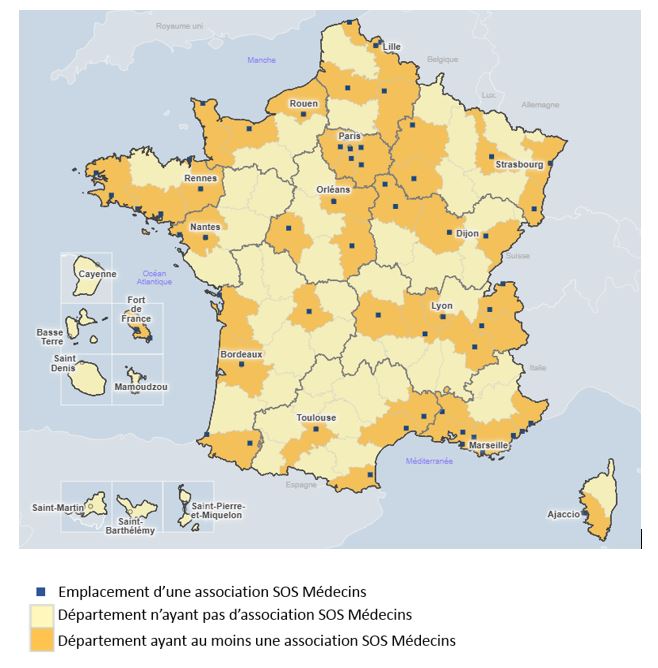
SOS Médecins France comprises 63 associations spread across mainland France and Martinique.
In 2020, 62 of the 63 SOS Médecins associations were members of the federation and transmitted data to Santé publique France daily. This network thus covers 95% of SOS Médecins medical procedures performed nationwide, or an average of 9,400 medical procedures per day. The SOS Médecins associations affiliated with the federation are located in 48 of the 97 metropolitan departments and cover all metropolitan regions (where they are primarily located in urban areas) as well as Martinique.
Automated data transmission
SOS Médecins associations provide medical services 24 hours a day, 7 days a week (home visits and consultations at SOS Médecins medical centers). Calls to the SOS call centers are routed through a dispatch process and are recorded. Every morning, SOS Médecins France automatically transmits to Santé publique France the individual and anonymized data regarding the medical services performed and recorded the previous day by the doctors of the SOS associations.
Map - SOS Médecins associations participating in SurSaUD®
Data Collection
The data collected daily by Santé publique France includes demographic information (gender, age), administrative details (time of call, association code, municipality of call, etc.), and medical information (reason for call, medical diagnoses, hospitalization requests).
Every morning, this data is entered into the SurSaUD® application and then aggregated by time intervals, geographic areas, age groups, and syndrome categories to enable the automated, daily generation of epidemiological indicators.
What Are Syndrome Groups?
Syndromic clusters are groups of medical diagnoses created for the purposes of surveillance by Santé publique France. They can be:
specific to a well-identified condition (influenza, acute gastroenteritis, bronchiolitis),
non-specific and based on clinical symptoms (isolated fever, malaise, dyspnea, etc.)
or broad, grouping families of diagnoses (acute lower respiratory infections, trauma, etc.).
New groupings may also be created in response to emerging needs (e.g., emergency department visits for suspected COVID-19). Nearly 90 syndromic groupings covering all areas of emergency medicine are available, and approximately 50 of them are subject to daily surveillance by Santé publique France.
Objectives of surveillance
Detect, investigate, inform
This surveillance supports Santé publique France’s monitoring and alert mission. Indeed, any unusual variation in the data constitutes a signal that is investigated in collaboration with regional units, through both in-depth data analysis and communication with SOS doctors. Depending on the situation, if the signal is validated, it may be reported to health authorities.
In the event of a health alert, surveillance is immediately implemented based on the daily analysis of relevant syndrome clusters, depending on the situation (e.g., the Lubrizol factory fire, an outbreak of gastroenteritis and foodborne illness linked to the consumption of shellfish, the COVID-19 pandemic, extreme weather events, etc.).
Analyzing the data and publishing it in a weekly epidemiological bulletin
In addition to daily surveillance for monitoring and alert purposes, SOS Médecins data undergoes a formal weekly analysis through an epidemiological bulletin intended for health authorities, network partners, and the general public, published weekly on our website.
This bulletin describes, for different age groups, the overall activity of SOS Médecins associations during the previous week, the 10 most frequently recorded conditions, and activity related to seasonal indicators and non-specific indicators tracked year-round.
Ten indicators developed at the regional and departmental levels are published online on Geodes, the cartographic observatory of Santé publique France, and are updated weekly. These include the rate of medical procedures for bronchiolitis, allergies, asthma, acute bronchitis, acute gastroenteritis, influenza, ENT conditions, pneumonia, trauma, and suspected COVID-19 (per 10,000 medical procedures).
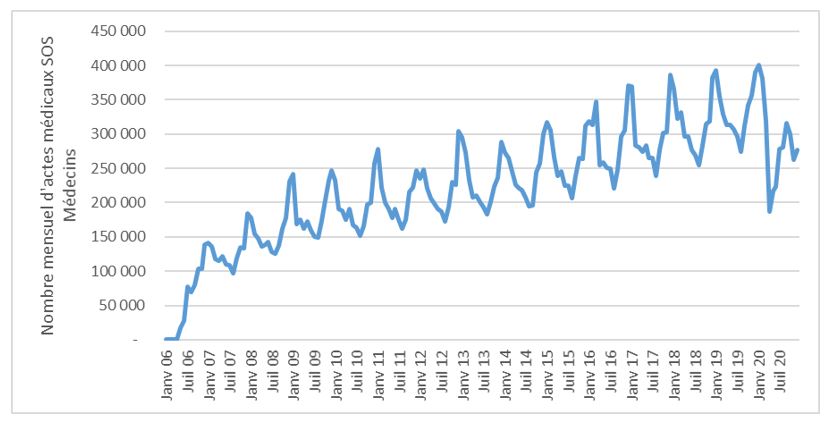
Figure - Monthly number of medical visits to SOS Médecins for all causes, coded since 2006 – all ages – France
Methodological notes on the production of indicators based on data from the SOS Médecins network
SOS Médecins data is transmitted on the day following the medical procedure and updated daily through the third day. In theory, therefore, it can be consolidated for three days following the medical procedure. This consolidation applies to the number of procedures reported and the diagnostic coding of these procedures. On average, 99% of procedures are transmitted on Day 1 and 100% by Day 2. The diagnostic coding rate averages 95% after consolidation and averages 93% on Day 1, rising to 95% by Day 2. We can therefore consider the data to be virtually consolidated as of Day 1.
The analyses that inform the graphs and tables presented in the monitoring reports are based on a constant sample of associations over the study period. This allows, when interpreting the results, for the exclusion of any day-to-day data gaps that may occur in the event of occasional and temporary interruptions in data transmission from one or more associations (primarily due to technical issues). The number of associations comprising the constant sample may vary from one analysis period to another, resulting in a slight discrepancy in the figures presented in successive bulletins.
Partners
SOS Médecins France website: http://www.sosmedecins-france.fr












