



Data
5% of the population report having had suicidal thoughts in the past 12 months, and 5% report having attempted suicide at some point in their lives
8.6%
prevalence of reported suicidal thoughts in the past 12 months among 18- to 29-year-olds in 2024
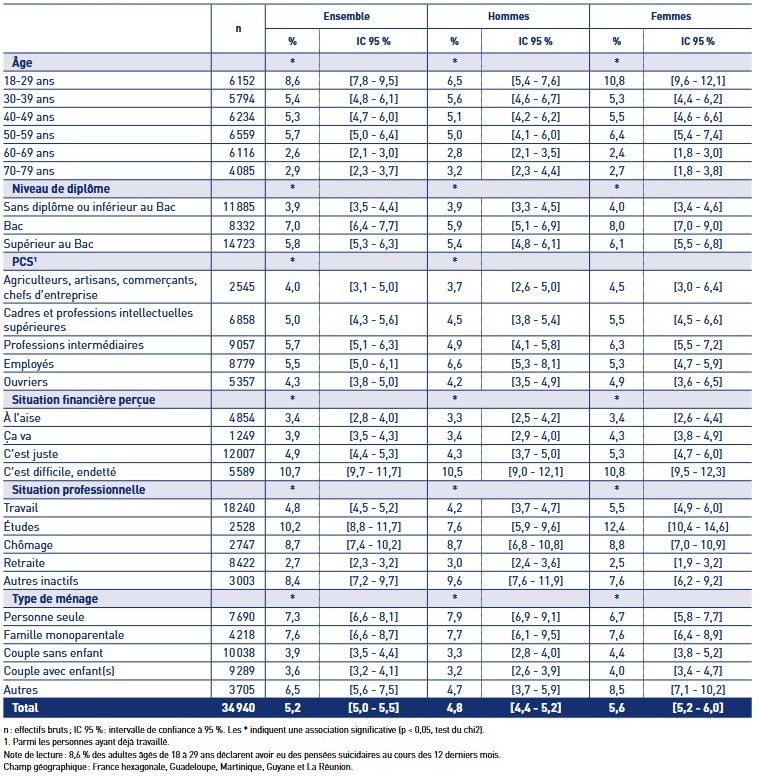
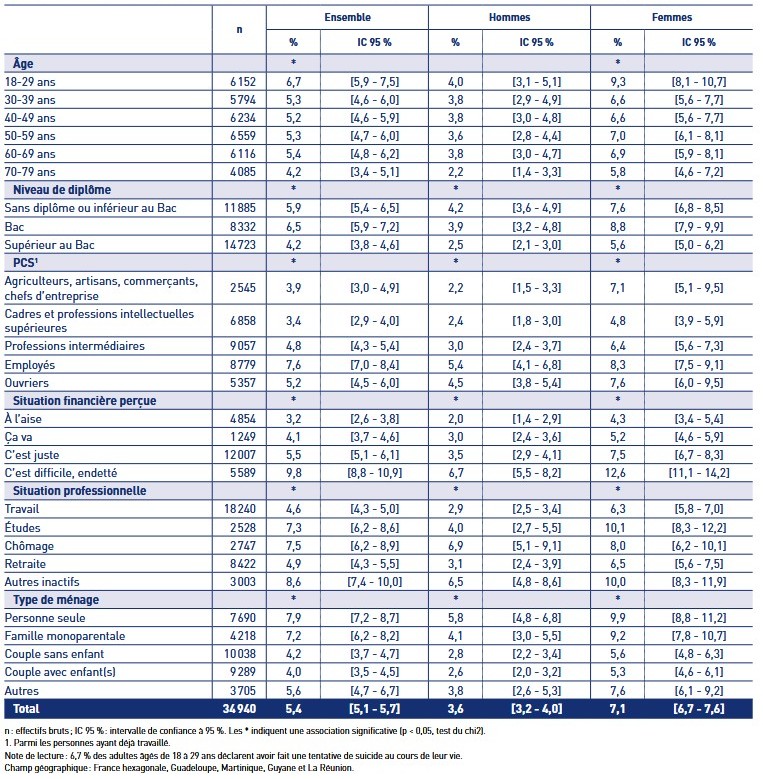
According to the 2024 Santé publique France Barometer, 5.2% of adults aged 18 to 79 in mainland France and the overseas departments and regions (excluding Mayotte) reported having had suicidal thoughts in the past 12 months (5.6% of women and 4.8% of men), 5.4% reported having attempted suicide at some point in their lives (7.1% of women vs. 3.6% of men) and 0.4% in the year preceding the survey (0.5% of women vs. 0.3% of men). Those aged 18–29 stand out as the most affected group, with prevalence rates of 8.6% for suicidal thoughts, 6.7% for lifetime suicide attempts, and 1.0% for suicide attempts in the past 12 months.
The 2024 edition of the Santé publique France Barometer introduced major changes to the survey methodology (new sampling design, data collection primarily via the Internet). Consequently, no trends can be identified through a direct comparison between the 2024 and 2021 data.
As a reminder, a sharp increase in suicidal behavior had been observed among 18- to 24-year-olds. The prevalence of suicidal thoughts within the past year thus rose from 3.3% to 7.2% between 2017 and 2021, and the prevalence of lifetime suicide attempts from 6.1% to 9.2% between 2017 and 2021, whereas it had remained stable between 2000 and 2017. In this age group, young women were particularly affected, with rates reaching 9.4% for suicidal thoughts and 12.8% for lifetime suicide attempts.
Beyond the effects of age or gender, our research shows that in 2024, unemployed individuals and, more broadly, those in precarious situations—whether living alone or in single-parent families—are more likely to engage in suicidal behavior.
Percentage of adults aged 18–79 who reported having suicidal thoughts in the past 12 months
Proportion of adults aged 18–79 who report a lifetime suicide attempt
Learn more

rapport/synthèse
4 September 2026
Suicidal Behavior: Prevalence of Suicidal Thoughts and Suicide Attempts. Santé publique France Barometer: Results from the 2024 Edition
Suicide Risk Monitoring Systems: Key Points 2024
SNDS CépiDc 2023 (all ages):
- 13 suicide deaths per 100,000 residents
SNDS PMSI-MCO 2024 (all ages):
- 142 hospitalizations for self-harm per 100,000 inhabitants
OSCOUR® 2024 (all ages—excluding PACA and Corsica):
- 4.5 emergency department visits due to self-harm per 1,000 visits
Public Health France Barometer 2024 (ages 18–79 – excluding Mayotte):
- 5.2% report having had suicidal thoughts in the past 12 months
- 5.4% report a suicide attempt at some point in their lives
- 0.4% report a suicide attempt in the past 12 months
3,114:
- 215,093 calls received from June through December 2024
VigilanS:
- 41,777 individuals enrolled in the program in 2024
Emergency room visits for self-harm remained stable in 2024, with high rates among young girls and women
In 2024, 77,041 emergency department visits for self-harm—including suicide attempts and self-mutilation—were recorded in France (mainland France plus overseas departments and regions, excluding Provence-Alpes-Côte d’Azur and Corsica), a figure stable compared to 2023. Emergency department visits for self-harm accounted for 4.5 ‰ of total emergency department activity (stable compared to 2023).
Among visits due to self-harm, nearly two out of three involved women. Across all age groups and for both genders, no significant changes were observed over the past three years. Among women, the 11–17 and 18–24 age groups had the highest shares of visits due to self-harm (17.8‰ and 14.1‰, respectively). Among men, the 18–24 and 25–44 age groups had the highest rates of hospitalizations for self-harm (5.2‰ and 4.6‰, respectively).
Hospitalizations for self-harm on the rise in 2024, with a more pronounced increase among girls and women aged 11–24
The number of hospitalizations for self-harm (HGAI), including suicide attempts and self-mutilation, in France (mainland France + overseas departments and regions) continued to rise in 2024, with 97,302 hospitalizations recorded (+7% compared to 2023). This figure corresponded to a standardized rate of 142 hospitalizations per 100,000 inhabitants (+6% compared to 2023). The observed increase affected both genders (+7% among women and +5% among men).
Nearly 2 out of 3 hospitalizations involved women. Among women, the highest rates were observed in the 11–17 and 18–24 age groups (674 and 424 hospitalizations per 100,000 women, respectively), which were significantly higher than in other age groups. Among men, those aged 18–24 and 25–44 had the highest hospitalization rates (166 and 152 hospitalizations per 100,000 men, respectively). An analysis of trends over the past five years highlights the need for increased vigilance regarding young people, whose hospitalization rate has been rising steadily since the COVID-19 health crisis.
Suicide Deaths Remained Stable in 2023, with Excess Mortality Among Men
The number of suicide deaths in France (mainland France + overseas departments and regions) remained relatively stable in 2023, with 8,848 deaths recorded. This figure corresponded to a standardized rate of 13 deaths per 100,000 inhabitants (down 4% from 2022). Over the past five years, standardized suicide death rates have remained generally stable nationwide for both sexes.
Nearly 3 out of 4 deaths were among men. Among men, those aged 65 and older and those aged 45–64 had the highest rates (37 and 29 deaths per 100,000 men, respectively). Among women, those aged 45–64 had the highest death rate, followed by those aged 65 and older (10 and 9 deaths per 100,000 women, respectively).
More than 3% of 17-year-olds reported having made a suicide attempt that resulted in hospitalization at some point in their lives
In 2022, according to the results of the Escapad survey, 3.3% of 17-year-olds reported having made a suicide attempt at some point in their lives that required hospitalization. Nearly one in five young people reported having thought about suicide at least once in the 12 months leading up to the survey. This phenomenon, which is strongly gender-specific, affects girls twice as often as boys (24.0% versus 12.3%).
1 in 5 adolescents reports having thought about suicide at least once
Suicidal behaviors are strongly associated with a high risk of depression. There is a strong link between suicide attempts and the use of psychoactive substances, particularly the use of illicit substances other than cannabis among boys and daily tobacco use among girls.
A comparison with the previous edition of the survey (2017) reveals a significant increase in suicide attempts requiring hospitalization (from 2.9% to 3.3%) and a sharp increase in suicidal thoughts (from 11.4% in 2017 to 18.0% in 2022).
Suicidal thoughts are five times more common among deaf and hard-of-hearing people
According to the Health Barometer for the Deaf and Hard of Hearing (2011–2012), suicidal thoughts in the past 12 months were five times more common among deaf and hard-of-hearing individuals compared to data from the general population in the 2010 Health Barometer (21.3% vs. 3.9%), and lifetime suicide attempts were three times higher for men and twice as high for women. However, unlike the data for the general population, the prevalence of suicidal thoughts within the sample was as high among men (21.9%) as it was among women (20.7%).
Learn more

Suicidal Thoughts, Suicide Attempts, and Experiences of Violence Among Deaf and Hard-of-Hearing Populations in France. Results from the Health Barometer for the Deaf and Hard-of-Hearing, 2011–2012
Nearly 4% of the employed workforce report having suicidal thoughts during the year, with significant differences by industry
In 2017, according to the Santé publique France survey, 3.8% of the "employed labor force" data-tooltip-title="employed labor force" data-tooltip-content="" data-tooltip-placeholder-is-selection="true" data-tooltip-placeholder-is-selection-text="employed workforce" data-tooltip-data="[{"tooltipTitle":"Employed Workforce","tooltipContent":"","placeholderIsSelection":"true","placeholderIsSelectionText":"employed"}]">employed individuals reported having had suicidal thoughts in the past 12 months (4.5% of women and 3.1% of men). For 45.0% of employed men, work-related reasons were the primary cause cited (34.7% among employed women). For one in five men and one in eight women, work-related reasons were the sole cause cited. Self-employed men were more frequently prone to suicidal thoughts than employees (4.3% versus 2.8%). The prevalence of suicidal thoughts was significantly higher among individuals with incomes below 1,500 euros per month (7.7% among women and 4.8% among men).
Suicidal thoughts were associated with fear of losing one’s job, having been subjected to verbal threats, humiliation, or intimidation at work, and having experienced a long period of unemployment during the past 12 months.
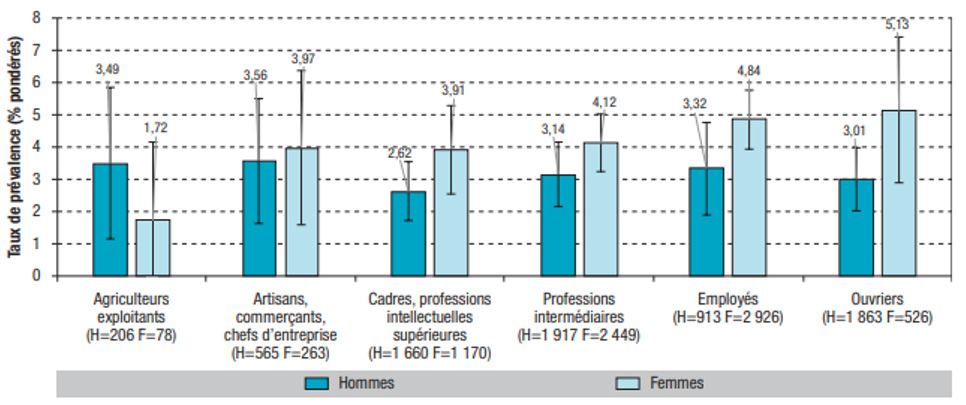
Prevalence of suicidal thoughts by socio-occupational category
No significant difference was observed by gender. However:
- among women, an increasing social gradient appeared to exist between managers (3.9%) and female manual workers (5.1%);
- among men, farm operators (3.5%) and artisans, merchants, and business owners (3.6%) were affected more frequently.
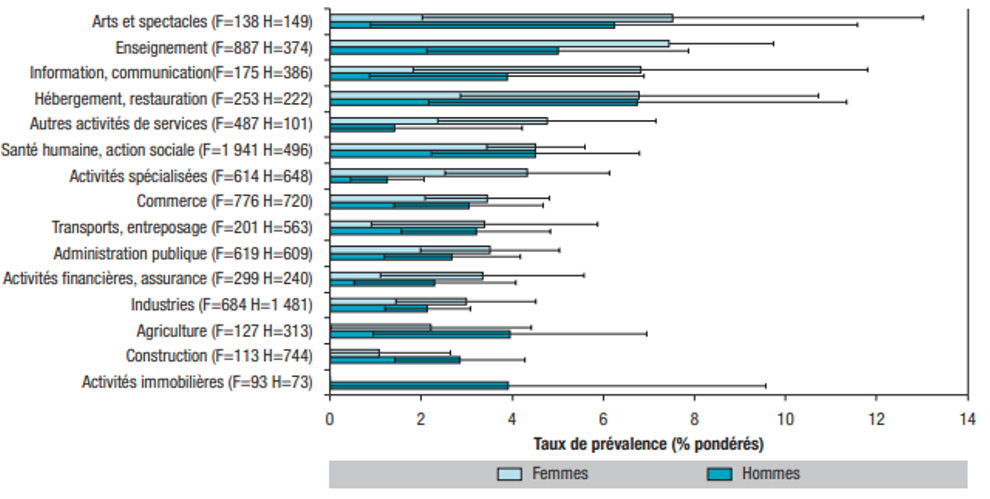
Prevalence of suicidal thoughts by industry
Men working in the accommodation and food services (6.8%), arts and entertainment (6.3%), education (5.0%), and human health and social work (4.5%) sectors had the highest prevalence rates. Women working in the arts and entertainment (7.5%), education (7.5%), information and communication (6.8%), and accommodation and food services (6.8%) sectors were the most affected.
Prevalence of suicidal thoughts in the past 12 months by socioeconomic category and sex among the employed labor force
Prevalence rates of suicidal thoughts in the past 12 months, by industry and by sex, among the employed labor force
Learn more
Suicidal Thoughts Among the Employed Workforce in France in 2017
A marked excess mortality rate among active farmers
An increased risk of death by "deliberate act of self-harm" data-tooltip-title="deliberate act of self-harm" data-tooltip-content="" data-tooltip-placeholder-is-selection="true" data-tooltip-placeholder-is-selection-text="suicide" data-tooltip-data="[{"tooltipTitle":"Act of deliberately take one’s own life","tooltipContent":"","placeholderIsSelection":"true","placeholderIsSelectionText":"suicide"}]">Suicide has been observed among farmers in several French and international studies. Santé publique France and the Caisse centrale de la mutualité sociale agricole (CCMSA) have partnered to produce regular indicators of suicide mortality among the farming population. The analyses focused on suicide mortality among farm owners from 2007 to 2011 and among agricultural workers from 2007 to 2013.
Among farm owners
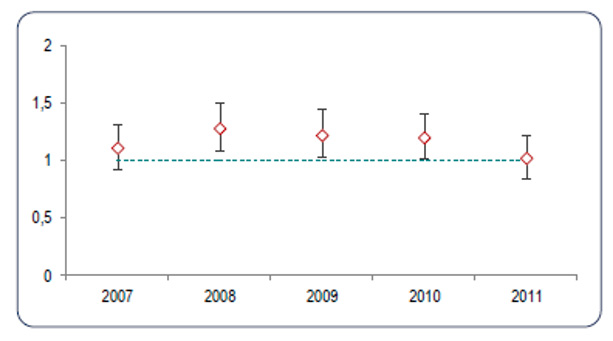
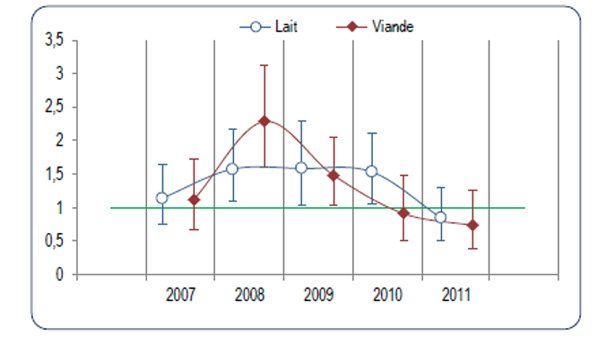
Male farm owners exhibited excess mortality due to “deliberate self-harm” data-tooltip-title="deliberate self-harm" data-tooltip-content="" data-tooltip-placeholder-is-selection="true" data-tooltip-placeholder-is-selection-text="suicide" data-tooltip-data="[{"tooltipTitle":"The act of deliberately taking one’s own life","tooltipContent":"","placeholderIsSelection":"true","placeholderIsSelectionText":"suicide"}]">suicide between 2008 and 2010 compared to the general male population of similar age, particularly among cattle ranchers and men aged 45 to 65.
The sociodemographic and occupational characteristics associated with suicide mortality were:
- being between the ages of 45 and 54 compared to those under 35;
- operating a farm as a sole proprietor compared to operating a farm as a corporate entity;
- being a full-time farmer;
- having an utilised agricultural area (UAA) of between 20 and 49 hectares, compared to having a UAA of more than 200 hectares;
- and having a farm located in Auvergne-Rhône-Alpes, Bourgogne-Franche-Comté, Brittany, or Hauts-de-France, as opposed to having a farm located in Grand-Est.
Among agricultural employees
Agricultural workers did not show an excess suicide mortality rate compared to the general population. However, certain occupational characteristics were associated with suicide among male agricultural workers:
- work in the “forestry,” “crops and livestock,” “contracting,” and “cooperative” sectors;
- employee status;
- working in Brittany, Burgundy-Franche-Comté, Pays de la Loire, Normandy, Grand Est, and Centre-Val-de-Loire.
None of the associations studied were observed among women.
Trends in Suicide-Related Mortality Rates Among Male Farm Owners Between 2007 and 2011
Trends in Suicide-Related Deaths Among Dairy and Beef Cattle Farmers Between 2007 and 2011
References
Report: “Monitoring Suicide Mortality Among Farming Operators—Situation in 2010–2011 and Trends from 2007 to 2011.”
Klingelschmidt J, Chastang JF, Khireddine-Medouni I, Chérié-Challine L, Niedhammer I. Occupational factors associated with suicide among French employees covered by the special agricultural social security scheme (MSA) who were employed between 2007 and 2013. Journal of Epidemiology and Public Health. 2020;68(1):1-8.
Klingelschmidt J, Chastang JF, Khireddine-Medouni I, Chérié-Challine L, Niedhammer I. Suicide mortality among employees affiliated with the agricultural social security scheme who were active between 2007 and 2013: description and comparison with the general population. Weekly Epidemiology Bulletin. 2018;(27):549-55.
Gigonzac V, Breuillard E, Bossard C, Guseva-Canu I, Khireddine-Medouni I. Characteristics associated with suicide mortality among male farm operators between 2007 and 2011. Saint-Maurice: Santé publique France; 2017. 10 p
Bossard C, Santin G, Guseva Canu I. Surveillance of suicide mortality among active farmers. Preliminary results. Saint-Maurice: Institute for Health Surveillance; 2013. 26 p.
In relation to

Mental distress and burnout
thematic dossier
Mental health can be affected by certain psychosocial workplace exposures, leading to conditions such as burnout, depression, and suicidal behavior.

Post-traumatic stress
thematic dossier
Terrorist attacks have a profound and lasting psychological impact on exposed civilians and first responders, particularly on civilians who were directly threatened or have lost loved ones, but...












