



The disease
The Scale of the Phenomenon
Research on suicidal behavior (see reports from the National Suicide Observatory—ONS) shows that, beyond individual factors, suicidal behavior is shaped by socio-environmental contexts (economy, employment, living environments, exposure to violence, isolation, access to prevention and care services) that strongly influence individuals’ life trajectories and mental health. From this perspective, suicide cannot be reduced to an individual and deliberate choice. Rather, it is more an expression of a lack of choice—a perceived absence of alternatives—aimed at putting an end to suffering or a situation that has become intolerable.
Suicide
According to estimates by the World Health Organization (WHO), suicide is the 14th leading cause of death worldwide, with more than one million deaths each year. By 2030, this figure is expected to rise by 50%, making suicide the 12th leading cause of death. It is therefore a major public health issue.
France has one of the highest suicide rates in Europe.
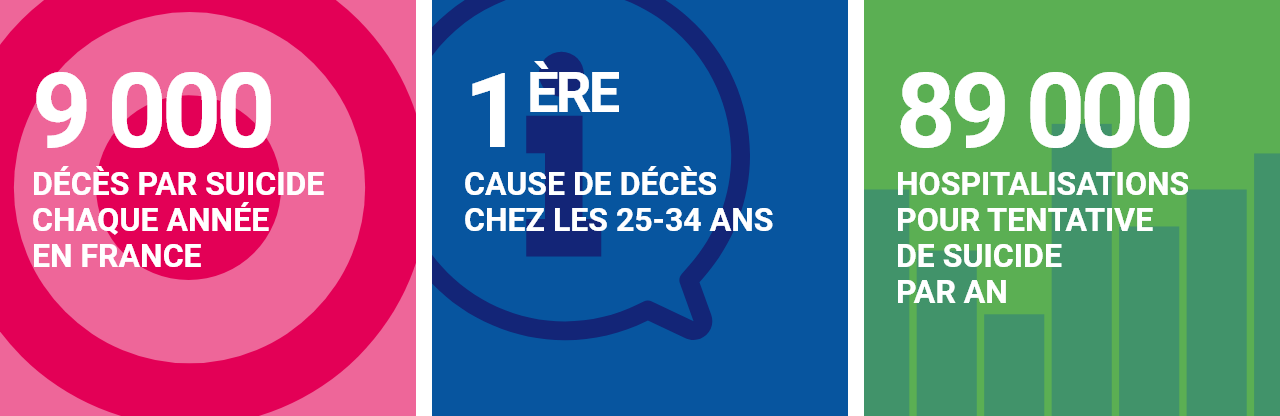
In France, 9,300 suicide deaths—three-quarters of which were men—were recorded in 2016 (CepiDc-Inserm data). They account for approximately 1.5% of all deaths in France.
In 2016, suicide was the leading cause of death among 25- to 34-year-olds (~19% of total deaths) and the second leading cause among 15- to 24-year-olds (15% of total deaths). The suicide rate increases with age, more sharply among men than among women.
Regional Disparities
The regions of Brittany, Pays de la Loire, Normandy, and Hauts-de-France had rates significantly above (>20%) the national average for both sexes, as did Nouvelle-Aquitaine for men and Bourgogne-Franche-Comté and Centre-Val-de-Loire for women in 2014–2016. Conversely, suicide mortality rates were significantly lower (<20%) than the national average in Île-de-France, Corsica, and the overseas departments and regions (DROM), with the exception of Réunion.
Suicide attempts
International data indicate that suicide attempts (SA) are 10 to 40 times more common than suicides and represent the most significant predictor of death by suicide.
In France, 89,000 hospitalizations for suicide attempts were recorded in 2017, representing a rate of 15.1 per 10,000 inhabitants. This number has been declining over the past 10 years.
Overall, hospitalizations are higher among women than among men, except for those over 85 years of age, with a peak observed among women aged 15 to 19 and among women aged 40 to 49. Conversely, the rate increases with age among men, peaking among those aged 40–49, then decreases among those aged 70–74 before rising again at the extreme ends of the age spectrum. In 2017, 7.2% of people aged 18–75 reported having attempted suicide at some point in their lives, and 0.4% in the past 12 months.
Regional Disparities
The regions of Brittany, Normandy, Hauts-de-France, and Burgundy-Franche-Comté had hospitalization rates between 2008 and 2017 that were significantly higher (>20%) than the national rates for both genders, and in Nouvelle-Aquitaine among women in 2017. Conversely, rates were significantly lower (<20%) than the national rates in Île-de-France, Occitanie, Corsica, and the overseas departments and regions (DROM), with the exception of Réunion.
Key statistics on suicidal behavior
Methods
Suicide
The most common method of suicide is hanging (58%), followed by firearms (13%) and the ingestion of medications and other substances (10%).
These methods differ by gender: among men, hanging accounts for 62% of suicides and firearms for 16%, while among women, hanging (44%) and the use of medications and other substances (21%) are the most common methods.
Suicide Attempts
Intentional medication overdose is the most common method of suicide attempts followed by hospitalization (87% among women and 75% among men, respectively). Other methods include poisoning by non-medicinal substances (7% among women and 12% among men), injuries caused by sharp objects (7% among women and 8% among men), and hanging (1% and 4%, respectively).
Risk factors for suicide and suicide attempts
personal history of suicide attempts, which is the most significant predictor of death by suicide;
family history of suicide attempts and suicide;
psychiatric disorders (mood disorders, eating disorders, personality disorders, psychotic disorders, substance use disorders, etc.);
personality traits: low self-esteem, impulsivity-aggressiveness, etc.;
physical health: chronic or disabling illnesses, conditions affecting quality of life;
personal history of childhood abuse (physical, psychological, or sexual abuse) or the loss of a parent during childhood;
financial or occupational difficulties;
social isolation, widowhood, separation;
experiencing a humiliating event, having been a victim of harassment;
“contagion” phenomenon following the suicide of another person.
Suicide and Suicidal Behavior: A Public Health Issue
Suicide was declared a public health priority in 1996, and a national prevention policy was implemented by the government. To this end, over the years, risk prevention measures have been incorporated into several government plans and national action programs aimed at addressing suicide and suicide attempts. A National Suicide Observatory was established in 2013 (Decree No. 2013-809 of September 9, 2013) to coordinate surveillance and research efforts in the field of suicide and suicide attempts. Santé publique France is responsible for coordinating surveillance-related activities.
More recently, the Ministry of Health set out guidelines in its mental health and psychiatry roadmap of June 28, 2018, with two complementary objectives:
an objective of promoting mental health and preventing mental disorders (given the close links between mental disorders and suicide):
to intervene early by strengthening individual protective factors (development of psychological and social skills, parenting support) with expected effects in the medium and long term,
promote living environments and settings conducive to mental health (family, school, work, access to care and support services).
a prevention objective focused on those most at risk (suicidal individuals with a history of suicide attempts, or those with depression).
The strategy, outlined in the directive of July 19, 2019, is to propose that regional health agencies combine, within their respective territories, a set of actions identified as effective in the scientific literature. These include:
maintaining contact with people who have attempted suicide;
training in the identification, assessment, and intervention for suicidal crises;
preventing suicide contagion;
establishing a national suicide prevention hotline;
improving public information.
Links
Decree No. 2013-809 of September 9, 2013, establishing the National Suicide Observatory
Decree No. 2018-688 of August 1, 2018, establishing the National Suicide Observatory
Inserm (fact sheet)
In relation to

Mental distress and burnout
thematic dossier
Mental health can be affected by certain psychosocial workplace exposures, leading to conditions such as burnout, depression, and suicidal behavior.

Post-traumatic stress
thematic dossier
Terrorist attacks have a profound and lasting psychological impact on exposed civilians and first responders, particularly on civilians who were directly threatened or have lost loved ones, but...












