
thematic dossier



Santé publique France has released updated surveillance data on hepatitis B, C, and Delta, which show an increase in hepatitis B vaccination rates and in screening for hepatitis B and C.
thematic dossier
The World Health Organization has set a global goal of eliminating hepatitis B virus (HBV) and hepatitis C virus (HCV) by 2030. France has committed to eliminating hepatitis C by 2025 by intensifying prevention and screening efforts targeting the most at-risk populations and by improving access to care and treatment for hepatitis C.
To provide data to help evaluate the measures implemented, Santé publique France is publishing an update on epidemiological indicators for hepatitis B, C, and Delta, specifically:
Screening and diagnosis of hepatitis B, C, and Delta:
across all clinical laboratories, including all tests—whether reimbursed or not, with or without a prescription—based on the 2021 LaboHEP survey;
based on health insurance reimbursement data, including tests performed in private-sector laboratories (community laboratories and private healthcare facilities) and public-sector laboratories (excluding tests performed during hospitalization) and reimbursed (Hepatitis B screening; Hepatitis C screening; Hepatitis Delta screening);
at CeGIDDs (Free Centers for Information, Screening, and Diagnosis of HIV, Viral Hepatitis, and Sexually Transmitted Infections) based on the SurCeGIDD surveillance system.
Individuals with a long-term illness (ALD) due to chronic hepatitis C or chronic hepatitis B (ALD Hepatitis B; ALD Hepatitis C);
Data from the mandatory reporting (DO) of acute hepatitis B (DO Acute Hepatitis B).
Epidemiological indicators at the regional or departmental level have also been updated on Géodes.
In 2021, the estimated number of screening tests based on the LaboHEP survey was 5.1 million for hepatitis C virus antibodies (anti-HCV antibodies) and 5.4 million for hepatitis B virus antigen (HBsAg). Compared to 2016, these estimated testing numbers increased by 24% for anti-HCV antibodies and by 25% for HBsAg.
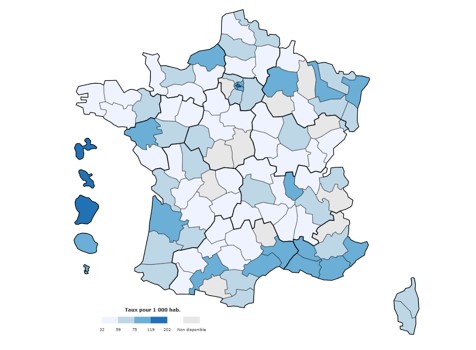
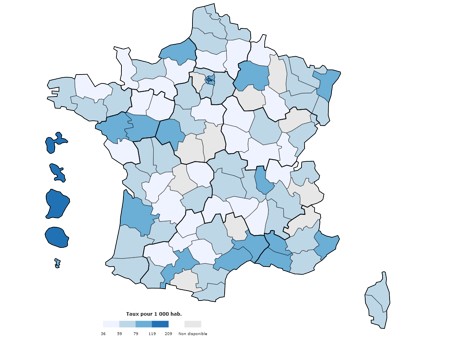
Relative to the population living in France in 2021, these figures correspond to screening rates of 76 per 1,000 inhabitants for anti-HCV antibodies and 80 per 1,000 inhabitants for HBsAg. They were higher:
in Île-de-France (101 per 1,000 for anti-HCV antibodies, 104 per 1,000 for HBsAg);
in Provence-Alpes-Côte d’Azur (92 per 1,000 for anti-HCV antibodies and HBsAg);
and in the French overseas departments and regions (129 per 1,000 for anti-HCV antibodies, 148 per 1,000 for HBsAg).
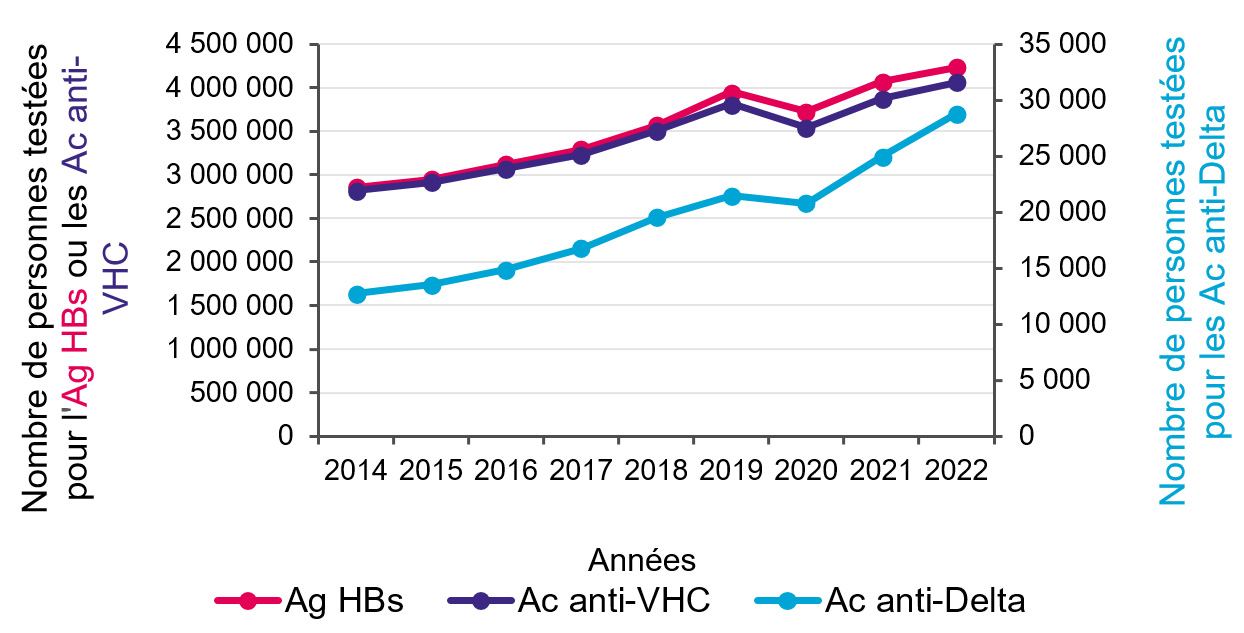
During the 2014–2022 period, Health Insurance reimbursement data show an annual increase in the number of people tested ranging from 3% to 9% for anti-HCV antibodies and from 3% to 12% for HBsAg, with the exception of 2020, which saw a decrease of 7% and 6% for anti-HCV antibodies and HBsAg, respectively. For anti-HDV antibodies, the annual increase in the number of people tested was even greater, ranging from 7% in 2015 to 20% in 2021, with the exception of 2020 (a 3% decrease).
In 2021, across all clinical laboratories, the positivity rates of screening tests (the proportion of positive tests among all screening tests performed) were estimated at 0.67% and 0.69% respectively for anti-HCV antibodies and HBsAg, based on the 2021 LaboHEP survey. These rates are lower than those estimated in 2016: 0.73% and 0.79% respectively for anti-HCV antibodies and HBsAg (2016 LaboHEP survey). They were higher in mainland France than in the overseas departments and regions (0.70% vs. 0.41% for anti-HCV antibodies; 0.70% vs. 0.62% for HBsAg). The highest rates were observed in Île-de-France (0.89% for anti-HCV antibodies, 1.32% for HBsAg) in mainland France and in French Guiana (0.75%) for anti-HCV antibodies and in Mayotte (2.08%) for HBsAg in the French overseas departments and regions (DROM).
In the CeGIDD centers that participated in the SurCeGIDD surveillance program (183 out of 303 centers surveyed) in 2021, positivity rates were 0.64% for anti-HCV antibodies and 0.83% for HBsAg. Rates were 0.62% in metropolitan France excluding Île-de-France, 0.49% in Île-de-France, and 0.74% in the French overseas departments and regions (DROM) for anti-HCV antibodies, and 0.74% in metropolitan France excluding Île-de-France, 1.0% in Île-de-France, and 1.34% in the DROM for HBsAg.
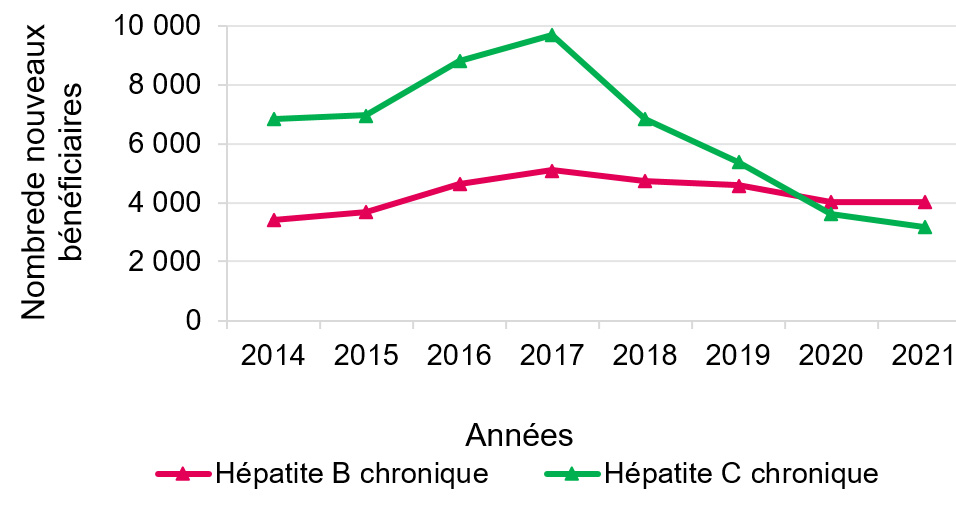
In 2021, 3,171 people were newly eligible for ALD coverage for chronic hepatitis C, which, relative to the population living in France, corresponds to a rate of 5 per 100,000 inhabitants. The annual number of new beneficiaries has been declining since 2017, following a trend similar to that of the annual number of patients who began treatment with direct-acting antivirals for HCV infection.
That same year, 4,029 people were newly granted ALD status for chronic hepatitis B in France, representing a rate of 6 per 100,000 inhabitants. The annual number of new beneficiaries has also been declining since 2017.
This data update supplements the information published in the BEH special issue on hepatitis B, C, and Delta, released on July 25, 2023.
Hepatitis refers to diseases of the liver. They are most often caused by a viral infection or have a toxic origin (alcohol and certain medications).
Viral hepatitis is classified from A to E based on the family of the virus involved. Their main common feature is their ability to infect liver cells and replicate within them. In response to this infection, the host’s immune system reacts, leading to the destruction of infected cells and inflammation (hepatitis).
Hepatitis B and C virus infections are very often asymptomatic. During the acute phase of the infection, symptoms may include yellowing of the skin and eyes (jaundice), dark urine, extreme fatigue, nausea or vomiting, and abdominal pain.
Vaccination is the most effective means of preventing hepatitis B.

What are vaccines for? How do they work? At what age should children be vaccinated? Vaccination-info-service.fr answers the most frequently asked questions about vaccination. A separate...












