



Data on the management of chronic hepatitis C
Data on Long-Term Conditions (ALD)
The management of chronic hepatitis C is described here through the Long-Term Illness (ALD) program, established by the Health Insurance system, with data available in the National Health Data System (SNDS). Analysis of the SNDS’s Inter-Regime Consumption Data (DCIR) makes it possible to identify and estimate the total number of beneficiaries and the number of new beneficiaries of the ALD for chronic hepatitis C (ALD6) (ICD-10 code = B182) during a given year and to track their trends over time.
These data pertain only to beneficiaries of the general scheme, the Local Mutual Insurance Sections (SLM), the Bank of France (BDF), the special health insurance scheme for the electricity and gas industries (CAMIEG), the National Military Social Security Fund (CNMSS), and the Pension and Welfare Fund for Clerks and Notary Employees (CRPCEN).
Total number of ALD beneficiaries (prevalence data)
Nationally
Over the period 2010 to 2023
The data presented below cover the period from 2010 to 2023. However, the 2023 data were not estimated using an algorithm similar to that used for previous years and therefore require consolidation from the SNDS. Trends are therefore discussed for the period from 2010 to 2022.
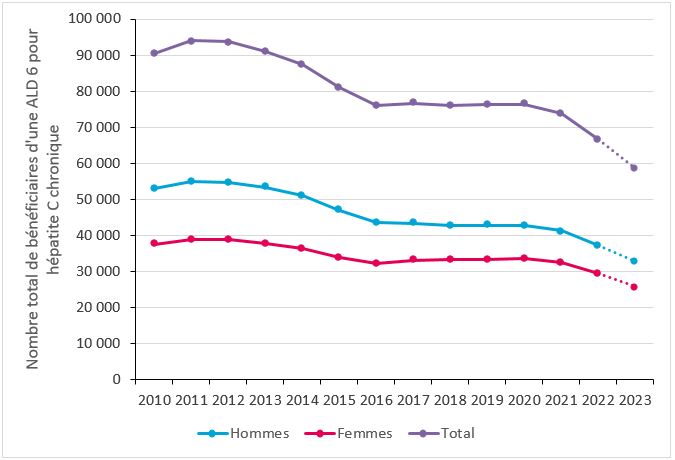
The data show an increase in the total number of people receiving ALD6 coverage for chronic hepatitis C between 2010 and 2011 (n=94,004), followed by a 19% decrease between 2011 and 2016 (75,952 beneficiaries in 2016), a stabilization at around 76,000 people between 2016 and 2020, and then another decrease between 2020 and 2022 (n=66,606).
Over the entire period, the majority of these recipients were men (57%), and 92% of them were at least 40 years old.
Annual change in the total number of people with a long-term illness (ALD6) due to chronic hepatitis C during the year in question, 2010–2023, France
Focus on 2022
In France, 66,606 people were covered by ALD6 for chronic hepatitis C, which, relative to the population living in France, corresponded to a rate of 98 per 100,000 inhabitants.
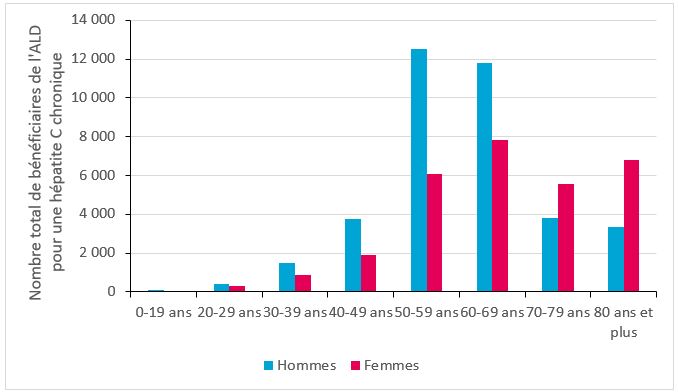
The majority of ALD6 beneficiaries were men (56%). Nearly two-thirds of men and half of women were aged 50 to 69.
Total number of people with ALD6 for chronic hepatitis C in 2022, by sex and age group, France
At the regional and departmental levels
Focus on 2022
In 2022, the rate of patients with an ALD6 designation for chronic hepatitis C was twice as high in mainland France (100 per 100,000) as in the overseas departments and regions (DROM) (45 per 100,000).
In mainland France:
The highest rates were observed in Corsica (187/100,000), Provence-Alpes-Côte d’Azur (PACA) (150/100,000), and Île-de-France (137/100,000); the lowest rates in Hauts-de-France (52 per 100,000) and Pays de la Loire (55 per 100,000).
At the departmental level, Southern Corsica (199/100,000), Paris (197/100,000), and Alpes-Maritimes (190/100,000) had the highest rates, while the lowest rates were observed in Pas-de-Calais (35/100,000) and Mayenne (37/100,000).
In the overseas departments and regions (DROM):
The rates were 64 per 100,000 in Martinique, 59 per 100,000 in Guadeloupe, 47 per 100,000 in Réunion, and 45 per 100,000 in French Guiana. The very low number of beneficiaries in Mayotte did not allow for a reliable estimate of this rate.
See Géodes:
Number of people with a long-term illness (ALD) for chronic hepatitis C
Rate of people with ALD for chronic hepatitis C (per 100,000 inhabitants)
Number of new ALD beneficiaries (incidence data)
Over the period 2011 to 2023
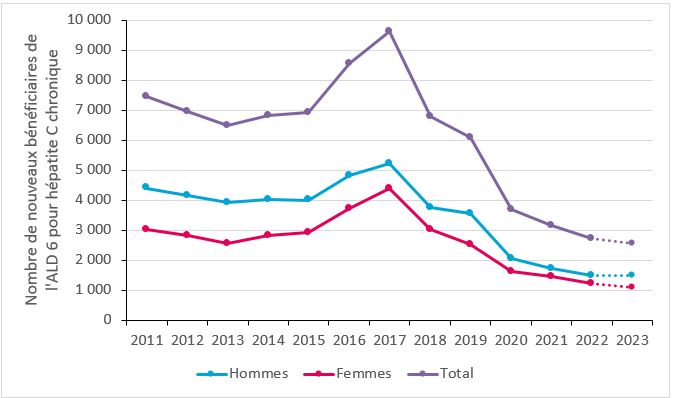
After a decline between 2011 and 2013, the annual number of new ALD6 beneficiaries for chronic hepatitis C increased from 2014 (n=6,829) through 2017 (n=9,617), then declined sharply through 2023 (n=2,573).
Annual change in the number of new ALD6 beneficiaries for chronic hepatitis C during the year in question, 2011–2023, France
A Look at 2022
In 2022, 2,726 people in France were newly diagnosed with chronic hepatitis C and granted ALD6 status, which, relative to the population living in France, corresponded to a rate of 4 per 100,000 inhabitants.
In mainland France, this rate of new ALD6 cases was 4 per 100,000 and was highest in Corsica (9 per 100,000), in the Provence-Alpes-Côte d’Azur region (6 per 100,000), in the Île-de-France region (5 per 100,000), in Grand Est (5 per 100,000), and in Occitanie (5 per 100,000). It ranged from 2 to 4 per 100,000 in the other mainland regions. At the departmental level, the highest rates were observed in Southern Corsica (10 per 100,000), Upper Corsica (9 per 100,000), the Alpes-Maritimes (8 per 100,000), and the Bas-Rhin.
In the overseas territories, the rate of people newly covered by ALD6 was 3 per 100,000 inhabitants in Guadeloupe, and 2 per 100,000 in Martinique, Réunion, and French Guiana.
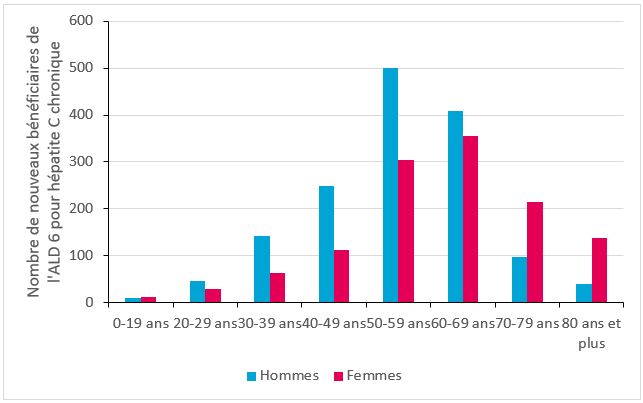
New ALD6 beneficiaries for chronic hepatitis C in France in 2022 were predominantly men (55%). The most represented age groups were those aged 50–59 (33% of men, 25% of women) and those aged 60–69 (27% of men, 29% of women).
Number of new ALD6 beneficiaries for chronic hepatitis C in 2022, by sex and age group, France
Check Géodes:
Number of new cases of chronic hepatitis C classified as a long-term illness (ALD)
Rate of new cases of chronic hepatitis C classified as a long-term illness (per 100,000 inhabitants)
Data on initiations of treatment with direct-acting antivirals (DAAs)
During the 2014–2021 period, the number of DAA initiations was 96,776 in mainland France (SNDS data, CNAM analysis). The annual number of patients starting DAA treatment increased between 2014 and 2017, from 11,500 to 19,248, then decreased to 6,972 in 2020 and 5,997 in 2021. Over the entire 2014–2021 period, the rate of AAD initiations was 149 per 100,000 in mainland France. The lowest standardized regional rates were observed in Hauts-de-France (77/100,000) and Pays-de-la-Loire (89/100,000), and the highest in Occitanie (207/100,000), Île-de-France (215 per 100,000), and PACA (229 per 100,000).
Learn more:
Brouard C, Schwager M, Expert A, Drewniak N, Laporal S, de Lagasnerie G, et al. Impact of public policies and the COVID-19 pandemic on hepatitis C screening and treatment in mainland France, 2014–2021. Bull Épidémiol Hebd. 2023;(15-16):292-301. http://beh.santepubliquefrance.fr/beh/2023/15-16/2023_15-16_3.html
Hospitalization Data
Analysis of data from the PMSI-MCO (Program for the Medicalization of Information Systems—Medicine, Surgery, Obstetrics, and Dentistry) shows, between 2005 and 2020:
a decrease in the rate of patients hospitalized with a primary diagnosis (PD), related diagnosis (RD), or significant associated diagnosis (SAD) of chronic hepatitis C from 0.45% in 2005 to 0.10% in 2020;
an 88% decrease in the number of hospitalized patients with chronic hepatitis C, i.e., those with chronic hepatitis C as a PD/RD or a complication of chronic hepatitis C as a PD/RD associated with chronic hepatitis C as an ASC;
a 58% decrease in the number of deaths among patients hospitalized for chronic hepatitis C.

article
7 February 2022
Prevalence of chronic hepatitis B and C, morbidity, and mortality among hospitalized patients in France, 2005–2020
article
6 September 2019
Prevalence, Morbidity, and Mortality Associated with Chronic Hepatitis B and C Among Hospitalized Patients in France, 2004–2011
National surveillance data on chronic hepatitis C from reference centers and voluntary hepatitis networks
Although data collection began in April 2000, the results are presented starting in 2001, which is considered the reference year due to higher-quality data collection covering a full year.
Tables and figures regarding patients newly enrolled in the reference centers, 2001–2007
Distribution of genotypes by risk exposure(s) among viremic patients
Distribution of risk exposures by patient genotype among viremic patients
Distribution of histological stages (Métavir classification)
Initiation of antiviral treatment in RNA-positive patients managed by reference centers, 2004–2007
In relation to

Hepatitis B and D
thematic dossier
Viral liver infections can be very severe; hepatitis B and D are transmitted through sexual contact, blood, and from mother to fetus. Vaccination and screening are the cornerstones of prevention.

HIV/AIDS
thematic dossier
HIV, or Human Immunodeficiency Virus, is a sexually transmitted human retrovirus. It weakens the immune system, and if left untreated, leads to AIDS.

Illegal drugs
thematic dossier
The use of illicit drugs exposes individuals to various health, social, and legal risks. In light of this major public health issue, prevention is essential.












