



Social inequalities by age and life stage
Social inequalities have long been observed and have an impact on health throughout the life course. Here, as an example, we present data broken down by life stage.
Pregnancy
In 2012, according to the Elfe cohort, the prevalence of gestational diabetes was 7.0% in the general population and 8.9% among screened women. In France, lower rates of gestational diabetes screening were observed among women with the lowest or highest levels of education, and among those without a profession compared to those in intellectual professions. Female manual workers had an increased risk of gestational diabetes compared to those in intellectual professions. Women who tested positive for gestational diabetes had an increased risk of giving birth to a child with a high birth weight for gestational age.
Birth
In 2021, according to the national perinatal survey, in mainland France, the rate of low birth weight (less than 2,500 g) was 15.5% among mothers in households with monthly incomes below €1,000, compared to 9.4% for households with monthly incomes above €3,000. This rate was generally higher in Réunion, Martinique, and Guadeloupe (between 10.5% and 12.4%) compared to 7.1% in mainland France.
Childhood
In 2022, according to the Enabee survey (National Study on Children’s Well-being), children aged 3 to 11 attending preschool and elementary school in France spent an average of:
1 hour and 22 minutes per day for 3- to 5-year-olds;
1 hour and 53 minutes per day for 6- to 8-year-olds;
2 hours and 33 minutes per day for 9- to 11-year-olds.
These durations exceed the WHO’s recommendations for sedentary screen time (max 1 hour/day for ages 2–4) and are twice as high on days without school compared to school days. There is now a scientific consensus recognizing the harmful effects of sedentary behavior linked to screen time—which is mostly passive—on children’s development and health. Associated risks include physical inactivity, overweight and obesity, sleep disorders, cardiovascular risks, and behavioral difficulties, among others.
Screen time was significantly higher:
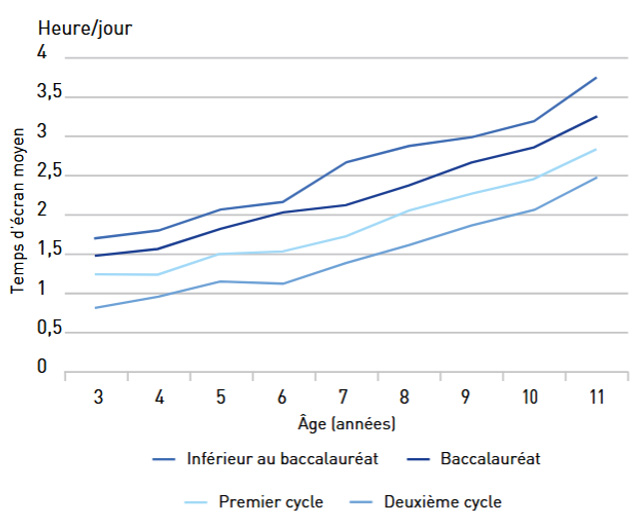
among children whose parents had the lowest levels of education, with this difference observed as early as preschool and persisting with age;
among boys aged 6–8, who were more likely than girls to spend more than 2 hours a day in front of a screen on non-school days;
among boys aged 9–11, who spent more time than girls in front of screens on both school days and days off from school.
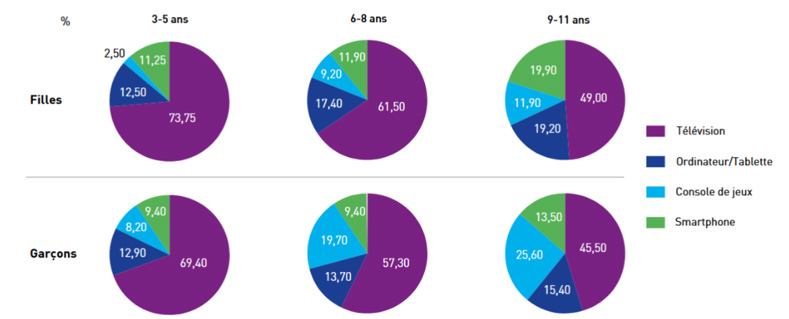
The types of screens used varied by gender:
boys preferred video game consoles (at all ages);
girls used smartphones more (starting at age 9) and accessed social media more (starting at age 6).
Average daily screen time for preschool and elementary school children in mainland France by age, by highest level of education in the household, Enabee, 2022
Breakdown of the average daily screen time among preschool and elementary school children in mainland France, by type of screen, Enabee, 2022
Adults
The prevalence of diabetes is twice as high in the overseas departments and regions (DROM) as in mainland France, where it is higher in the northeastern departments while decreasing in the western departments.
It is more prevalent among people with a middle school education or less (8.9%, according to the Constances study) than among those with other levels of education.
Beyond the onset of diabetes, significant social and regional disparities are observed in the use of healthcare services by people with diabetes and in their health status. The Entred 3 study shows that people with type 2 diabetes living in Réunion and French Guiana are less likely to see general practitioners compared to those in the French West Indies or mainland France. Consultations with a diabetologist are also lower among residents of Guadeloupe, Martinique, French Guiana, and Réunion than in mainland France.
Learn more:
Prevalence and risk factors associated with prediabetes and undiagnosed diabetes in France: The national CONSTANCES cohort (Santé publique France).
Characteristics, health status, and healthcare utilization among people with type 2 diabetes living in overseas territories: results of the Entred 3 study (Santé publique France).
Prevalence of diagnosed diabetes in four overseas departments and regions: Guadeloupe, Martinique, French Guiana, and Réunion. Results of the 2021 Santé publique France Health Barometer (Santé publique France).
Estimated prevalence of diabetes and prediabetes in Mayotte and characteristics of people with diabetes (Santé publique France).












