



Health inequalities: the impact of social determinants of health
Santé publique France has compiled an initial national overview of health inequalities by gender and socioeconomic status in 2024 through the Santé publique France Health Barometer.
In this article
- Health status
- Gender Inequalities in Health: Statistical Data and Social Issues
- Socioeconomic inequalities in relation to health behaviors and prevention messages
- Health behaviors vary depending on socioeconomic status
- Food insecurity
- Health and Social Justice: Prevalent Forms of Discrimination in the Population
Health status
Socially disadvantaged people are in poorer general, physical, and mental health than socially advantaged people
General and Physical Health
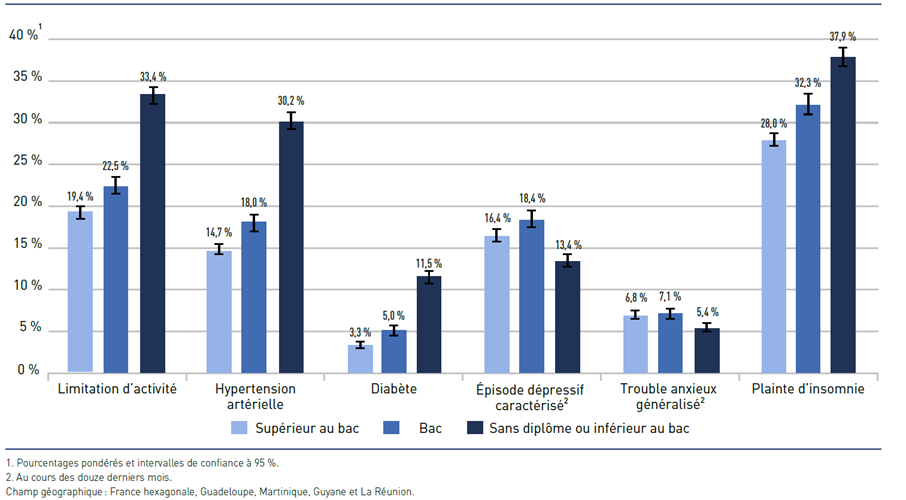
All indicators of general and physical health show a socioeconomic gradient. Regardless of the socioeconomic status indicator used, the most advantaged individuals report better health. For example, those with the highest levels of education more often report perceived health as good or very good (77.6% versus 58.0% for those with the lowest levels of education), report fewer activity limitations, and report being half as likely to have high blood pressure (HBP) and 3.5 times less likely to have diabetes than those with lower levels of education (Figure 1).
Figure 1. Prevalence of various reported indicators of physical and mental health among adults aged 18 to 79, by educational attainment
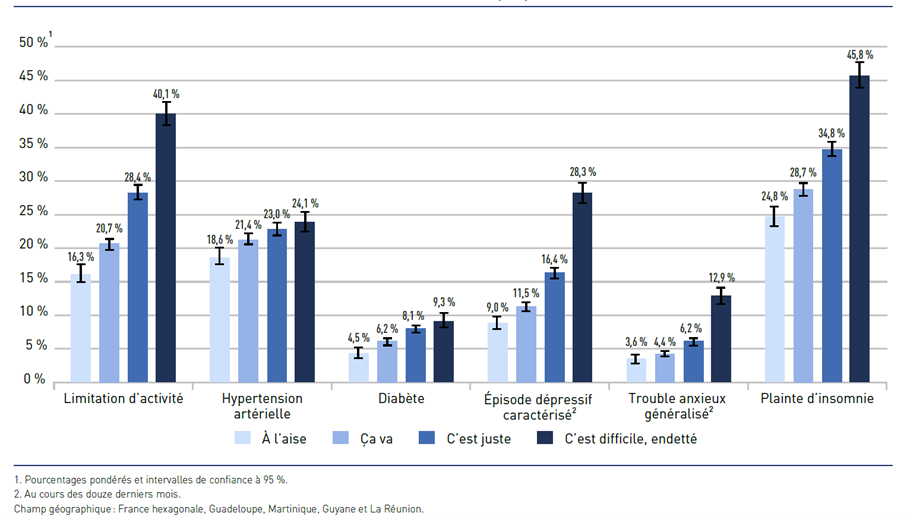
Similarly, people who report being financially better off are more likely to rate their health as good to very good (82.5% compared with 50.4% among those experiencing financial difficulties), report fewer limitations on their activities, and have lower prevalence rates of hypertension and diabetes than those who are less financially well-off (Figure 2).
Figure 2. Prevalence of various self-reported indicators of physical and mental health among adults aged 18 to 79, by perceived financial situation
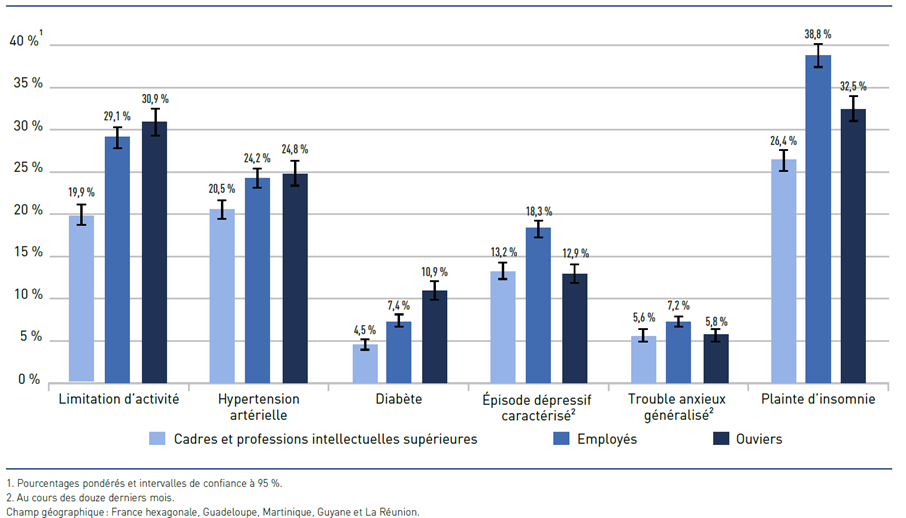
Overall, managers and professionals report better perceived health (77.9% versus 61.7% among manual workers), fewer activity limitations (19.9% versus 30.9% among manual workers), and a prevalence of diabetes that is nearly half as high (4.5% versus 10.9% among manual workers) (Figure 3).
Figure 3. Prevalence of various self-reported indicators of physical and mental health among adults aged 18 to 79 who have ever worked, by socio-occupational category
Mental Health
With regard to mental health, inequalities are particularly pronounced based on financial status, with adverse trends observed among individuals in the least advantaged socioeconomic categories. The prevalence of major depressive episodes, generalized anxiety disorder, and suicidal thoughts is more than three times higher among those who report being financially less well-off than among those who are financially better off (28.3% versus 9.0%; 12.9% versus 3.6%; 10.7% versus 3.4%). Regarding lifetime suicide attempts, the lowest prevalence rates are observed among those with the highest educational attainment (4.2% versus 5.9% for those with the lowest educational attainment), managers and professionals (3.4% versus 7.6% among employees), and the most financially well-off (3.2% versus 9.8% for the least well-off).
Regarding sleep, the more difficult the financial situation is reported to be, the more frequent complaints of insomnia are—rising from 24.8% among the most financially well-off to 45.8% among the least well-off—and the shorter the average sleep duration over a 24-hour period (7 hours and 38 minutes for the most well-off to 7 hours and 22 minutes for the least well-off).
Gender Inequalities in Health: Statistical Realities and Social Challenges
Women report being in poorer health than men in 2024. 65.8% of women report having “good” to “very good” perceived health, compared to 70.3% of men, and 27.3% report activity limitations, compared to 24.6% of men (Figure 4). Conversely, more men report having diabetes and hypertension. In terms of cardiovascular health, health inequalities based on occupation and socio-professional category (SPC) are observed only among women: the prevalence of hypertension is twice as high among manual workers (28.7%) as among managers and professionals (16.1%).
Figure 4. Prevalence of various self-reported indicators of physical and mental health among adults aged 18 to 79, by sex
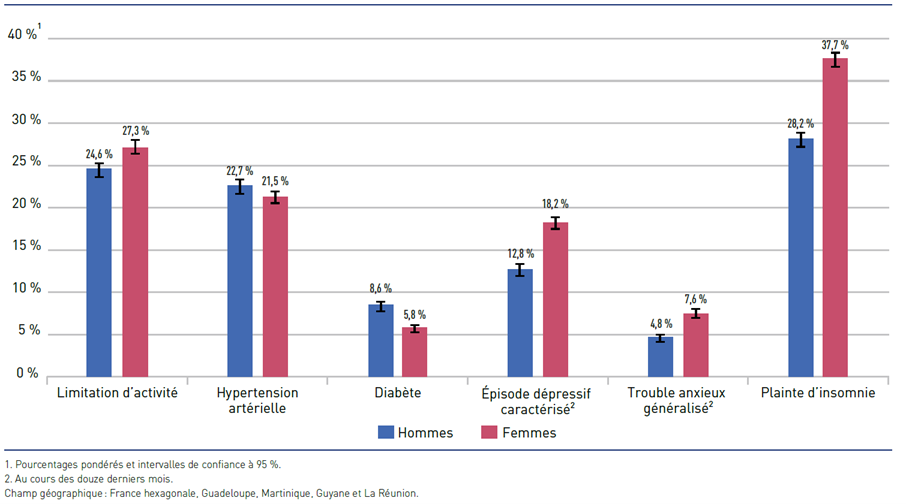
In terms of mental health, women appear to be more affected than men by depression and anxiety (across all age groups), as well as by suicidal thoughts and attempts (particularly among those aged 18–29). The prevalence of major depressive episodes is 18.2% among women (compared to 12.8% among men), that of generalized anxiety disorder is 7.6% (compared to 4.8%), that of suicidal thoughts is 5.6% (compared to 4.8%), and that of lifetime suicide attempts is 7.1% (compared to 3.6%). Women are also more likely than men to seek treatment (consulting a healthcare professional, undergoing psychotherapy, or taking medication for anxiety or sleep), in cases of a major depressive episode (62.1% versus 46.1%, respectively) or generalized anxiety disorder (76.9% versus 60.9%, respectively). Women are also more prone to insomnia than men (37.7% versus 28.2%) (Figure 4).
For more information: “Anxiety-Depressive Disorders and Suicidal Behavior: Social Determinants of Gender Differences. Summary based on data produced by Santé publique France for the period 2010–2023”
Socioeconomic Inequalities in Health Prevention Behaviors and Messages
When it comes to prevention, disparities emerge that disadvantage the most disadvantaged social groups.
Vaccination
Vaccination uptake increases with higher educational attainment (73.8% for those with the lowest educational attainment to 87.2% for those with the highest) and as financial circumstances are perceived to be more favorable (70.1% for the least affluent to 88.3% for the most affluent). This uptake is highest among managers and professionals (89.9%), while it is lowest among manual workers (73.7%) and farmers, artisans, merchants, and business owners (73.7%).
Awareness of health prevention messages
Less advantaged social groups are less influenced by certain health prevention messages than more advantaged groups. For example, awareness of the recommendation “at least 30 minutes of physical activity per day” is lower among those with fewer educational qualifications (47.5% compared to 66.4% among those with the highest qualifications) and among those reporting financial difficulties (51.0% compared to 66.4% among the most affluent). Similarly, people who are less advantaged in terms of education and financial situation are less well-informed about antibiotic resistance.
Health behaviors vary by socioeconomic status
The prevalence of daily smoking follows a gradient based on educational attainment and perceived financial status: it ranges from 13.0% among those with the highest levels of education to 20.9% among those with the lowest levels of education, and from 10.1% among the wealthiest to 30.0% among the least affluent. These gradients are more pronounced among men. Daily smoking is also half as common among managers and professionals (11.8%) as among manual workers (25.1%). Among daily smokers, those with the highest levels of education and managers and professionals are also more likely to want to quit smoking and to report having attempted to quit.
Regarding regular physical activity for leisure purposes, it increases with educational attainment, with prevalence rates ranging from 33.3% among those with the lowest levels of education to 49.7% among those with the highest levels of education. It is twice as common among the most affluent (55.4%) as among the least affluent (26.2%). Differences by socio-professional category confirm this trend, as regular physical activity stands at 54.8% among managers and professionals, compared to 34.7% among manual workers and 30.5% among clerical workers.
However, the most privileged social groups are also affected by behaviors that are less conducive to health. Inverse gradients are observed for alcohol consumption and sedentary behavior (i.e., spending more than 7 hours on average per day in a seated position). The higher the educational level and the more favorable the financial situation is perceived to be, the greater the proportion of adults exceeding the guidelines for safer alcohol consumption (19.3% for those with the lowest educational attainment to 26.0% for those with the highest, and 19.7% for the least affluent to 29.4% for the most affluent). Among men, the disparity in the proportion of people exceeding the guidelines for safer alcohol consumption based on financial situation is more pronounced than among women. This indicator is twice as high among farmers, artisans, merchants, and business owners (30.6%) and among managers and professionals (29.7%) than among employees (15.1%). Finally, the higher the level of education and the more favorable the financial situation is perceived to be, the more common a sedentary lifestyle is. It is nearly three times more common among those with the highest levels of education (42.7%) than among those with the lowest levels of education (15.0%), 1.6 times higher among the wealthiest (39.2%) than among the least affluent (23.7%), and nearly twice as high among managers and professionals (48.5%) than among manual workers (15.8%) and farmers, artisans, merchants, and business owners (14.7%).
Food insecurity
Food insecurity, which most frequently affects low-income households, can contribute to the widening of social health inequalities observed in most chronic conditions (cardiovascular disease, diabetes, obesity, etc.). On the rise in Western countries, it is a telling example of the social and economic changes that have occurred in recent years. At the population level, food insecurity results from prolonged periods of high or rising unemployment and underemployment, declining wages, and a lack of affordable housing. In 2024, we observe that, as reflected in the experience of feeling hungry without being able to eat, this situation is closely linked to households’ socioeconomic characteristics, such as income and family structure (single-parent families and people living alone are particularly affected), and primarily impacts younger generations.
In 2024, among those reporting a financial situation perceived as “just” or “difficult, in debt,” the proportion of adults aged 18 to 79 who have gone hungry without being able to eat for financial reasons stands at 15.2%, or 15.9% among men and 14.6% among women (Table 1). This proportion is highest among young adults aged 18–29 (25.9%) and decreases with age. It also varies by socioeconomic status and household type. Thus, those with the highest levels of education are the least likely to report this situation (12.8% compared to 15.4% among those with the lowest levels of education). This situation affects people in financial difficulty nearly four times more often (31.1%) than those who perceive their financial situation as “adequate” (8.2%). Finally, people living in single-parent households are more likely to report this situation (22.0%), followed by people living alone (19.2%), compared to people living as a couple without children (9.1%) or as a couple with child(ren) (12.8%).
Health and Social Justice: Prevalent Forms of Discrimination in the Population
The differences observed here in health status, behaviors, and awareness of prevention messages are part of a social gradient of health that is well documented in the literature (Marmot, 2005; WHO, 2008). These inequalities are themselves shaped by broader structural determinants (Solar & Irwin, 2010). For example, an unfavorable socioeconomic situation can result from systemic discrimination (related to gender, origin, or other social factors), which acts as a barrier to health equity and reinforces disparities between groups.
In 2024, 22.0% of adults aged 18 to 79 reported having experienced unequal treatment or discrimination in the past five years. This proportion varies with age: it is highest among young adults aged 18–29 (32.9%) and then gradually decreases with age. It is higher among women (24.9% compared to 18.8% among men) and among those reporting the greatest financial difficulties (33.2% compared to 17.4% for the most affluent). In particular, among women, a gradient based on educational attainment and socio-economic status is observed. Reports of experienced discrimination increase with educational attainment: it rises from 15.5% among those with the lowest levels of education to 33.3% among those with the highest levels of education. Women in managerial or professional roles are proportionally more likely to report such treatment than female farmers, artisans, shopkeepers, business owners (19.2%), office workers (20.9%), and manual laborers (21.8%).
See also

rapport/synthèse
16 December 2025












