




Data
The diabetes surveillance system established by Santé publique France makes it possible to study the epidemiological trends of this increasingly common disease.
Diabetes, an increasingly common disease
In France, the prevalence of pharmacologically treated diabetes (all types) was estimated at 5.6% of the population in 2023, or more than 3.8 million people. The prevalence of diabetes continues to rise.
In 2024, 7.1% of adults aged 18 to 79 reported having diabetes. This proportion increases with age and is higher among men than among women.
Furthermore, in France, the incidence of type 1 diabetes is increasing by an average of 4% per year. Its rate was estimated at 18.0 per 100,000 in 2013–2015 and at 19.5 per 100,000 for the 2015–2017 period.
See also:
Fuentes S, Mandereau-Bruno L, Regnault N, Bernillon P, Bonaldi C, Cosson E, Fosse-Edorh S. Is the type 2 diabetes epidemic plateauing in France? A nationwide population-based study. Diabetes Metab. 2020 Jan 7:S1262-3636(20)30001-X. doi: 10.1016/j.diabet.2019.12.006.
Piffaretti C, Mandereau-Bruno L, Guilmin-Crepon S, Choleau C, Coutant R, Fosse-Edorh S. Trends in childhood type 1 diabetes incidence in France, 2010–2015. Diabetes Res Clin Pract. 2018 Nov 12. pii: S0168-8227(18)30466-2.
Regional Variations in the Incidence of Type 1 Diabetes
Incidence of type 1 diabetes in children
Over the 2015–2017 period, regional variations were observed, with the highest incidence rates:
the highest in the regions of Martinique (24.0 per 100,000 person-years), Occitanie (21.9), and Provence-Alpes-Côte d'Azur (21.8);
the lowest were found in French Guiana (6.2 per 100,000 person-years), Guadeloupe (14.9), and Réunion (16.5)—and in metropolitan France in the regions of Pays de la Loire (16.4), Normandy (17.6), and Nouvelle-Aquitaine (19.0).
Download

article
6 September 2019
Incidence of type 1 diabetes among children in France in 2013–2015, based on the National Health Data System (SNDS). Regional variations.
Significant regional and socioeconomic disparities in the prevalence of pharmacologically treated diabetes
In 2023, the highest prevalence rates of pharmacologically treated diabetes are observed in the overseas departments. With an identical age structure, prevalence rates are 1.9 times higher in Réunion, 1.7 times higher in Guadeloupe, and 1.5 times higher in French Guiana and Martinique than the national rate (Odissé). In mainland France, prevalence rates are 1.6 times higher in Seine-Saint-Denis and 1.3 times higher in Val d’Oise, Pas-de-Calais, and Aisne (Odissé).
Conversely, the lowest prevalence rates were observed in the four departments of Brittany, as well as in the Hautes-Alpes and Lozère, with rates 0.7 times lower than the national rate (Odissé).
Standardized prevalence of pharmacologically treated diabetes by department in 2023 (Odissé)
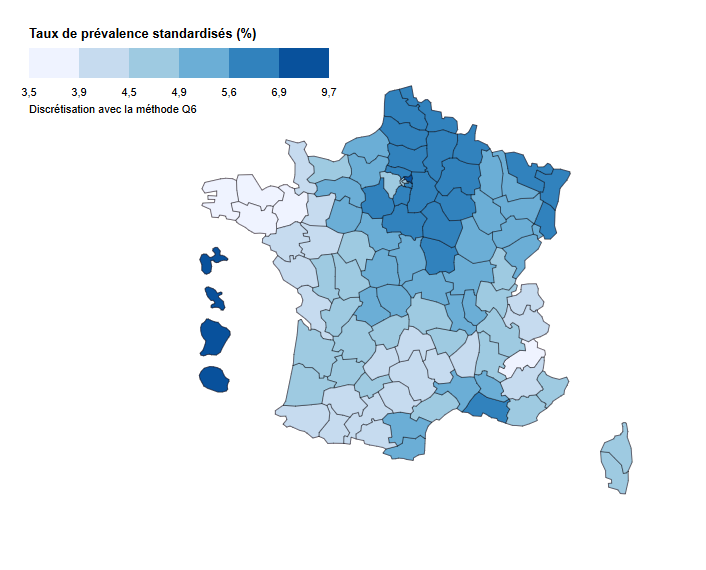
In 2024, regional disparities were also observed according to data from the Santé publique France Barometer, with a higher prevalence of reported diabetes in Guadeloupe, Réunion, Martinique, Hauts-de-France, and Bourgogne-Franche-Comté.
Learn more:
In Mayotte, in 2019, the prevalence of total diabetes (including diabetes treated with medication or not and undiagnosed diabetes) in the population aged 18 to 69 was 12.1% with a 95% confidence interval (95% CI): [10.6–13.6].
The results of the 2024 Public Health France Barometer also highlight marked disparities based on socioeconomic status, whether in terms of educational attainment, socio-professional category, or employment status. Thus, more than 11% of people with a level of education below the high school diploma report having diabetes, whereas this rate is only 3% among those with a level of education above the high school diploma.
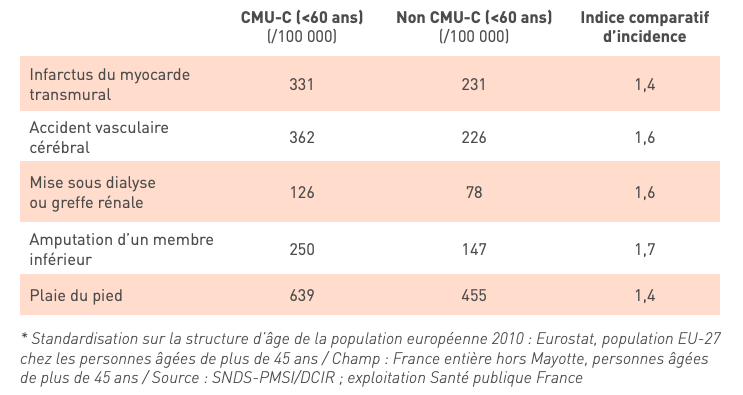
Furthermore, in 2016, among people under the age of 60, the standardized prevalence of treated diabetes was twice as high among those covered by CMU-C as among those not covered (3.4% vs. 1.6%).
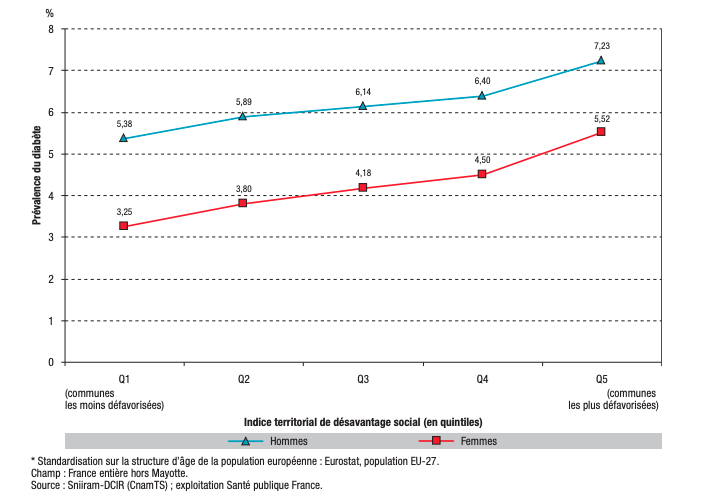
For the same age structure, the prevalence of pharmacologically treated diabetes increased in line with the territorial index of social disadvantage. The prevalence of pharmacologically treated diabetes was 1.4 times higher among men living in the most disadvantaged metropolitan municipalities than among those living in the most advantaged metropolitan municipalities. This ratio was 1.7 for women.
Standardized prevalence* of pharmacologically treated diabetes by level of social disadvantage in the municipality of residence in mainland France in 2016
A higher prevalence among men than among women
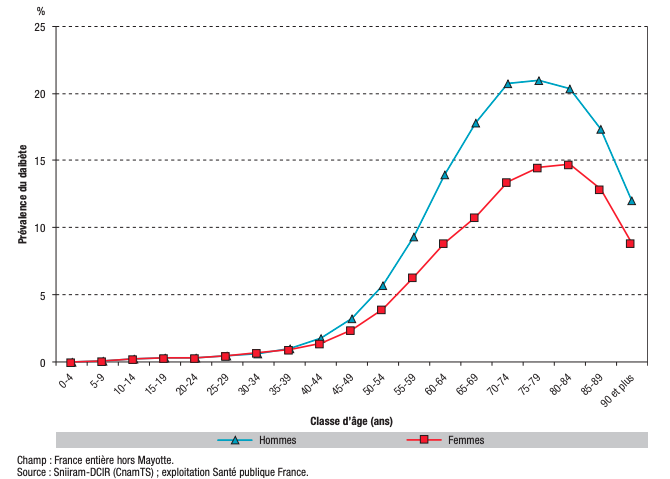
Men are affected more than women (2 million men vs. 1.6 million women). The prevalence of diabetes increases with age.
One in five men aged 70 to 85 and one in seven women aged 75 to 85 are receiving medication for diabetes.
Breakdown by age and sex of the prevalence of medically treated diabetes in France in 2016
1.36% treated with insulin
Click here to view the table of prevalence data for insulin-treated diabetes in 2020 by 5-year age groups
A high prevalence of undiagnosed diabetes
In 2014–2016, the Esteban survey revealed a prevalence of undiagnosed diabetes of 1.7% (95% CI 1.1 to 2.4) among adults aged 18 to 74. This prevalence was higher among men (2.7%, 95% CI 1.4 to 4.0) than among women (0.9%, 95% CI 0.3 to 1.4). The proportion of people with undiagnosed diabetes among all people with diabetes was 23%.
In 2006–2007, the ENNS survey reported a prevalence of undiagnosed diabetes based on standard fasting blood glucose criteria of 1% (95% CI 0.6–1.7), accounting for less than 20% of all diabetes cases. This proportion decreases with age, falling from 30% among those aged 30 to 54 to 12% among those aged 55 to 74.
In 2019, in Mayotte, among the population aged 18 to 69, the prevalence of undiagnosed diabetes was 4.7% (95% CI 3.8–5.7), accounting for nearly 40% of all diabetes cases.
High prevalence of prediabetes
The prevalence of prediabetes (according to WHO fasting blood glucose criteria) was 9.9% (95% CI 8.3 to 11.5) according to the Esteban survey (2014–2016). The prevalence was higher among men (13.2%, 95% CI 10.5–15.8) than among women (7.0%, 95% CI 5.1–8.9). This prevalence has increased by 4.3 percentage points since the ENNS survey (2006–2007).
In 2019, in Mayotte, among the population aged 18 to 69, the prevalence of prediabetes was 12.1% (95% CI 10.6 to 13.6).
See also
Azaz A, Jezewski-Serra D, Ruello M, Youssouf H, Piffaretti C, Fosse-Edorh S.Estimation of the prevalence of diabetes and prediabetes in Mayotte and characteristics of people with diabetes, Mayotte, 2019. Bull Epidémiol Hebd. 2022;(9-10):164-9.
Lailler G, Piffaretti C, Fuentes S, Djessira Nabe H, Oleko A, Cosson E, Fosse-Edorh S. Prevalence of prediabetes and undiagnosed type 2 diabetes in France: Results from the national ESTEBAN survey, 2014–2016, Diabetes Research and Clinical Practice, Volume 165, 2020, 108252, ISSN 0168-8227.
Bonaldi C, Vernay M, Roudier C, Salanave B, Oleko A, Malon A, Castetbon K, Fagot-Campagna A. A first national prevalence estimate of diagnosed and undiagnosed diabetes in France in 18- to 74-year-old individuals: the French Nutrition and Health Survey 2006/2007. Diabet Med. May 2011;28(5):583-9.
A decrease in mortality among people with diabetes but a stabilization in excess mortality
Santé publique France analyzed mortality over a 5-year period following the two Entred studies. The findings are as follows:
Overall mortality among people with diabetes aged 45 and older who were receiving medication decreased between the periods 01/2002–12/2006 and 08/2007–07/2012 by 26% among men and 11% among women. This decrease is primarily due to the decline in mortality from cardiovascular diseases, major complications of diabetes.
Excess mortality relative to the general population remained high during the 2007–2012 period for both men (+34%) and women (+51%). Excess mortality decreased between the two periods for men (+53% during the 2002–2006 period) but remained stable for women (+57%). In contrast to what is observed among men, excess mortality from cardiovascular disease did not decrease among women between the two periods (+68% over the 2002–2007 period versus +74% over the 2007–2012 period). It remained high for men over the most recent period (+41%).
Both men and women with diabetes aged 45 and older included in the Entred 2001 cohort have a 10-year excess mortality rate, compared to the general population, due to cardiovascular and renal diseases as well as certain cancer sites: pancreas, liver, and colorectal. Among women, excess mortality is observed for uterine cancer, and among men for bladder cancer and leukemia. Furthermore, excess mortality is higher for both sexes for diseases of the digestive system, infectious diseases, and respiratory diseases, including pneumonia. All of these results are consistent with those in the literature.
In addition to the well-known determinants of mortality—namely male sex and disease severity—the Entred cohorts have demonstrated, among people with type 2 diabetes, an association between mortality and socioeconomic status, as well as with modifiable determinants: obesity, morbid obesity, tobacco use, alcohol consumption, and delayed diagnosis.
A reduction in vascular risk among people with diabetes
The Entred studies examined changes in vascular risk among people with type 2 diabetes.
An improvement in vascular risk control was observed between 2001 and 2007. Glycemic control improved (median HbA1c: 6.9%, -0.3%), and blood pressure (median 130/80 mmHg, -3/-2 mmHg) and cholesterol (median LDL: 1.06 g/L, -0.18 g/L) decreased regardless of age. In contrast, obesity has become even more common (41%, +7 percentage points since 2001).
Nevertheless, the frequency of diabetes complications has increased slightly, which is partly due to more frequent screening for these complications, and may also be due to longer life expectancy.
Common diabetes-related complications
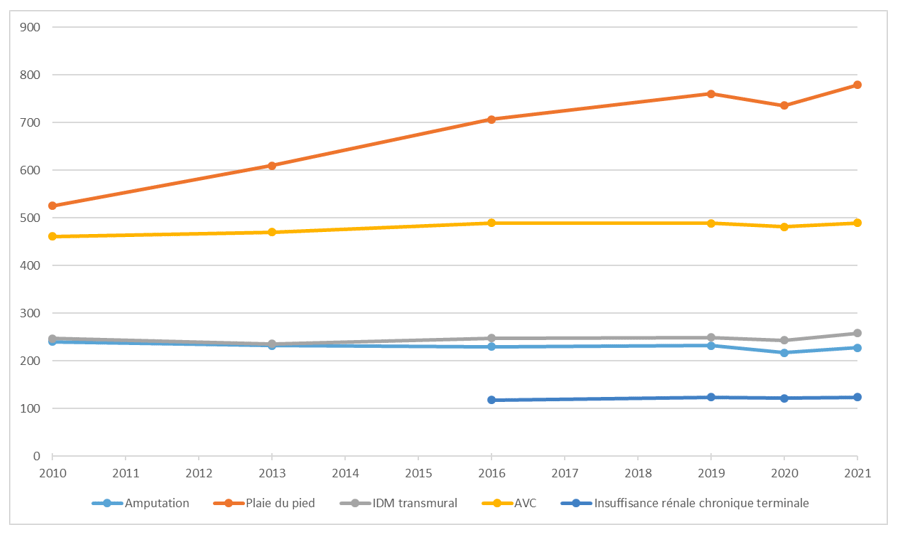
In 2021, chronic diabetes-related complications remain very common. For the first time since the start of the follow-up in 2010, hospitalizations for foot ulcers and strokes had decreased moderately in 2020. The incidence of lower limb amputations, transmural myocardial infarctions, and end-stage chronic kidney disease—which had been relatively stable since the start of the study—also decreased modestly in 2020. Between 2020 and 2021, incidence rates increased and returned to a level close to that seen before 2020
Trends in the incidence of hospitalizations for diabetes-related complications in France between 2010 and 2021
Diabetes-related complications are also more common among men
Santé publique France has observed higher hospitalization rates for various complications among people with diabetes than in the general population.
At the same age, the rate of people with diabetes receiving medication and hospitalized for:
myocardial infarction was 2.1 times higher than in the non-diabetic population
stroke was 1.4 times higher than in the non-diabetic population
initiation of renal replacement therapy for end-stage chronic kidney disease was 1.5 times higher than in the non-diabetic population
foot ulcers was 1.6 times higher than in the non-diabetic population
lower limb amputation was 2.7 times higher than in the non-diabetic population.
Furthermore, men, who are more frequently affected by diabetes than women, are also more affected by complications.
The incidence rates of hospitalizations for diabetes-related complications also vary significantly by region.
Standardized incidence rates* of diabetes-related complications, by sex, France as a whole, 2016
Download

rapport/synthèse
6 September 2019
The Burden of Diabetes in France in 2016: An Epidemiological Overview
A reduced quality of life
The two Entred studies conducted in 2001 and 2007 provided insights into the quality of life of people with type 1 and type 2 diabetes.
The quality of life of people with type 2 diabetes depends heavily on the consequences of diabetes (complications, dependence on assistance for daily activities) as well as on socioeconomic factors and social support. Across all age groups, quality-of-life scores are lower among women.
A Need for Information and Education for People with Diabetes
80% of people with type 2 diabetes say they are well or very well informed about their condition. However, this does not satisfy their desire for information: 76% of people with type 2 diabetes would like additional information, particularly regarding:
diet (45%)
possible complications related to diabetes (35%)
how to live well with diabetes (29%).
Physical activity is rarely mentioned (18%), likely because its role in managing diabetes is underestimated and difficult to implement.
The desire for additional information is strongest among younger people, those with complications from the disease, or those reporting financial difficulties.
People with type 2 diabetes primarily obtain information from doctors (82% of cases), much less frequently from the media (16%), from other healthcare professionals or family and friends (13% each), or from patient organizations (2%).

To access other data
Epidemiological data on diabetes:
To apply to ENTRED programs
ENTRED 3 Study
The ENTRED 3 study was launched in 2019 to better understand the health status, quality of life, healthcare utilization, and healthcare costs of people being treated for diabetes, and to track changes over time.
ENTRED Study 2007-2010
The ENTRED 2007-2010 study (“National Representative Sample of People with Diabetes”) aims to deepen our understanding of the health status of people with diabetes in France, their medical care, their quality of life, their educational needs, and the cost of diabetes.
Entred Study 2001-2003
The Entred 2001-2003 study (National Representative Sample of People with Diabetes) was conducted in partnership with the National Association for the Coordination of Diabetes Networks, the Health Insurance Fund, and the Institute for Public Health Surveillance, with the support of the French Diabetes Association.
In relation to

Nutrition and Physical Activity
thematic dossier
Nutrition and physical activity are two major determinants of health that contribute to improving the health of the population and are key priorities in public health policy.

Alcohol
thematic dossier
Alcohol is deeply rooted in French culture. Its consumption remains a major cause of death and illness in France.

Tobacco
thematic dossier
Despite a slight decrease compared to 2015, tobacco remains responsible for more than 68,000 premature deaths in 2023—accounting for 11% of total mortality—making it still the leading cause of...











