




Data
Alarming figures
Alcohol consumption has declined significantly in France, falling from an annual average of 26.0 liters of pure alcohol per capita among people aged 15 and older in 1961 to 10.8 liters in 2022. However, this downward trend has not been observed in recent years, and the consumption of alcoholic beverages remains deeply rooted in French cultural practices. However, alcohol remains a major cause of mortality and morbidity in France.
Alcohol is one of the top three causes of preventable mortality
In 2015, an estimated 41,000 deaths were attributable to alcohol, including:
30,000 deaths among men,
11,000 deaths among women.
This includes 16,000 deaths from cancer, 9,900 deaths from cardiovascular disease, 6,800 from digestive diseases, 5,400 from external causes (accidents or suicide), and more than 3,000 from other conditions (mental illnesses, behavioral disorders, etc.).
Fetal alcohol syndrome is the leading cause of non-genetic disability in France
Between 2006 and 2013, 3,207 newborns were diagnosed with fetal alcohol spectrum disorders (FASD) during their hospital stay in the neonatal period, representing 0.48 cases per 1,000 births, including 0.07 cases of fetal alcohol syndrome (FAS) per 1,000 births.
At the regional level, the proportion of children diagnosed with FASD was highest in Réunion (1.22‰), Upper Normandy (1.02‰), Champagne-Ardenne (0.90‰), and Nord-Pas-de-Calais (0.90‰).
Between the periods 2006–2009 and 2010–2013, there was a significant decrease in the number of children diagnosed with FAS but an increase in the number of other fetal alcohol spectrum disorders (aFASD).
These results likely underestimate the prevalence of FASD, particularly due to the difficulty in identifying children with such disorders.
See also

rapport/synthèse
22 January 2020
Monitoring of fetal alcohol spectrum disorders: analysis of data from the French healthcare information systems program between 2006 and 2013
Alcohol consumption remains high in France in 2021
Trends in adult alcohol consumption
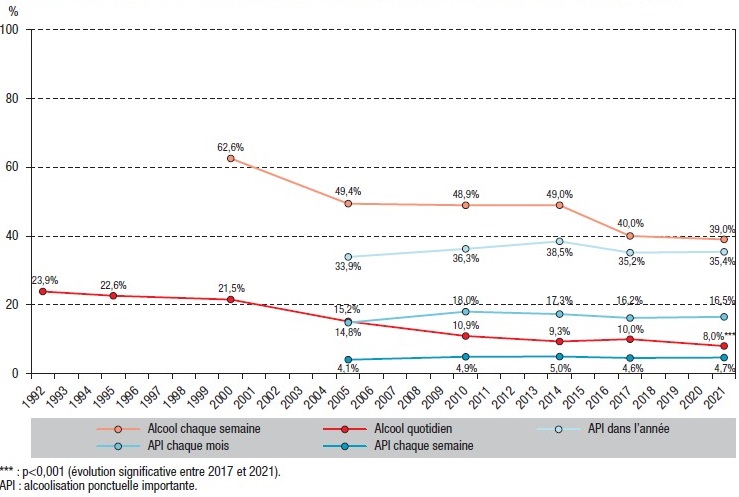
In mainland France in 2021, 94.9% of adults report having consumed alcohol at some point in their lives, a proportion that has remained relatively stable since at least the early 1990s. Weekly and daily consumption has been declining for several decades:
the share of weekly drinkers was 62.6% in 2000 and reached 39.0% in 2021;
the proportion of adults consuming alcohol every day was 23.9% in 1992, compared to 8.0% in 2021.
In the recent period, between 2017 and 2021:
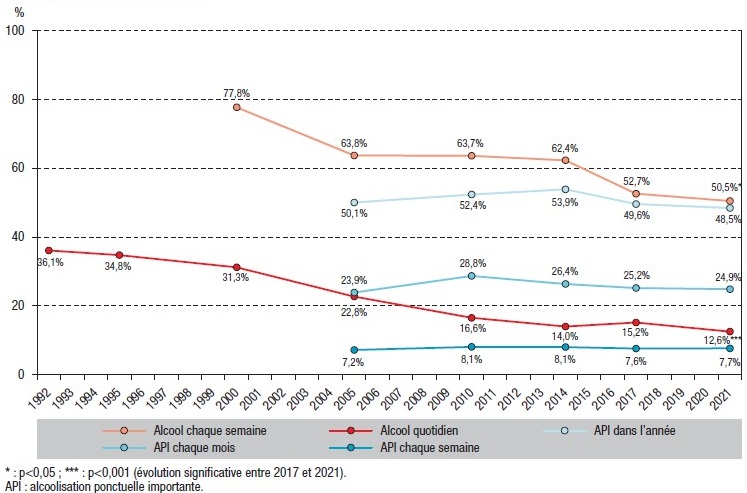
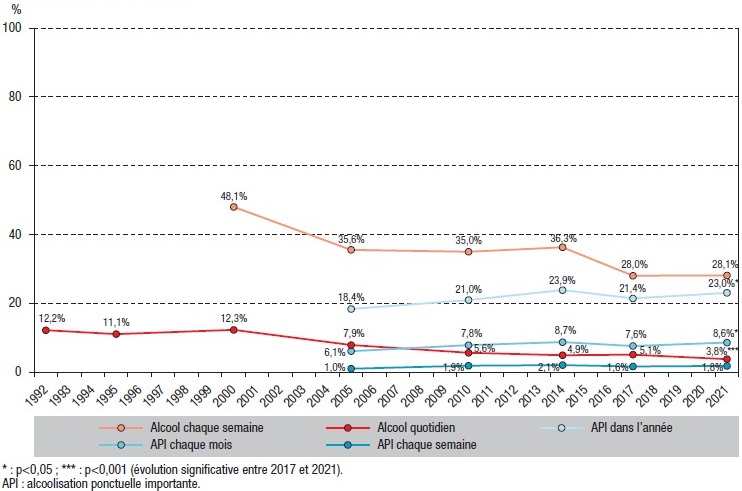
the proportion of adults who drink weekly (39.0% in 2021) is stable among adults overall but has declined among men (from 52.7% in 2017 to 50.5% in 2021) and remained stable among women (28.1% in 2021);
the proportion of daily drinkers has decreased significantly between 2017 (10.0%) and 2021 (8.0%). This decline is observed among both men (15.2% in 2017 and 12.6% in 2021) and women (5.1% in 2017 and 3.8% in 2021).
Indicators of the frequency of heavy episodic drinking (HED, defined as 6 or more drinks on a single occasion) did not change significantly between 2017 and 2021 among adults overall or among men. In contrast, the proportion of women reporting having engaged in HED at least once in the past year and the proportion reporting at least one HED episode per month are on the rise. Conversely, there has been a decrease in the frequency of heavy episodic drinking among young men. Heavy episodic drinking remains significantly more frequent among men, however: in 2021, 24.9% of men reported having at least one heavy drinking episode per month, compared to 8.6% of women.
Regardless of the method of alcohol consumption, it remains generally higher among men than among women.
Trends in alcohol consumption indicators between 1992 and 2021 in mainland France among people aged 18–75
Changes in alcohol consumption indicators between 1992 and 2021 in mainland France among men aged 18–75
Changes in alcohol consumption indicators between 1992 and 2021 in mainland France among women aged 18–75
Behaviors vary significantly by age
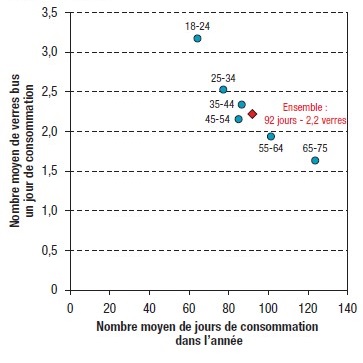
As was already observed in 2017, average alcohol consumption (frequency and amount consumed) varies significantly by age.
Thus, younger people drink less frequently but consume larger volumes of alcoholic beverages than their elders, who, for their part, drink more often: 18- to 24-year-olds consume an average of 3.2 drinks per day and drink on 64.3 days per year, while 65- to 75-year-olds consume 1.6 drinks on 123.7 days per year. When considering the entire 18–75 age group (including abstainers), in 2021, each adult consumed an average of 0.6 drinks per day.
Among 18- to 24-year-olds, the proportion of people reporting at least one drinking day per month was 33.1% among men and 20.3% among women. Among 65- to 75-year-olds, these proportions were 14.7% and 3.9%, respectively. Conversely, 28.4% of men aged 65–75 reported drinking every day (9.1% of women), compared with 3.3% of men aged 18–24 (1.8% of women).
Distribution of the average number of alcoholic drinks consumed and the average number of days on which alcohol was consumed, by age, among people aged 18–75 who had consumed alcohol in the past 12 months in mainland France, 2021
Learn more

article
19 February 2024
Alcohol Consumption Among Adults in France in 2021: Recent Developments and Long-Term Trends
Alcohol Use Among Adolescents
Alcohol is the most commonly tried and consumed psychoactive substance among adolescents, according to the Enclass and Escapad surveys conducted by the French Monitoring Center for Drugs and Addictive Behaviors (OFDT) among adolescents. Alcohol consumption is higher among boys than among girls. For several years now, there has been a trend toward younger ages of first use and a decline in various forms of alcohol consumption.
Regional Disparities
In 2021, daily alcohol consumption was more common in Nouvelle-Aquitaine (particularly among women) and in Occitanie. Conversely, it was less common in Île-de-France and in the DROMs. Reporting at least one episode of heavy drinking per month was less frequent in Île-de-France, Hauts-de-France, and Guadeloupe, and more frequent in Brittany and Pays de la Loire.
Exceeding low-risk consumption guidelines
In 2017, a group of experts commissioned by Santé publique France and the National Cancer Institute (INCa) issued an opinion presenting alcohol consumption guidelines aimed at limiting health risks. These guidelines were established based on an analysis of the scientific literature, models of lifetime mortality risk attributable to alcohol for the French population, and an ad hoc qualitative study. They are stated as follows: “If you drink alcohol, to limit the risks to your health over the course of your life, it is recommended that you: consume no more than 10 standard drinks per week and no more than 2 standard drinks per day; and have days during the week when you do not drink.”
In 2024, the proportion of adults aged 18 to 75 reporting alcohol consumption in the past seven days was 54.7%. The proportion of adults reporting consumption exceeding the low-risk guidelines in the past week was 22.2% (30.3% of men and 14.6% of women), a figure stable compared to 2021.
Those most likely to exceed the guidelines are individuals with higher educational attainment and a higher perceived financial status.
Finally, among those exceeding the guidelines, 26.7% reported wanting to reduce their consumption.
2024 Survey Results
rapport/synthèse
2 February 2026
Alcohol consumption: Exceeding the low-risk guidelines. Santé publique France Health Barometer: Results of the 2024 edition
Alcohol consumption during pregnancy is uncommon, but not rare
It is difficult to measure alcohol consumption among pregnant women due to significant underreporting linked to social desirability bias.
Data from the Santé publique France Barometer show that in 2017, among mothers of children aged five or younger, 11.7% (CI 9.9%–13.8%) reported having consumed alcohol during their most recent pregnancy:
10.7% reported doing so only on special occasions;
< 1% reported having consumed alcohol more than once a month but less than once a week;
< 1% reported having consumed alcohol once a week or more.
Among women who reported drinking at least on special occasions, 51.0% reported having consumed only a few sips of alcohol on the days they drank.
Older women (aged 35 or older) and those with higher education (a degree beyond high school) were more likely to report drinking alcohol during their last pregnancy.
Among women who were pregnant at the time of the 2017 Santé publique France Public Health Barometer survey, 10.7% (CI 6.9%–16.3%) reported having consumed alcohol since learning of their pregnancy.
More recently, in 2021, in the National Perinatal Survey (ENP)—which focuses on the pregnancy period and covers all children born in all French maternity wards over a given period—approximately 3% of women reported having consumed alcohol during their pregnancy.
It should be noted that the sampling methods, study populations, and questionnaires differ significantly between these studies, which may explain these discrepancies. In particular, the ENP survey questionnaire is administered by a midwife, which may increase social desirability bias (particularly regarding alcohol) compared to the Santé publique France Health Barometer, which is conducted by telephone by a non-healthcare professional interviewer.
Learn more:
The "zero alcohol during pregnancy" guideline is becoming increasingly well-known, but is partly out of step with actual behaviors
According to a repeated cross-sectional telephone survey conducted in mainland France in 2004, 2007, 2015, 2017, and 2020 among a sample of 1,000 people per wave, aged 15 and older, selected using the quota method, the “zero alcohol during pregnancy” recommendation is becoming increasingly well-known and accepted:
91% of respondents were aware of it in 2020 (+10 percentage points between 2004 and 2020), with no difference by gender;
nearly half (46%) state that there is a risk starting with the first drink (+22 percentage points);
the proportion of those who state that a drink on special occasions poses no risk has been cut in half between 2004 and 2020 (48% vs. 25%).
Despite significant improvements, there is still a gap between awareness of “zero alcohol during pregnancy” and perceptions of risky consumption levels for small amounts.
Furthermore, certain (misguided) beliefs persist in 2020:
19% say it is advisable to have a small glass of wine from time to time during pregnancy;
23% believe it is advisable to drink a little beer while breastfeeding.
Learn more:
In relation to

thematic dossier
The First 1,000 Days
The period from conception through the first two years of life is critical for a child’s development and the health of the adult they will become. That is why it is essential to prioritize the...

thematic dossier
Cancers
Les cancers représentent en France la première cause de décès chez l’homme et la deuxième chez la femme. Santé Publique France copilote la surveillance épidémiologique et participe à leur prévention.











