




What are the health risks associated with alcohol consumption?
Alcohol, a psychoactive substance, has immediate effects that depend primarily on blood alcohol concentration.Blood alcohol concentration (expressed in grams per liter in France)" data-tooltip-title="Blood alcohol concentration (expressed in grams per liter in France)" data-tooltip-content="" data-tooltip-placeholder-is-selection="true" data-tooltip-placeholder-is-selection-text="blood alcohol concentration" data-tooltip-data="[{"tooltipTitle":"Blood ethanol concentration (expressed in grams per liter in France)","tooltipContent":"","placeholderIsSelection":"true","placeholderIsSelectionText":"blood alcohol level"}]"> Drinking alcohol carries short-term and long-term risks, even in small amounts.
Ethanol, also known as ethyl alcohol or, colloquially, pure alcohol, is produced through the fermentation of fruits, grains, or tubers.
After consumption, 70 to 80 percent of the ethanol is absorbed in the "Initial portion of the small intestine following the stomach" data-tooltip-title="Initial portion of the small intestine following the stomach" data-tooltip-content="" data-tooltip-placeholder-is-selection="true" data-tooltip-placeholder-is-selection-text="duodenum" data-tooltip-data="[{"tooltipTitle":"Initial portion of the small intestine following the stomach","tooltipContent":"","placeholderIsSelection":"true","placeholderIsSelectionText":"duodénum"}]">duodenum and the segment of the small intestine that follows the duodenum" data-tooltip-title="Segment of the small intestine that follows the duodenum" data-tooltip-content="" data-tooltip-placeholder-is-selection="true" data-tooltip-placeholder-is-selection-text="jejunum" data-tooltip-data="[{"tooltipTitle":"Segment of the’small intestine that follows the duodenum","tooltipContent":"””, “placeholderIsSelection”: “true”, “placeholderIsSelectionText”: “jejunum” }]">jejunum.
Food intake slows gastric emptying, prolonging the time ethanol remains in the stomach and thereby altering its absorption kinetics. The time to reach peak plasma ethanol concentration is doubled if ethanol is ingested with a meal (90 minutes on average versus 45 minutes if the subject is fasting).
The volume of distribution for ethanol averages 0.50 L/kg in women and 0.65 L/kg in men. Ethanol readily crosses the placental barrier, and concentrations in amniotic fluid and in the fetus are close to the mother’s plasma concentrations.
After absorption, ethanol is distributed within a few minutes (distribution half-life: 7 to 8 minutes) to highly vascularized organs such as the brain, lungs, and liver.
Alcohol is eliminated primarily by the liver (95%). The remaining 5% is eliminated by the kidneys, skin, lungs, and saliva.
The pharmacokinetics of ethanol:
- differ between men and women, as women have a higher body fat mass, which results in a Blood ethyl alcohol concentration (expressed in grams per liter in France)" data-tooltip-title="Blood ethanol concentration (expressed in grams per liter in France)" data-tooltip-content="" data-tooltip-placeholder-is-selection="true" data-tooltip-placeholder-is-selection-text="blood alcohol concentration" data-tooltip-data="[{"tooltipTitle":"Blood alcohol content (expressed in grams per liter in France)"","tooltipContent":""","placeholderIsSelection":"true"","placeholderIsSelectionText":""blood alcohol concentration"}]">higher blood alcohol concentration for the same amount consumed.
- varies with age because the ratio of fat mass to lean mass changes over time in both men and women.
A standard drink, as served in a bar or restaurant, contains approximately 10 grams of pure alcohol regardless of the type of alcoholic beverage (wine, beer, aperitif, or spirits).
Alcohol Content of a Standard Drink

These equivalents are based on the amount of pure alcohol (proof) contained in alcoholic beverages: each standard drink contains 10 grams of pure alcohol. Thus, the volume of standard glasses varies depending on the alcohol content of the alcoholic beverage.
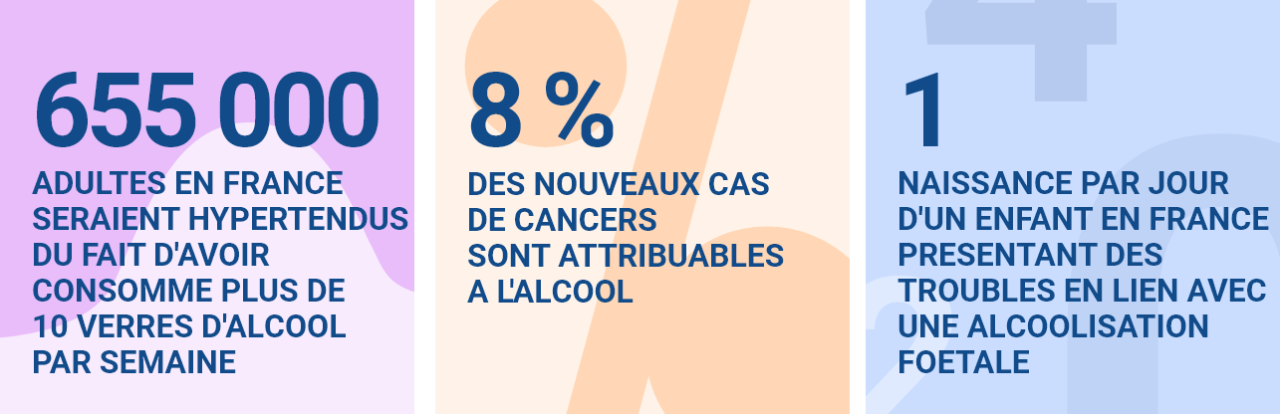
Key Statistics on Alcohol
Short-term consequences that depend on the blood ethyl alcohol concentration (expressed in grams per liter in France)" data-tooltip-title="Blood ethyl alcohol concentration (expressed in grams per liter in France)" data-tooltip-content="" data-tooltip-placeholder-is-selection="true" data-tooltip-placeholder-is-selection-text="blood alcohol concentration" data-tooltip-data="[{"tooltipTitle":"Blood ethyl alcohol level (expressed in grams per liter in France)", "tooltipContent":"","placeholderIsSelection":"true","placeholderIsSelectionText":"blood alcohol"}]">blood alcohol level
Alcohol is a psychoactive substance. It alters consciousness and perceptions, and consequently affects emotions and behavior. The immediate effects depend primarily on the blood ethyl alcohol content (expressed in grams per liter in France)" data-tooltip-title="Blood ethyl alcohol content (expressed in grams per liter in France)" data-tooltip-content="" data-tooltip-placeholder-is-selection="true" data-tooltip-placeholder-is-selection-text="blood alcohol concentration" data-tooltip-data="[{"tooltipTitle":"Blood alcohol content of ethyl alcohol (expressed in grams per liter in France)","tooltipContent":"","placeholderIsSelection":"true","placeholderIsSelectionText":"blood alcohol"}]">blood alcohol level.
| Doses | Possible effects |
|---|---|
| Low dose | Feeling of relaxation, euphoria, or even excitement. Disinhibition Diminished reflexes Narrowed field of vision |
| Higher dose | Intoxication Poor coordination of movements, slurred speech, impaired reflexes and alertness, drowsiness, etc. memory loss, including blackouts (forgetting what happened the previous day, as the drinker has lost the ability to process and retain the memory) hypothermia |
| Very high dose | Alcoholic coma, which, if left untreated, can lead to death. Alcoholic coma requires emergency hospitalization |
An Increased Risk of Traffic Accidents
Even if the person doesn’t realize it, the effects of alcohol begin to set in after the very first drink. Alcohol slows reaction time. It impairs reflexes, alertness, and resistance to fatigue. It also affects vision, depth perception, and coordination. Furthermore, its disinhibiting effect leads people to underestimate danger and thus take risks: “forgetting” to fasten a seatbelt or wear a helmet, speeding, etc.
The risk of causing a fatal traffic accident increases eightfold when alcohol is consumed. This risk increases very rapidly as blood alcohol concentration rises: it increases sixfold for a concentration between 0.5 and 0.8 g/l, and fortyfold for a concentration above 2 g/l.
According to the latest road safety figures, alcohol is a factor in nearly one-third of fatal accidents. The risks are heightened both for drivers of vehicles (cars, trucks, scooters, etc.) and for pedestrians.
An Increase in Psychosocial Risks
Acute alcohol intoxication exposes individuals to numerous immediate health and social risks:
- self-harm
- aggression toward others, particularly domestic violence
- unprotected and/or unwanted sexual intercourse
Medium- and long-term consequences even with low consumption
Alcohol is one of the top three causes of preventable mortality and the second leading risk factor for cancer related to lifestyle or the environment. In 2015, an estimated 41,000 deaths were attributable to alcohol (30,000 deaths among men, 11,000 deaths among women). Alcohol is directly or indirectly associated with the development of more than 200 diseases.
Even in small amounts, alcohol consumption influences the development of cancers, cardiovascular and digestive diseases, high blood pressure, nervous system disorders, and mental health issues. Alcohol can also cause problems that impact quality of life (fatigue, sleep disturbances, memory or concentration problems, etc.). There is no such thing as alcohol consumption that is risk-free for health. These risks are still largely unknown to consumers, who may also tend to downplay them, put them into perspective, or dismiss them as irrelevant.
Cancer and Alcohol
Alcohol is a known carcinogen (Group 1) and has been classified as such since 1988 by the International Agency for Research on Cancer (IARC).
The risk of developing certain cancers increases starting with just one drink per day, regardless of the type of alcohol consumed—whether it is wine, beer, or spirits. In fact, 19% of alcohol-related cancers occur in men who drink less than 40 grams of alcohol per day (equivalent to 4 standard drinks) and in women who consume less than 20 grams of alcohol per day (equivalent to 2 standard drinks).
In France, in 2015, 8% of new cancer cases were attributable to alcohol. It is the second leading cause of preventable cancers after tobacco. This represents approximately 28,000 alcohol-attributable cancers in France, out of the 352,000 new cancer cases diagnosed annually in adults over the age of 30.
Seven types of cancer have a proven link to alcohol consumption: cancers of the mouth, larynx, pharynx, esophagus, liver, colon and rectum, and breast. A link between pancreatic cancer and alcohol consumption is likely, but the data are still limited.
Alcohol is therefore responsible for many cancers, even with low levels of consumption. For example, 1 in 6 breast cancers is attributable to alcohol consumption, and a quarter of these breast cancers occur in people who drink fewer than 2 drinks per day. The risk of cancer increases with the total amount of alcohol consumed, though the relationship varies by cancer site: depending on the site, this dose-response relationship can be either linear (i.e., proportional to the level of consumption) or nonlinear.
Thus, consuming at least one glass of an alcoholic beverage (approximately 10g of pure alcohol) per day increases the risk of developing breast cancer (a 5% increase in breast cancer risk in premenopausal women, 9% in postmenopausal women), oral cancer (+28%), laryngeal cancer (+20%), pharyngeal cancer (+32%), and esophageal cancer (+25%). This relationship between alcohol consumption and cancer risk is nearly linear for these sites.
For colorectal cancer, the increase in cancer risk based on alcohol consumption becomes significant at 30 g per day and then rises with the amount consumed. The increased risk of liver cancer is significant starting at a consumption of 45 g per day and then increases exponentially for very heavy drinkers (more than 100 g per day).
Certain mechanisms underlying alcohol-related cancer development are common to several cancer sites. The most important of these is the production of genotoxic metabolites from ethanol. Other mechanisms are more specific to certain cancer sites.
The main hypotheses are as follows:
- Acetaldehyde, which is present in alcoholic beverages or produced from ethanol by locally present bacteria, comes into direct contact with the mucous membranes of the upper aerodigestive tract (UADT: mouth, pharynx, larynx, and esophagus) and exerts its mutagenic effect locally.
- The ethanol contained in alcoholic beverages may act locally as a solvent and increase the permeability of the upper aerodigestive tract mucous membranes to carcinogens such as those from smoking, thereby contributing to the observed synergy between these two risk factors for cancers of the upper aerodigestive tract.
- Chronic alcohol consumption may be accompanied by reduced folate intake, which can lead to folate deficiency or insufficiency; this, in turn, can affect DNA methylation and promote the development and progression of colorectal cancer.
- Alcohol consumption can increase levels of circulating steroid hormones (estrogens, androgens) and affect hormone receptors, a mechanism implicated in breast cancer.
- Regular and heavy consumption of alcoholic beverages can promote the development of liver diseases such as steatosis, hepatitis, or cirrhosis, which are themselves risk factors for liver cancer.
Alcohol and Cardiovascular Disorders
Regular alcohol consumption raises blood pressure and increases the risk of hypertension. The effect of alcohol on blood pressure is dose-dependent, but the risk of hypertension increases differently in men and women:
- in men: any alcohol consumption is associated with an increased risk of high blood pressure;
- for women: the risk increases with consumption exceeding 30 g of alcohol per day.
It also increases the risk of (hemorrhagic) strokes and atrial fibrillation (the risk increases starting at 10 g of alcohol per day for men and 30 g of alcohol per day for women). Alcohol is, in fact, cardiotoxic. It has negative effects on cardiac electrophysiology: shortening of the atrial action potential, leading to atrial fibrillation; effects on the autonomic nervous system that promote tachycardia; and structural changes in the atria that disrupt conduction.
Cirrhosis
There is a dose-dependent relationship between alcohol consumption and cirrhosis. Cirrhosis, which results from the gradual destruction of liver cells replaced by fibrous tissue, is significantly more likely to occur when consumption reaches:
- 24 to 36 grams of alcohol per day for women
- for men, 36 to 48 grams of alcohol per day
Mortality from cirrhosis is significantly increased with any alcohol consumption among women and at consumption levels of 12 to 24 grams of alcohol per day among men.
Effects on the Brain
In addition to impairments in attention, concentration, memory, abstract thinking, and executive functions, chronic alcohol abuse can lead to Korsakoff’s syndrome, characterized by severe and irreversible memory impairment, a tendency to fabricate stories to compensate for memory loss, mood disorders, and other symptoms.
Heavy drinking, such as binge drinking, has harmful effects on brain structure and function, particularly in adolescents, who are especially vulnerable to the toxic effects of alcohol.
Furthermore, there is a link between alcohol and dementia. A study by Xu and colleagues published in 2017 shows that beyond 12.5 g of alcohol per day, the risk of dementia increases linearly and reaches statistical significance when alcohol consumption exceeds 38 g/day. This dose-response relationship can be explained by the neurotoxicity of ethanol on the brain or by the indirect effects of the increased risk of diabetes, hypertension, and stroke associated with alcohol consumption on the risk of dementia.
Alcohol Dependence
When addiction sets in, the harmful consequences are numerous and affect every aspect of the drinker’s life. Health deteriorates both physically and psychologically. Relationships with loved ones and the lives of those around the drinker are disrupted. Professional life can also be affected.
Alcohol dependence is particularly toxic to the nervous system and causes numerous disorders:
- encephalopathies resulting from vitamin deficiencies
- cognitive disorders, such as dementia
- epileptic seizures
- neuropathies
There are several ways to define alcohol use disorders. There are two major classifications: the American Psychiatric Association’s DSM-5 (which is limited to mental disorders) and the World Health Organization’s ICD-10 or ICD-11. The ICD-10/11 distinguishes between harmful use and dependence. There is thus a spectrum of severity in alcohol-use disorders.
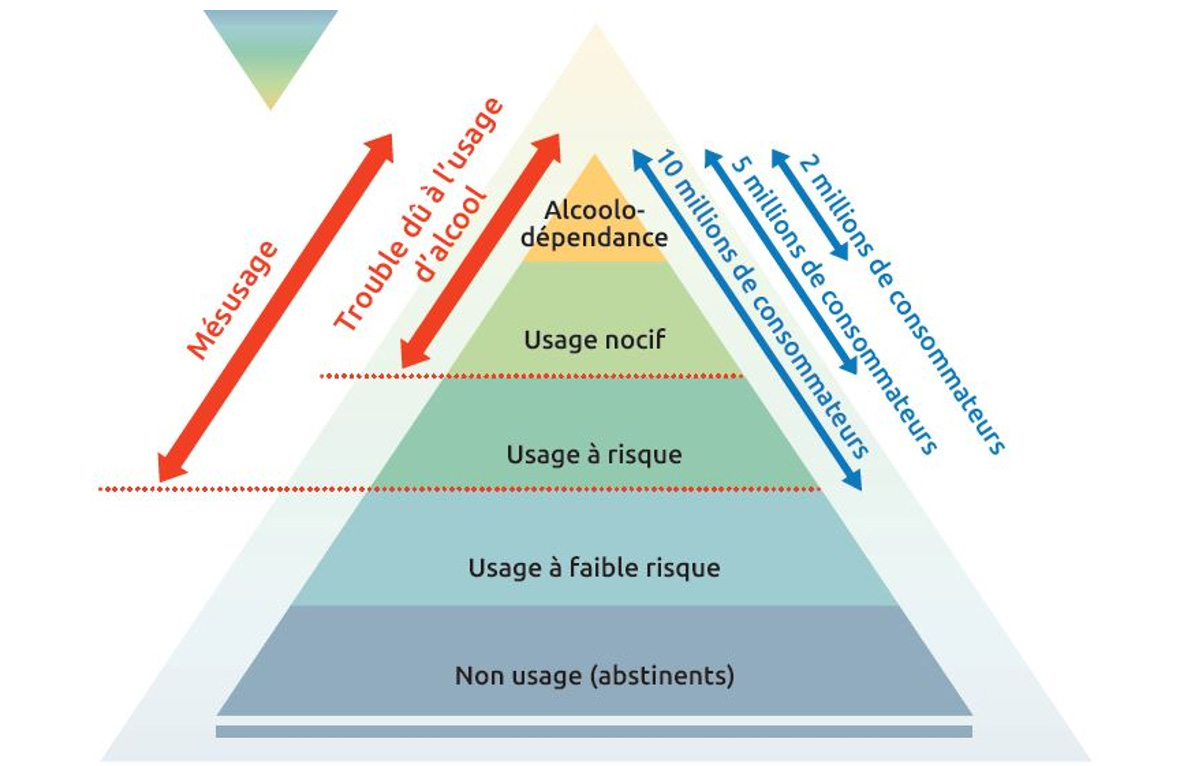
According to the ICD-10, the diagnosis of dependence is based on six criteria:
- A strong or compulsive desire to use a psychoactive substance;
- Difficulty controlling substance use (starting or stopping use, or levels of use);
- A physiological withdrawal syndrome when the individual reduces or stops using a psychoactive substance, as evidenced by the onset of a withdrawal syndrome;
- A characteristic of the substance or the use of the same substance (or a related substance) to relieve or avoid withdrawal symptoms;
- Evidence of tolerance to the effects of the psychoactive substance: the individual requires a larger amount of the substance to achieve the desired effect;
- Gradual abandonment of other sources of pleasure and interests in favor of psychoactive substance use, and an increase in the time spent obtaining the substance, using it, or recovering from its effects;
- Continued use of the substance despite these clearly harmful consequences. Efforts should be made to determine whether the individual was aware of, or should have been aware of, the nature and severity of the harmful consequences.
Dependence is defined by the presence of all three criteria simultaneously during the past year.
Significant Risks During Pregnancy
In France, as in other Western countries, alcohol consumption during pregnancy is the leading cause of non-genetic mental disability in children.
Despite an increasingly encouraging awareness of the issue, too many French people still downplay the impact of even light or occasional alcohol consumption on the health of unborn children. Ethanol easily crosses the placental barrier. As a result, the fetus’s blood alcohol level is the same as its mother’s. Alcohol affects fetal development at all stages of pregnancy.
Fetal Alcohol Spectrum Disorders (FASD) encompass a wide range of clinical manifestations. They can range from fetal death to fetal alcohol syndrome (FAS), a specific form of malformation characterized notably by facial or cranial dysmorphia, to isolated neurodevelopmental disorders—that is, those without associated physical signs. These disorders are not limited to situations involving heavy drinking or alcohol dependence.
It is still impossible today to define a threshold below which there would be no risk to the baby. That is why, as a precautionary measure, it is recommended not to drink alcohol during pregnancy—or, if possible, as soon as a pregnancy is planned.
The prevalence of FAS in the Western world is estimated at between 0.5 and 3 per thousand live births, while the prevalence of FASD is estimated at 9 per thousand live births. Early intervention helps limit the impact of these disorders and supports the child’s development.
The toxicity of alcoholic beverages stems from ethanol (ethyl alcohol) and its hepatic breakdown product: acetaldehyde. Ethanol is a small, hydrophilic molecule that crosses the placenta by simple passive diffusion. The fetal blood alcohol concentration therefore does not differ from that of the mother and may even be higher.
In fact, due to the immaturity of its liver, the fetus cannot metabolize ethanol because of the low activity of the enzyme responsible for its breakdown, alcohol dehydrogenase. Alcohol is eliminated solely through placental return into the maternal circulation. This process occurs more slowly in the fetus than in the mother due to the re-ingestion of alcohol-laden amniotic fluid, thereby delaying its breakdown. For a given dose of alcohol, the fetal blood alcohol concentration is therefore equal to or higher than that of the mother. Ethanol is also excreted into breast milk, which can prolong the child’s exposure after birth.
Alcohol is teratogenic and neurotoxic at all stages of development, with specific risks:
- in the first trimester of pregnancy, the risk is primarily of birth defects or miscarriage;
- during the second and third trimesters, the risks involve the development and maturation of the central nervous system and overall growth (leading to intrauterine growth restriction, or IUGR).
There are multiple mechanisms of toxicity: they are both direct—affecting developing cells—and indirect. The combination of factors involved in determining alcohol toxicity underlies a high degree of individual susceptibility, which contributes to clinical variability.
Factors involved in toxicity include:
- the intrinsic toxicity of ethanol molecules (direct toxicity) and its derivative, acetaldehyde (indirect toxicity), both of which are teratogenic molecules;
- multiple cellular and molecular mechanisms: induction of apoptosis, disruption of morphogenetic substances (retinoic acid, etc.), and epigenetic mechanisms (methylome modification, etc.);
- the modulation of these modes of action by genetic factors (for example, the efficiency of maternal hepatic clearance);
- caloric malnutrition and specific maternal deficiencies (folate, zinc, etc.) that may be associated
- patterns of maternal consumption (frequency, quantity, duration, etc.): there appears to be a link with the early onset, frequency, and extent of consumption, but all types of consumption are affected;
- the stage of the baby’s development:
- during the embryonic stage, that is, up to 11 weeks of amenorrhea, which corresponds to organogenesis (organ development): alcohol is teratogenic, and all cells are sensitive to it;
- during the fetal stage, which extends from the 11th week of amenorrhea to birth: Exposure leads to abnormalities in late organogenesis, growth, and maturation of the central nervous system, particularly through abnormalities in cell migration, cell adhesion, and neurotransmission, as well as through associated cytotoxic mechanisms (direct or indirect: neuroinflammation, apoptosis, etc.) associated with these processes.
Fetal Alcohol Spectrum Disorder (FASD) is a group of conditions characterized by:
- A combination of physical, cognitive, and behavioral symptoms and prenatal exposure to alcohol
- A continuum of functional severity (ranging from intellectual disability to characterized attention disorder, including “dys” and “multidys” conditions) and syndromic severity (ranging from forms where the neurodevelopmental disorder is isolated to full-blown FAS). Milder forms or those with delayed onset are underdiagnosed.
- Secondary consequences of FASD or complications must also be taken into account: difficulties with social integration, risky behaviors, mood or anxiety-related effects… These consequences are not rare; evidence shows they are more common than for other neurodevelopmental disorders and are all the more severe when FASD goes undiagnosed.
- It is impossible to predict which disorders an unborn child will develop. The threshold at which alcohol becomes toxic to development is unknown, which justifies applying the precautionary principle even to low levels of alcohol consumption.
The clinical phenotype of fetal alcohol syndrome (FAS) is an embryo-fetal disorder characterized by three diagnostic criteria, which may be accompanied by visceral abnormalities—cardiac, skeletal, and renal.
- Prenatal and postnatal growth restriction: growth restriction that is often proportional (head circumference, weight, height) and begins in the second half of pregnancy.
- Persistent damage to the central nervous system, the most obvious manifestation of which is impaired growth that can lead to microcephaly, with or without macroscopic malformations (corpus callosum, vermis). The most common consequence is the development of a neurodevelopmental disorder (cognitive and behavioral impairment).
- Craniofacial dysmorphism (no single abnormality is pathognomonic on its own; only their combination is suggestive): narrow palpebral fissures, a smooth philtrum, a thin upper lip, low hairline, protruding ears that are malformed and set low, a domed and narrow forehead…
Fetal alcohol syndrome is primarily associated with heavy alcohol consumption during the first trimester of pregnancy.
The neurobehavioral phenotype is varied but characterized by intellectual impairment (which may progress to intellectual disability), nearly universal executive and attention deficits, and constitutional difficulties with emotional regulation. The development of this phenotype is particularly sensitive to the child’s sociocultural, educational, and emotional environment.
At the individual level, there is no difference between the neurodevelopmental disorders observed in cases of FAS and FASD-NS; at most, the severity is, on average, slightly greater in the syndromic forms (FAS). These disorders can affect all areas of cognitive functioning, ranging from global impairments such as intellectual disability to selective impairments characteristic of specific disorders. The typical pattern involves multiple “multidys” impairments that can be potentially severe in terms of their impact on adaptive functioning and academic learning.
Malformations occur when alcohol is consumed during organogenesis and account for 10 to 30 percent of cases of fetal alcohol spectrum disorders. They are most often associated with fetal alcohol syndrome but not always; in fact, there are cases of FAS-NS that present with minor morphological abnormalities or malformations, even if these are not sufficient to characterize FAS. Furthermore, isolated malformations, without associated neurodevelopmental disorders, have been attributed to fetal alcohol exposure.
The malformations with the clearest link to fetal alcohol exposure are:
- Cardiovascular: atrial septal defect (ASD), ventricular septal defect (VSD), tetralogy of Fallot…
- Cerebral: agenesis or hypoplasia of the corpus callosum, microcephaly, cerebral or vermis hypoplasia…
- Skeletal malformations: funnel chest, spinal abnormalities, abnormalities of the fingers and toes or certain limb joints…
- Urogenital anomalies: ectopia, hypospadias, renal hypoplasia or aplasia, hydronephrosis, duplication…
- Other anomalies: nail hypoplasia…
Alcohol consumption during pregnancy can have obstetric consequences, including spontaneous abortion, intrauterine fetal death, preterm birth and its associated complications, and alcohol exposure syndrome or alcohol withdrawal syndrome with hyperexcitability during the neonatal period.
Early intervention helps limit the impact of these disorders and promote the child’s development. Diagnosis is difficult due to nonspecific symptoms. It is therefore important to consider the possibility of fetal alcohol exposure even in the absence of known alcohol consumption. If alcohol consumption is already known, this should prompt even greater vigilance in screening for symptoms. Unexplained symptoms in an infant, for example, should raise suspicion of withdrawal syndrome.
In relation to

thematic dossier
The First 1,000 Days
The period from conception through the first two years of life is critical for a child’s development and the health of the adult they will become. That is why it is essential to prioritize the...

thematic dossier
Cancers
Les cancers représentent en France la première cause de décès chez l’homme et la deuxième chez la femme. Santé Publique France copilote la surveillance épidémiologique et participe à leur prévention.











