




How can we reduce the risks associated with alcohol consumption?
Alcohol consumption poses health risks. Santé publique France is expanding our understanding of these risks and providing assessment and management tools to better prevent them.
Guidelines for Alcohol Consumption
There is no such thing as risk-free alcohol consumption. The health risks associated with alcohol consumption increase over the course of a lifetime in proportion to the amount consumed.
However, a report issued by a group of experts commissioned by Santé publique France and INCa attempted to define acceptable risks and proposes a single guideline for both genders, expressed as the number of standard drinks: 10 standard drinks per week and no more than 2 standard drinks per day. These same experts recommend having days during the week without alcohol consumption and, for each occasion of drinking, to:
reduce the total amount of alcohol consumed on each occasion
drink slowly, while eating and alternating with water
avoid risky places and activities
ensure you are surrounded by people you trust and can get home safely
These guidelines can be summarized as follows: for your health, alcohol means:
“MAXIMUM 2 DRINKS PER DAY AND NOT EVERY DAY”
Generally speaking, the safest option is to avoid alcohol in the following situations:
throughout pregnancy and breastfeeding
during childhood, adolescence, and throughout the growth period
when driving
when participating in high-risk sports
when taking certain medications
if you have certain medical conditions
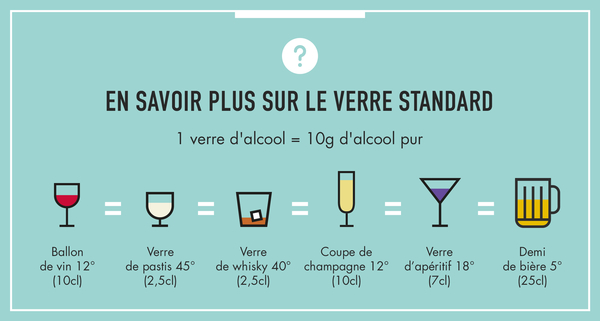
For reference, a “standard drink” contains 10 grams of pure alcohol, regardless of the type of alcoholic beverage (wine, beer, or spirits).
Alcohol content of a standard drink
Risk Prevention
Even with alcohol consumption considered low, health risks exist. It is therefore important to be able to identify, inform, and assist individuals with risky drinking habits—that is, those exceeding recommended consumption limits. The Alcoomètre tool allows for self-assessment and can be offered to patients and the general public: alcoometre.fr.
This tool is a redesign of the tool launched in 2010 and positively evaluated in a randomized controlled trial (Guillemont J, Cogordan C, Nalpas B, et al. Effectiveness of a web-based intervention to reduce alcohol consumption among French hazardous drinkers: a randomized controlled trial. Health Educ Res. 2017 Aug 1;32(4):332-342).
General practitioners, as well as primary care providers (midwives, obstetrician-gynecologists, pharmacists, etc.), are the key actors in identifying alcohol-related problems. By identifying these patients and, if necessary, conducting a so-called “brief” intervention, they have the opportunity to inform them of the risks associated with their alcohol consumption. This screening program is crucial because non-dependent drinkers find it easier to reduce or stop their alcohol consumption, with appropriate support and effort, than those who are already dependent. Healthcare
professionals can take action at several levels:
For patients with low-risk drinking, the goal will be to reinforce health-promoting behaviors (primary prevention).
For patients in whom the physician has identified probable problematic drinking, brief intervention (detailed in this fact sheet) will help prevent the progression to complications, reduce the harm resulting from this behavior, and improve patients’ quality of life.
For dependent patients, a referral to a specialized treatment facility will be made
Early Identification and Brief Intervention (EIBI)
EBIR is a prevention procedure aimed at identifying substance use behavior—specifically alcohol use in this context—and promoting a shift toward reduced consumption.
It primarily targets individuals who are not alcohol-dependent. Dependent individuals, on the other hand, may be referred to specialized addiction treatment facilities.
EBIR consists of two stages:
Screening: this involves collecting self-reported consumption data and assessing risks using a questionnaire
Brief intervention: This takes the form of a motivational interview.
The RPIB has proven effective in numerous studies.
In practice: Early screening
The goal of early screening is to identify risky drinking patterns. To do this, the patient should be asked about their level of consumption, particularly in terms of quantity and frequency. It is better to ask specific questions (e.g., “How many drinks do you have per week?”) rather than vague questions (e.g., “Do you drink alcohol?”) that are sometimes difficult to answer.
To facilitate data collection, there are a wide variety of questionnaires available, tailored to the specific substances they assess. Regarding alcohol, two of the most commonly used questionnaires are:
AUDIT (Alcohol Use Disorders Identification Test)
and FACE (Fast Alcohol Consumption Evaluation)
AUDIT
, developed by the World Health Organization (WHO), consists of 10 questions that assess self-reported alcohol consumption over the past 12 months. The questions measure the frequency of alcohol consumption, dependence, and problems caused by alcohol use. Misuse [dependence
] is suspected:
in men with a score of 7 or higher [>12]
in women with a score of 6 or higher [>12].
|
|
Score |
||||
|---|---|---|---|---|---|
|
Questions |
0 |
1 |
2 |
3 |
4 |
|
1. How often do you drink alcoholic beverages? |
Never |
Once a month or less |
2 to 4 times a month |
2 to 3 times a week |
At least 4 times a week |
|
2. How many standard drinks do you have on a typical day when you drink alcohol? |
1 or 2 |
3 or 4 |
5 or 6 |
7 to 9 |
10 or more |
|
3. On a single occasion, how often do you drink six standard drinks or more? |
Never
|
Less than once a month |
Once a month |
Once a week |
Every day or almost every day |
|
4. Over the past year, how often have you found that you were unable to stop drinking once you had started? |
Never
|
Less than once a month |
Once a month |
Once a week |
Every day or almost every day |
|
5. Over the past year, how often has drinking alcohol prevented you from doing what was normally expected of you? |
Never
|
Less than once a month |
Once a month |
Once a week |
Every day or almost every day |
|
6. Over the past year, how often, after a period of heavy drinking, have you had to drink alcohol first thing in the morning to feel well? |
Never
|
Less than once a month |
Once a month |
Once a week |
Every day or almost every day |
|
7. Over the past year, how often have you felt guilty or regretful after drinking? |
Never
|
Less than once a month |
Once a month |
Once a week |
Almost every day |
|
8. Over the past year, how often have you been unable to remember what happened the night before because you had been drinking? |
Never
|
Less than once a month |
Once a month |
Once a week |
Every day or almost every day |
|
9. Have you ever hurt yourself or someone else because you were drinking?
|
No
|
/ |
Yes, but not in the past year |
/ |
Yes, within the past year |
|
10. Has a friend, doctor, or other healthcare professional ever expressed concern about your alcohol use and advised you to cut back? |
No
|
/ |
Yes, but not in the past year |
/ |
Yes, in the past year |
FACE
The FACE questionnaire is based on a simplified version of AUDIT. It consists of 5 questions scored from 0 to 4. Questions 1 and 2 assess self-reported alcohol consumption over the past 12 months, and questions 3 through 5 assess lifetime risky drinking and dependence. It has the advantage of being extremely quick and therefore easily administered during a consultation.
Misuse is suspected:
in men with a score of ≥ 5,
in women with a score of ≥ 4.
|
|
Score |
||||
|---|---|---|---|---|---|
|
Questions |
0 |
1 |
2 |
3 |
4 |
|
1. How often do you drink alcoholic beverages? |
Never |
Once a month or less |
2 to 4 times a month |
2 to 3 times a week |
At least 4 times a week |
|
2. How many standard drinks do you have on a typical day when you drink alcohol? |
1 or 2 |
3 or 4 |
5 or 6 |
7 to 9 |
10 or more |
|
3. Have people around you ever commented on your alcohol consumption? |
No |
/ |
/ |
/ |
Yes |
|
4. Have you ever needed alcohol in the morning to feel well? |
No |
/ |
/ |
/ |
Yes |
|
5. Do you ever drink and then not remember what you said or did afterward? |
No |
/ |
/ |
/ |
Yes |
See also
HAS - Tool for Early Detection and Brief Intervention - Alcohol, Cannabis, and Tobacco in Adults, December 2014 Recommendation from the French Society of Addiction Medicine. Alcohol Misuse: Screening, Diagnosis, and Treatment. Key Messages
Brief intervention
Brief intervention aims to motivate behavioral change among at-risk drinkers. It should be offered to:
Men with a score of 7 to 12 on the AUDIT questionnaire or 5 to 9 on the FACE questionnaire.
Women with a score of 6 to 12 on the AUDIT questionnaire or 4 to 9 on the FACE questionnaire.
Lasting anywhere from 5 to 20 minutes, brief intervention can be a one-time session or repeated.
The recommended steps are:
Inform |
Report the results of the alcohol consumption questionnaires. Provide information on the risks associated with alcohol consumption. |
Discuss |
Assess personal and situational risks. Identify the patient’s perceptions and expectations. Discuss the personal benefits of stopping or reducing consumption. |
Set goals |
Propose goals and let the person choose. The most effective approach appears to be encouraging self-assessment of consumption, that is, asking the person to record the number of drinks consumed daily Assess motivation, timing, and confidence in successfully reducing or stopping consumption. Offer the opportunity to reassess during a follow-up visit. A second effective approach is to regularly reinforce the person’s commitment to reducing their drinking |
Refer |
Provide a brochure / refer to a website, app, forum, organization, or remote support… |
Prevention of Alcohol Use During Pregnancy
The issue of alcohol consumption during pregnancy must be addressed with every patient, systematically. There are several appropriate times to do so, but the sooner the better.
Preconception
Upon confirmation of pregnancy
During the early prenatal visit
During a follow-up visit
During childbirth preparation classes
Many questionnaires are available, but they cannot replace dialogue. They can, however, facilitate dialogue by encouraging and informing the conversation. The T-ACE is the test that is generally used.
In addition to pregnancy, for women of childbearing age, gynecological and medical consultations provide an opportunity—just as we address tobacco use—to screen for alcohol use and inform patients about the associated health and obstetric risks.
Learn more
https://www.alcool-info-service.fr/Alcool/Home-Professionnels/Alcool-et-grossesse
Guillemont J, Cogordan C, Nalpas B, et al. Effectiveness of a web-based intervention to reduce alcohol consumption among French hazardous drinkers: a randomized controlled trial. Health Educ Res. 2017 Aug 1;32(4):332-342.
In relation to

thematic dossier
The First 1,000 Days
The period from conception through the first two years of life is critical for a child’s development and the health of the adult they will become. That is why it is essential to prioritize the...

thematic dossier
Cancers
Les cancers représentent en France la première cause de décès chez l’homme et la deuxième chez la femme. Santé Publique France copilote la surveillance épidémiologique et participe à leur prévention.

thematic dossier
Mental health
Selon l’Organisation mondiale de la santé, la santé est un état de complet bien-être physique, mental et social, et ne consiste pas seulement en une absence de maladie ou d’infirmité.











