




Data
The measles surveillance system established by Santé publique France enables the study of epidemiological trends for this vaccine-preventable disease and virological monitoring. The epidemiological situation regarding measles in France is the subject of regular epidemiological updates, issued weekly during an epidemic.
Trends in Measles in France
Between January 1, 2008, and December 31, 2023, more than 30,000 cases of measles were reported in France, including nearly 15,000 in 2011 alone, and 26 deaths occurred during the 2008–2019 period. Following a major outbreak in 2010–2011 and a decline in 2012, case numbers remained stable between 2013 and 2016, with a significant outbreak in Alsace in 2015. In 2017, the circulation of the virus increased, particularly in Nouvelle-Aquitaine, Grand-Est, and Occitanie, with an epidemic resurgence in 2018 and 2019 that led to nearly 5,500 cases.
In 2020, there was a major shift in the epidemiology of measles linked to a drastic decline in cases beginning in April 2020: 230 cases were reported in the first quarter out of a total of 240 cases for the year. This decline continued in 2021 and 2022, with 16 and 15 cases, respectively, and through August 2023 (28 cases in the first 8 months out of a total of 117 reported in 2023). This near-absence of measles between April 2020 and August 2023 is likely due to COVID-19 prevention measures (lockdowns, preventive measures, mask-wearing, social distancing), as well as an improvement in two-dose MMR vaccination coverage among infants born since 2018 who are subject to mandatory vaccination, thereby increasing herd immunity. However, this situation is fragile.
A resurgence of measles cases in France observed in 2023, accelerating in 2024 and intensifying in 2025
In 2023, data from mandatory reporting (SO) indicated, starting in September, a resurgence of measles cases in France, primarily linked to imported cases (84%), reflecting the resumption of international circulation of the measles virus.
The largest cluster of measles cases was observed in Auvergne-Rhône-Alpes (64 cases between August and November 2023) and primarily involved middle school students who had been properly vaccinated but at an early age.
This resurgence continued and intensified in 2024, with the total number of cases and the national incidence rate increasing fourfold compared to 2023 (N=483 in 2024 versus 117 in 2023; 0.58 cases per 100,000 versus 0.13 cases per 100,000 inhabitants), as well as a tenfold increase in the number of clustered cases compared to 2023 (N=68 in 2024 versus 7 in 2023).
Six major clusters of epidemiologically linked cases (each comprising more than 5 cases) were observed. The largest cluster occurred in Auvergne-Rhône-Alpes (53 cases between January and April 2024).
The resurgence in reported cases in 2024 and the increase in the number of detected clusters reflect: on the one hand, the international epidemiological situation, marked by a resurgence of measles since 2022 and particularly in 2023 due to several years of declining vaccination coverage abroad, and, on the other hand, the existence of pockets of individuals in the French population who remain susceptible to the virus, particularly among adolescents and young adults.
Distribution of the number of reported measles cases by month, throughout France, January 1, 2008 – December 31, 2025
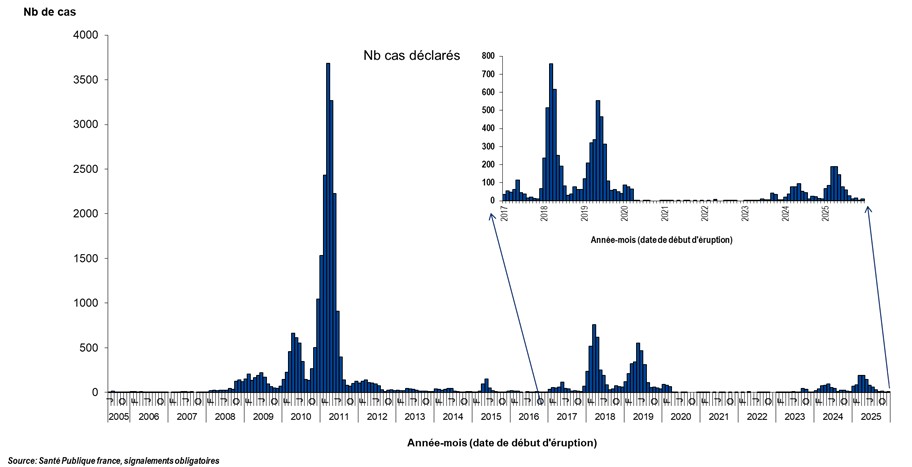
In 2025, the spread of the virus intensified, with the number of cases (873) significantly higher than that observed throughout all of 2024 (483), as well as a large number of clusters of cases (116) compared to 2024 (68). The trends in reported cases and emergency department visits followed the seasonal pattern typically observed with measles in the spring, with an increase beginning in January 2025 and a peak between March and April.
Of the 116 clusters of epidemiologically linked cases identified in total, 30 major clusters of epidemiologically linked cases (involving more than 5 cases) were observed.
The largest outbreak involved at least 75 reported cases across 18 departments following attendance at a Parisian trade show.
These clusters occurred in early childhood care facilities, schools, healthcare settings (healthcare facilities), family circles, and among vulnerable populations or those with limited access to healthcare (Roma camps, Traveling People).
The rise in cases and the occurrence of these outbreaks particularly affect adolescents and young adults, as evidenced by the median age of cases at 16 years. Surveillance data highlight the severity of measles in these age groups and serve as a reminder that it is not merely a benign childhood illness. These data therefore call for intensified efforts to catch up on vaccinations. Forty years after the introduction of the trivalent MMR vaccine into the French immunization schedule in 1986, the year 2025 was marked by 7 reported deaths linked to complications from measles infection. These deaths occurred either among immunocompromised adults following a measles infection contracted in 2025, or among young children, who were likely infected at a very young age and died as a result of a late-onset, extremely severe neurological complication of measles —subacute sclerosing panencephalitis. They underscore the need to protect individuals at risk of severe forms of the disease who cannot receive the vaccine through optimal herd immunity provided by those around them, as well as the need to implement post-exposure prophylaxis in the event of contact with a confirmed case.
The international spread of measles remains a cause for concern. Large-scale outbreaks are occurring on several continents, including in Europe but also in regions that had previously eliminated measles many years ago. These outbreaks increase the risk of imported cases into our country (e.g., outbreaks in Morocco, Vietnam, and Romania).
Bulletins to download:
- Measles in France from January 1 to July 31, 2026
- Measles in France from January 1 to June 30, 2026
- Measles in France from January 1 to May 31, 2026
- Measles in France from January 1 to April 30, 2026
- Measles in France from January 1 to March 31, 2026
- Measles in France from January 1 to February 28, 2026
- Measles in France from January 1 to January 31, 2026
- Measles in France. 2025 Annual Report.
- Measles in France from January 1 to December 31, 2025
- Measles in France from January 1 to November 30, 2025
- Measles in France from January 1 to October 31, 2025
- Measles in France from January 1 to September 30, 2025
- Measles in France from January 1 to August 31, 2025
- Measles in France from January 1 to July 31, 2025
- Measles in France from January 1 to June 30, 2025
- Measles in France from January 1 to May 31, 2025
- Measles in France from January 1 to April 13, 2025
- Measles in France from January 1 to March 14, 2025
- Measles in France. 2024 Annual Report.
Measles Epidemiological Bulletins from 2008 to 2025
Measles Vaccination Coverage in France
Although “two-dose” measles vaccination coverage has increased in recent years in France, particularly among infants, it remains below the 95% threshold required for measles elimination.
- Data on measles, rubella, and mumps vaccination coverage by age group
- Subnational vaccination coverage data for measles, rubella, and mumps by region
- Subnational vaccination coverage data for measles, rubella, and mumps by department
European and Global Surveillance Data
As part of the global measles elimination plan, measles cases are analyzed monthly by the ECDC and the WHO:
- https://www.ecdc.europa.eu/en/measles
- https://www.ecdc.europa.eu/en/measles/surveillance-and-disease-data
- https://www.who.int/teams/immunization-vaccines-and-biologicals/diseases/measles
- https://www.who.int/teams/immunization-vaccines-and-biologicals/immunization-analysis-and-insights/surveillance/monitoring/provisional-monthly-measles-and-rubella-data
In relation to

Rubella
thematic dossier
Rubella is a viral infection that is usually mild but can, during pregnancy, lead to fetal death or congenital rubella syndrome. A vaccine is available to prevent infection.

Vaccination
thematic dossier
Contagious diseases most often affect children at a very young age. Because children are particularly vulnerable, they are a priority target for vaccination programs.











