




The disease
Measles, one of the most contagious infectious diseases
Measles is one of the most contagious infectious diseases. It is caused by a virus of the genus Morbillivirus in the Paramyxoviridae family.
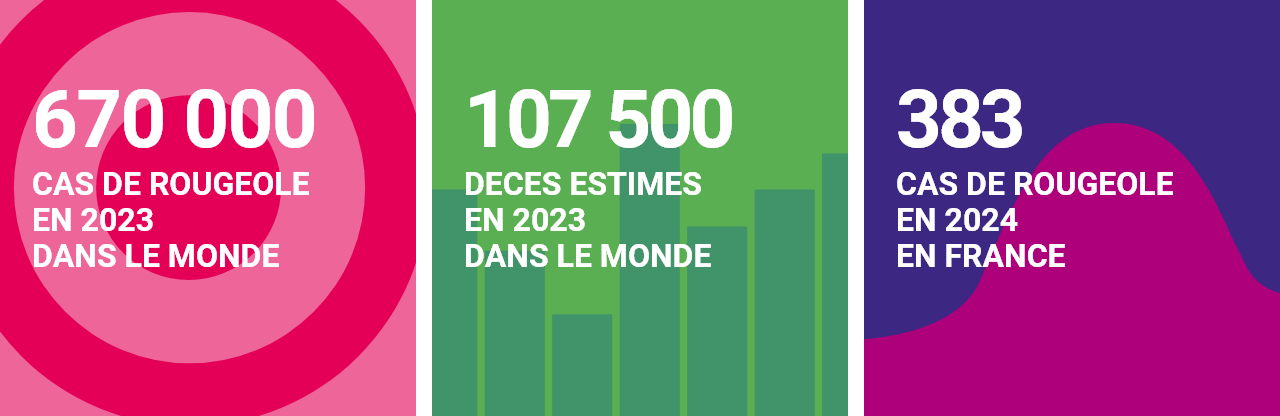
According to estimates by the World Health Organization (WHO), measles is expected to have caused approximately 95,000 deaths worldwide in 2024, mostly among children under the age of 5. In France, since the introduction of mandatory vaccination for infants in 2018, vaccination coverage with the measles-mumps-rubella (MMR) vaccine has continued to increase among children aged 2 years. However, the goal of 95% two-dose measles-mumps-rubella (MMR) vaccination coverage—necessary for the elimination of the disease—has not yet been achieved, either nationally or in any of the regions.
Furthermore, to interrupt the circulation of the virus and eliminate measles in France, a strengthened catch-up vaccination campaign remains necessary to increase vaccination coverage in older age groups, particularly among adolescents and young adults for whom vaccination was not mandatory.
Measles remains one of the world’s major infectious scourges. However, this disease can be eliminated in the various WHO regions. The World Health Organization has implemented a plan to eliminate measles and rubella in each of the WHO regions worldwide with a view to eradication. The challenge is therefore to achieve sufficiently high vaccination coverage to achieve this (95% for both doses of the vaccine). WHO Europe recognized the interruption of measles virus circulation in France in 2022 and 2023 but projected a return to endemic circulation of the virus in 2024 based on data presented by the Ministry of Health and Santé publique France. This situation is reassessed by WHO annually.
Key Facts About Measles
Airborne transmission
Measles is a highly contagious viral infection. Transmission occurs primarily through the air. The virus is transmitted either directly from an infected person or, in some cases, indirectly due to the virus lingering in the air or on a surface contaminated with nasopharyngeal secretions.
Skin symptoms
The incubation period lasts 10 to 12 days. The contagious phase begins 5 days before the rash appears, when the first signs or symptoms appear, and lasts up to 5 days after the rash begins. Between infection and the first signs of the disease, the rash typically appears within 14 days (7 to 18 days). The prodromal phase lasts 2 to 4 days and is characterized by the onset of a fever of 38.5°C, an oculorespiratory catarrh (cough, rhinitis, conjunctivitis) accompanied by general malaise with a feeling of intense fatigue. Koplik’s spots, a pathognomonic sign characterized by the presence of small bright red spots with white or bluish-white centers, are variable and precede the rash. The maculopapular rash lasts 5–6 days.
Complicated forms are more common in patients under 1 year of age and over 20 years of age. Measles mortality is linked to the severe respiratory and neurological complications it causes. The leading cause of death is pneumonia in children and acute encephalitis in adults. It is estimated that there are 1 to 10 deaths per 1,000 cases due to measles in high-income countries such as France. Atypical forms (including those without the characteristic measles rash) may be observed in patients with impaired immunity.
Complications of measles, which are fairly common and serious, can fall into four categories
- secondary infections of the ENT tract and respiratory tree caused by pyogenic bacteria: pneumonia, subglottic laryngitis, acute purulent otitis media.
- pneumonias directly caused by the virus or by bacterial superinfections.
- Acute measles encephalitis, occurring during the acute phase (1 case per 1,000), or subacute (inclusion encephalitis) occurring several weeks or months after the rash in immunocompromised individuals.
- Subacute sclerosing panencephalitis (SSPE): a slow-progressing degenerative disease of the central nervous system associated with persistent measles virus. A late complication, invariably fatal, occurring four to ten years after measles. Its incidence varies depending on the age at which measles occurs, affecting 1 in 100,000 cases if measles occurs after age 5, but rising to as many as 18 cases per 100,000 when measles occurs before age 1.
A diagnosis requiring laboratory confirmation
Given the decline in the disease’s incidence, any clinically suggestive case of measles must be confirmed by laboratory testing. Furthermore, virological confirmation is strongly recommended in cases of high viral circulation.
The diagnosis is based on:
- Direct detection of the virus by RT-PCR, primarily from oropharyngeal swabs or other upper respiratory tract specimens, or even urine samples. Detection of the virus by RT-PCR is indicated in the first few days of the rash and is covered by health insurance.
- Testing for specific IgM antibodies in serum or saliva, in addition to RT-PCR testing, or detection of a rise in antibody titers (IgG), while ensuring that no recent vaccination has occurred. The sample must be collected between 3 and 28 days after the onset of the rash (high risk of false negatives before 3 days).
Unlike direct virus detection techniques using RT-PCR, serology does not allow for genotype identification by the CNR or the diagnosis of post-vaccination measles.
Vaccine Prevention
For infants, the vaccination schedule calls for the administration of a first dose of MMR vaccine at 12 months and a second dose between 16 and 18 months. Catch-up vaccination is recommended for anyone over 12 months of age and born since 1980, regardless of their history regarding these three diseases.
If a case occurs, containment measures are required. Isolation of the case is recommended for the entire contagious period, i.e., up to 5 days after the onset of the rash.
It is also essential to ensure that contacts are well protected by verifying their vaccination status (two doses for individuals born in or after 1980, or even three doses for those who received a first dose of vaccine before the age of 12 months).
Post-exposure vaccination, if administered within 72 hours of contact with a case, can prevent the onset of the disease in the vaccinated individual.
Other post-exposure measures involving the intravenous administration of immunoglobulins within 6 days of contact with a confirmed case may be indicated for individuals at risk of severe disease who cannot be vaccinated or have not received post-exposure vaccination (infants under one year of age, pregnant women, immunocompromised individuals).
Vaccination Recommendations in France
Infant vaccination schedule:
- first dose at 12 months and,
- second dose between 16 and 18 months.
This vaccination has been mandatory since January 1, 2018, and is required for admission to or continued attendance in childcare settings for all children born on or after January 1, 2018.
Catch-up vaccination for individuals born in or after 1980 and at least 12 months of age (regardless of prior history regarding the three diseases):
- two doses, with a minimum interval of one month between doses;
- three doses for individuals who received a first dose of the vaccine before the age of 12 months.
Reference Documents
- Decree No. 2023-700 of July 31, 2023, regarding the mandatory transmission of individual data to the health authority and the establishment of the “LABOé-SI” personal data processing system
- Decree No. 2018-42 of January 25, 2018, regarding mandatory vaccination
- Instruction No. DGS/SP/SP1/2018/205 of September 28, 2018, regarding the procedures to follow in the event of one or more cases of measles
- CSHPF Opinion on measles surveillance in France. CSHPF, September 2003
- Measles and Rubella Strategic Framework: 2021–2030 (World Health Organization)
In relation to

Rubella
thematic dossier
Rubella is a viral infection that is usually mild but can, during pregnancy, lead to fetal death or congenital rubella syndrome. A vaccine is available to prevent infection.

Vaccination
thematic dossier
Contagious diseases most often affect children at a very young age. Because children are particularly vulnerable, they are a priority target for vaccination programs.











