Antibiotic Use in the Community and in Healthcare Facilities
Antibiotic Use in Urban Areas
By 2025, antibiotic use in urban areas had declined, with encouraging data that remains to be confirmed over time.
What is the level of antibiotic use in urban areas in France in 2025?
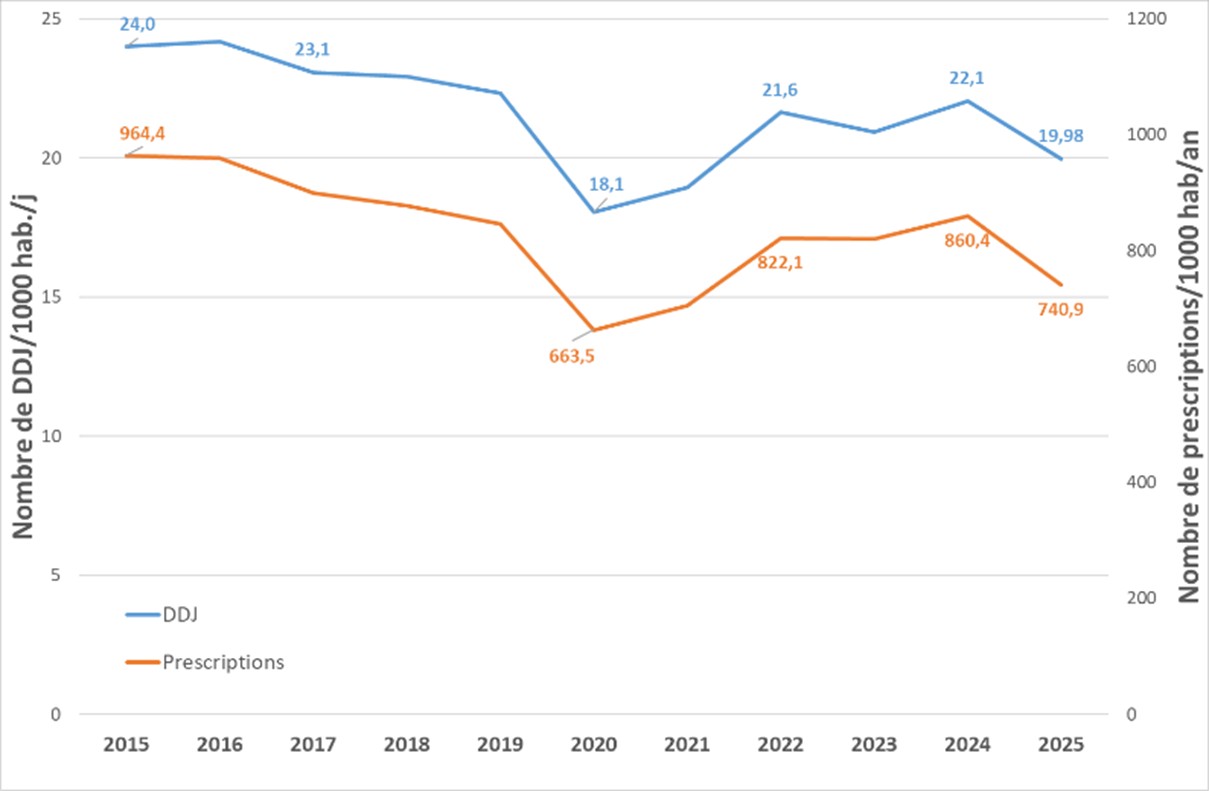
- Nearly 20 doses of antibiotics, measured in defined daily doses (DDD), are consumed each day per 1,000 residents (down 9.6% from 2024).
- 740.9 antibiotic prescriptions per 1,000 inhabitants per year (down 13.9% from 2024).
DDJs (Defined Daily Doses) are a standardized unit of measurement used to assess and compare the consumption of antibiotics (or other medications) across different countries, facilities, or time periods.
Who uses the most antibiotics?
- Women receive more antibiotics than men, except among those over 65, where the trend is reversed.
Who prescribes the most antibiotics?
- General practitioners are the leading prescribers of antibiotics (77.5%), followed by dentists (11.9%) and then medical specialists (9.1%).
For the first time in 2025, the direct dispensing of antibiotics by pharmacists following a rapid diagnostic test (RDT) exceeded 1% of prescriptions.
Source: Antibiotic reimbursement data from the SNDS analyzed by Santé publique France: https://www.preventioninfection.fr/spares/
Trends in antibiotic use, expressed in terms of the number of prescriptions and defined daily doses (DDD). France, 2015–2025.

rapport/synthèse
16 November 2026
Antibiotic Use in the Private Sector in France, 2015–2025

bulletin national
17 November 2026
Antibiotic Resistance and Antibiotic Use in 2025
Antibiotic Use in Healthcare Facilities
In 2025, antibiotic use in healthcare facilities has declined but remains higher than its 2019 level.
What will antibiotic use in healthcare facilities be like in 2025?
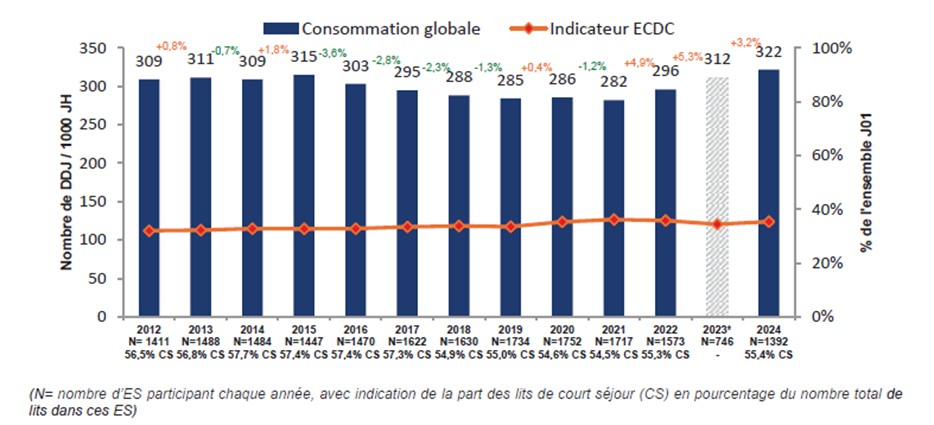
- 309 doses of antibiotics, measured in defined daily doses (DDD), are administered each day per 1,000 patient-days
- This figure is lower than that observed in 2024 (322 DDJ/1,000 hospital days), with variations depending on the type of facility and clinical specialty.
DDJs (Defined Daily Doses) are a standardized unit of measurement used to assess and compare the consumption of antibiotics (or other medications) across different countries, facilities, or time periods.
Which antibiotics are most commonly used?
Amoxicillin and amoxicillin combined with clavulanic acid account for more than one-third of the defined daily doses consumed in participating facilities. These two antibiotics are the most commonly prescribed, but their use has decreased compared to 2024.
Changes between 2019 and 2025
- The consumption of amoxicillin increased, while that of amoxicillin-clavulanic acid decreased.
Source: Data from 1,620 participating facilities (covering 83% of recorded hospital stay days) in the surveillance program coordinated by the national Spares initiative, overseen by Santé publique France.
Trends in consumption and the ECDC indicator from 2012 to 2024 across all healthcare facilities that participated in the SPARES surveillance program each year (number of DDJ per 1,000 JH). National SPARES Mission. 2024 Surveillance.
rapport/synthèse
16 November 2026
Monitoring of antibiotic and antifungal use in healthcare facilities and long-term care facilities with an in-house pharmacy, and monitoring of bacterial resistance in healthcare facilities. Key…
bulletin national
17 November 2026
Antibiotic Resistance and Antibiotic Use in 2025
The Situation in Europe: Where Does France Stand?
The European surveillance network ESAC-Net, led by the European Center for Disease Prevention and Control (ECDC), allows for comparisons of antibiotic use across European countries. French data, based on antibiotic sales and analyzed by the ANSM, show that France remains one of the largest consumers of antibiotics in Europe.
Overall Consumption (Combined Outpatient and Hospital Sectors)
In 2025, France ranked fourth among European Union countries in terms of antibiotic consumption, with 22.8 daily doses per 1,000 inhabitants per day (tied with Spain).
Community sector (outpatient)
In the community sector, France ranks fifth with 21.1 DDD per 1,000 inhabitants per day, behind Greece (28.4 DDD per 1,000 inhabitants per day), Malta (22.8 DDD per 1,000 inhabitants per day), Romania (22.5 DDD per 1,000 inhabitants per day), and Spain (21.3 DDD per 1,000 inhabitants per day).
Hospital Sector
In hospitals, French consumption stands at 1.7 DDJ per 1,000 inhabitants per day, placing the country close to the European average (1.6 DDJ per 1,000 inhabitants per day).
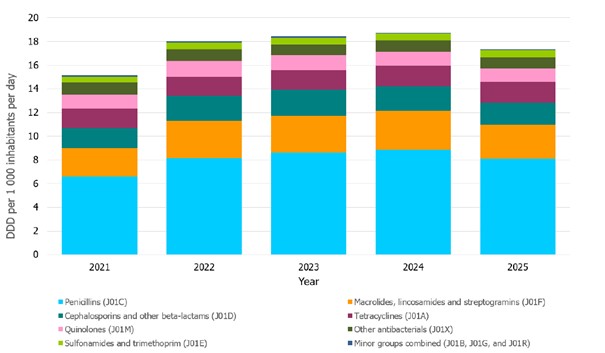
Community consumption of systemic antibacterials (ATC J01) by subgroup (ATC level 3), expressed in DDJ per 1,000 inhabitants per day, weighted by the EU/EEA population, 2021–2025
In relation to

Healthcare-associated infections
thematic dossier
Santé publique France is tasked with monitoring and preventing these infections in healthcare facilities, long-term care facilities, and community healthcare settings, thereby helping to limit...