


e-DO - Mandatory Online Reporting of HIV Infection, AIDS, and Tuberculosis
The mandatory reporting system for HIV/AIDS and tuberculosis is based on the submission of information via the e-DO application. Learn all about the system and how to log in to the application.
e-do app
e-DO is the application designed for the mandatory online reporting of HIV infection, AIDS, and tuberculosis.
HIV/AIDS
Since 1999, infection with the human immunodeficiency virus (HIV), regardless of its stage, has been included on the list of reportable diseases (MDO). Clinicians and laboratory professionals, whether in the public or private sector, are required to report individual data on cases of HIV infection or AIDS that they diagnose to health authorities. Analysis of this information makes it possible to describe the number and characteristics of infected individuals in order to guide prevention, screening, and care efforts and to provide data for evaluating these efforts.
Since April 2016, HIV and AIDS reporting has been conducted online via the e-DO application for all reporting entities.
Tuberculosis
Tuberculosis (TB) has been a reportable disease since 1964. Much more recently, latent tuberculosis infection (LTBI) in children (those under 15 years of age in 2003, and under 18 years of age in 2021) and treatment outcomes for active tuberculosis (2007) were added to the list of reportable conditions. Clinicians and laboratory professionals, whether in the public or private sector, are required to submit individual data to health authorities regarding diagnosed cases of active tuberculosis or latent tuberculosis infection (LTBI) in individuals under 18 years of age and the treatment outcomes for active tuberculosis. Analysis of this information makes it possible to describe the number and characteristics of affected individuals in order to guide management, screening, and prevention efforts, and to provide data for evaluating tuberculosis control measures.
Mandatory Reporting

The reporting physician or laboratory technician submits a report of an HIV infection, AIDS, or tuberculosis via e-DO after logging into their account. e-DO allows them to choose between an HIV/AIDS report and a tuberculosis report. Once the reporting form is completed, clicking the “Submit” button sends the report, which then becomes visible simultaneously to the Regional Health Agency (ARS) in the reporter’s region and to Santé publique France.
The mandatory reporting system for HIV infection and AIDS is based on the submission of information via the e-DO application.
Diagnoses of HIV infection must be reported separately by each reporting party (clinician and laboratory technician) in the e-DO application. Both types of reports are necessary; they are not redundant because the information requested from laboratory technicians and clinicians is different and complementary. AIDS diagnoses are reported solely by the clinician.
The ARS can view the reports entered by the reporters and monitor the surveillance system’s performance (number of reports per month, overall or by report type or by the reporter’s place of practice, etc.).
Santé publique France, along with the ARS, has access to the reports submitted by reporting entities, compiles reports concerning the same patient into a virtual file, contacts the reporting entity as needed to obtain further details, and follows up with reporting entities that have not submitted their portion of the report.
Once in the e-DO application, the reporter selects the tuberculosis report they wish to submit (TM, ITL, treatment outcome) and fills out the report form directly online. The process takes a few minutes. Once the information has been entered, the reporter sends the report to the ARS electronically—with a single click of the mouse. All other stakeholders involved in tuberculosis surveillance can access this reporting system in e-DO. The main roles include validating the report by filing it in a case file (ARS), verifying the information and, if necessary, requesting additional information (CLAT), entering biological data (testing laboratories), and validating multidrug-resistant tuberculosis cases (CNR-MyRMA). Teams at Santé publique France, both nationally and regionally, can extract data and perform preliminary analyses (during the year) or final analyses after the national database has been validated. These analyses may be conducted routinely once a year, or during the year—for example, at the request of an ARS. The calculated indicators provide public health authorities with information on the epidemiology of tuberculosis in France and enable the transmission of this data to international bodies (ECDC, WHO). Although it is still possible to report using the “paper” form, the goal of e-DO is the complete digitization of the system in order to simplify the process and improve access to it, to improve the quality and completeness of the data, to enhance responsiveness by replacing paper-based transmission with electronic transmission, and, finally, to reduce the workload associated with filling out and entering data on forms by the various stakeholders in the reporting process.
Since 2019 for regional health agencies and starting in 2022 for reporting entities, tuberculosis reporting has been conducted online via the e-DO application.
Reporting Criteria
- Download the tutorial: HIV/AIDS Reporting Criteria
Tuberculosis:
Any confirmed case of tuberculosis (positive culture for M. tuberculosis OR positive microscopy (BAAR+) with a positive PCR for M. tuberculosis) or probable (clinical and/or radiological signs consistent with tuberculosis AND a physician’s decision to treat the patient with standard antituberculosis therapy)
Treatment outcome:
Any case of active tuberculosis reported within 12 months of the start of treatment or diagnosis
Tuberculous infection (TI):
Child/adolescent under 18 years of age with no clinical or radiological signs of tuberculosis but with a positive 5U tuberculin skin test (> 10 mm, or > 15 mm if vaccinated with BCG, or an increase of 10 mm compared to an IDR performed within the past 2 years) OR a positive result on an interferon-gamma release assay (IGRA)
Access to the e-DO app
e-DO is the application designed for the mandatory online reporting of HIV/AIDS and tuberculosis. Regardless of the type of report, e-DO can be accessed via the single link http://www.e-do.fr/.
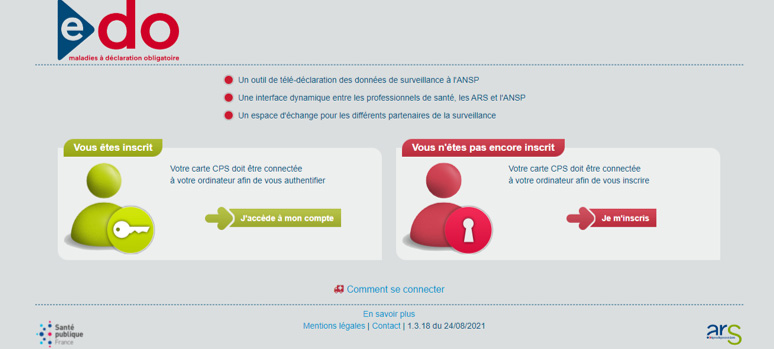
Once registered, the reporter has access to their account and can choose to submit an HIV/AIDS or tuberculosis report, as well as access a number of features, such as responding to a request for additional information or adding information to a report that has already been submitted.
Your CPS-type card must be connected to your computer, and you must know the associated PIN.
Authentication for the app relies on healthcare professional cards (CPS) or other cards in the CPS family (CPA, CPE, etc.). These electronic cards, issued by the Digital Health Agency (ANS), verify the identity of healthcare professionals (ANS. CPS Portal. Available at: https://esante.gouv.fr/securite/cartes-et-certificats/CPS.
They are automatically distributed by the ANS to all healthcare professionals registered with the professional associations for physicians, pharmacists, midwives, and dental surgeons. Cards must be ordered from the ANS for non-medical healthcare professionals employed by a healthcare facility or by an authorized organization (e.g., Santé publique France, ARS, etc.) who need to log in to the e-DO application.
To use the CPS family of cards, a card reader must first be installed on the user’s computer.
For more information and to view the legal texts, see the bottom of this page.
Each user must create an account and provide a valid email address.
Each account is associated with one or more profiles. For example, for the reporter, the profile may be that of a clinician or a biologist. A surveillance partner (CNR, CLAT) has its own profile that allows it to access specific features; this is also the case for non-reporters (SpFrance, ARS).
When creating an account, the screen offers three registration options depending on the desired profile (reporter, partner, or non-reporter).
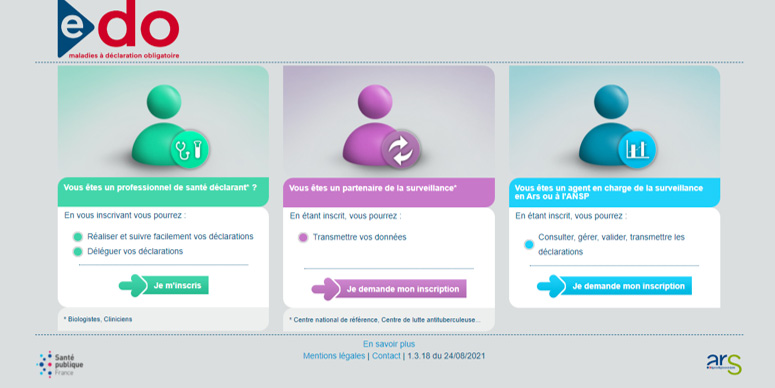
Once the account and profile have been created, users can begin using e-DO. A user may then create additional profiles (for example, if they work at two different locations).
After creating an account, a user may authorize another person to submit reports in e-DO on their behalf. For example, a clinical trial technician or a resident may submit reports on behalf of the chief of service, provided that the chief of service has authorized them to do so.
As an e-DO user, in accordance with the provisions of Articles 39 and 40 of Law No. 78-17 of January 6, 1978, on information technology, data files, and civil liberties, you may access and modify your personal data directly through your account, and you may also deactivate your account.
Features of the e-DO app
Reporters
The app allows users to enter and directly submit their reports of HIV infection and AIDS to health authorities. Reporters have access to a “draft” feature that allows them to start their report and continue it later within a 12-month period. The first step in the reporting process is to generate an anonymity code, which will be stored in the app for 12 months. No personally identifiable patient data is recorded. Reporters have access to the reports they’ve submitted for 12 months. If information is missing or there are inconsistencies in the submitted reports, communication between Santé publique France epidemiologists and reporters takes place via e-DO.
Regional Health Agencies (ARS) and Santé publique France
Reports submitted by laboratory technicians and clinicians via the app are immediately available to both the ARS and Santé publique France simultaneously. Authorized staff at the ARS can view reports submitted by reporters practicing in their region for 12 months.
Public Health France
Santé publique France has access to the reports as soon as the reporter clicks “send”; if necessary, it can send requests for additional information to reporters via e-DO and can follow up with co-reporters when only one of the two parts (laboratory technician or clinician) has been submitted, consolidates HIV/AIDS reports concerning the same patient into a virtual patient record, and exports data from the received reports and the created patient records.
Reporters
The e-DO app allows users to enter and directly submit a tuberculosis report (TM, ITL, treatment outcome) to regional health authorities (ARS). The “draft” feature allows users to start a report and continue working on it within 12 months. Submitted reports remain visible in the reporter’s account for 5 years. Other actions that a reporter can perform include searching for reports, submitting additional information, and entering treatment outcomes at the request of the ARS or CLAT.
Other Stakeholders in Surveillance
Regional Health Agencies (ARS)
When a report is sent to the ARS, the agency files it in a case and, in doing so, assigns it to a CLAT in the region, which is notified by email. Thus, for each case entered into e-DO, a file is created into which all reports for that individual will subsequently be incorporated: additional information, treatment outcome. Each file—which is unique to a patient—is assigned a unique file number and an anonymization code. A single file may therefore contain multiple reports. This file can be modified by the ARS and the CLAT to correct information or add additional details.
The CLAT
The CLAT has access to the file assigned to it by the ARS and can “take action” on it: modify it, transfer it to another ARS or another CLAT, or request additional information from the reporter. Each person who uses e-DO within a CLAT creates a profile that is shared by all users of that CLAT, allowing them to share information and manage the patient collaboratively. A CLAT physician can also create a reporter profile to report cases (which is not possible with a CLAT profile). Thus, a CLAT physician may have multiple profiles for different roles. This is also the case for reporters, who may create multiple profiles when, for example, they work in different locations.
The National Tuberculosis Reference Center (CNR-MyRMA)
The CNR also has access to e-DO. Like Santé publique France, it has access to non-identifying data, unlike the ARS and CLATs, which have access to indirectly identifiable data, allowing them to manage the patient’s care. This indirectly identifiable data is retained for 5 years, whereas for reporters and the CNR, non-identifying data remains visible in their e-DO accounts for 5 years. The CNR plays a fundamental role in confirming MDR tuberculosis: it is notified when an MDR report has been classified by the ARS. By accessing e-DO, the CNR confirms (or does not confirm) the MDR tuberculosis case. When this is done, CLAT and the ARS are notified, which allows them to inform the reporting entity.
Mycobacteriology laboratories
Mycobacteriology laboratories have access to e-DO and can report a patient or enter results from microscopic examination, PCR, culture, genotyping, or phenotypic antibiotic susceptibility testing for first-line antituberculosis drugs.
Santé publique France
Santé publique France has access to the reports (indirectly identifiable) and individual data files (indirectly identifiable), which it can export and analyze. An automated email notifies the national level of Santé publique France whenever tuberculosis is reported in a child under 2 years of age or severe tuberculosis (meningeal or miliary) is reported in a child under 15 years of age. This system allows for real-time monitoring of the incidence of tuberculosis in young children and the impact of the suspension of mandatory BCG vaccination on the epidemiology of pediatric tuberculosis.
Need help?
- Tutorials:
- HIV/AIDS:
- HIV/AIDS Reporting Criteria
- Create an account, a profile, or an authorization
- Submit a report (for clinicians)
- Submit a report (for laboratory professionals)
- Respond to a follow-up
- Respond to a request for additional information
- Edit a report (for the reporter)
- Edit a report (for ARS and regional units of Santé publique France)
- LaboVIH (for the laboratory technician)
- Tuberculosis:
- HIV/AIDS:
- Videos for filers:
- Tuberculosis (playlist of 8 videos available)
- Frequently Asked Questions:
- Procedures and informational messages
If the online support materials (FAQs, tutorials, etc.) have not helped you resolve your issues, you can contact the e-DO Info Service at the e-DO Info Service number:

Official Texts
Decision 2015-344 of October 6, 2015 (authorization request No. 1818160). National Commission on Information Technology and Civil Liberties.
Order amending the template for the notification form set forth in Annex 29 of the Order of August 22, 2011, regarding the mandatory reporting of infectious diseases and other diseases mentioned in Article D.3113-7 of the Public Health Code.
DGS Directive of July 4, 2016, regarding the rollout of the e-DO application for the online reporting of HIV/AIDS infections.
Decree of February 17, 2021, amending the tuberculosis reporting form and setting the retention period for identifying data at 5 years.
DGS Directive of July 1, 2021, and its four appendices announcing the launch of online tuberculosis reporting.
Download
Patient information leaflets and posters:

HIV/AIDS
thematic dossier
HIV, or Human Immunodeficiency Virus, is a sexually transmitted human retrovirus. It weakens the immune system, and if left untreated, leads to AIDS.

Tuberculosis
thematic dossier
Tuberculosis is a contagious disease that primarily affects the lungs. It is spread through the air. The BCG vaccine given to children primarily protects against severe forms of the disease.












