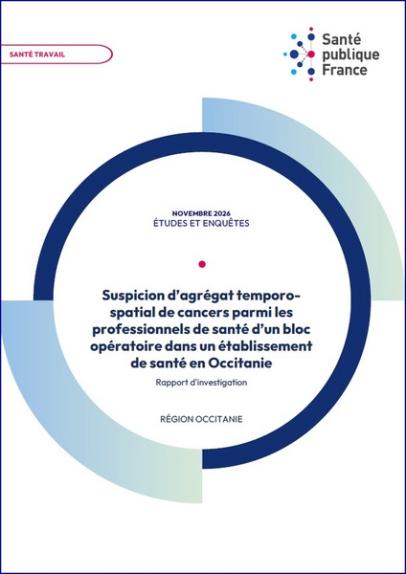
Suspected Temporal-Spatial Cluster of Cancers Among Healthcare Professionals in an Operating Room at a Healthcare Facility in Occitanie. Investigation Report
In January 2020, a healthcare professional working in an operating room at a hospital in Occitanie reported 10 cases of cancer among staff over the past ten years. After a hiatus due to the COVID-19 pandemic, and following validation of the reported cases by the Occitanie Regional Health Agency, the investigation resumed in 2023, focusing on 8 cases of cancer diagnosed between 2011 and 2023 (3 B-cell lymphomas, 2 breast cancers, 1 intrahepatic bile duct cancer, 1 rectal cancer, and 1 anal canal cancer). The investigation was conducted by Santé publique France Occitanie and a multidisciplinary team composed of epidemiologists, lymphoma experts, and experts in occupational diseases. It followed four steps in accordance with the Santé publique France methodological guide for the assessment and management of spatiotemporal clusters of non-infectious diseases (2023): assessment of the local context, case documentation (detailed description of the 8 cases, analysis of occupational and environmental exposures through consultations with the Regional Center for Occupational and Environmental Diseases), identification of known risk factors (literature review), and evaluation of the relevance of continuing the investigation. Regarding the epidemiological analyses, the reported cancers comprise 5 different types, each with distinct etiological mechanisms. Some are common cancers in the general population, while others are rarer, such as lymphomas and cholangiocarcinomas. With regard to occupational exposures, ionizing radiation is a factor with limited evidence for lymphomas, rectal cancers, and bile duct cancers, and established evidence for breast cancer. Six out of eight cases were under occupational monitoring for exposure to ionizing radiation; the doses recorded were below the regulatory threshold requiring specific monitoring (1 mSv/year) and comparable to the national average for healthcare professionals (0.29 mSv/year). No radiation incidents were reported at the facility (ASNR and ANSM databases). Social expectations were deemed moderate. The evidence gathered does not support the validation of a cancer cluster or the continuation of investigations due to: the diversity and nonspecific nature of the reported cancers; the fact that certain reported cancers are not rare; the small number of cases (<10); the existence of exposure to ionizing radiation—a risk factor common to most of the reported cancers—but at very low exposure doses; the limited level of evidence regarding the link between the reported cancers and ionizing radiation (except for breast cancer); and the still limited knowledge in the literature regarding the risk factors underlying the occurrence of lymphoma cases. Given the confirmed occupational exposure to ionizing radiation, Santé publique France recommends that the facility ensure that its monitoring system is properly implemented and reiterate best practices to limit exposure.
Author(s): Durand Cécile, Rivière Stéphanie
Publishing year: 2026
Pages: 25 p.
Collection: Studies and Surveys
In relation to
Our latest news

news
Odissé Dataviz Challenge: Winners Honored at the Santé publique France...

news
Call for Nominations to Fill Vacancies on the National Reference Centers...

news