


Launch of the PestiRiv study: a groundbreaking study on pesticide exposure among people living in wine-growing regions
CP_lancement_PestiRiv_191021.pdf
Download (PDF - 707 KB)
Press Contacts
Santé publique France
Vanessa Lemoine: 01 55 12 53 36
Stéphanie Champion: 01 41 79 67 48
presse@santepubliquefrance.fr
ANSES
01 49 77 27 80 / 01 49 77 22 26 / 01 49 77 28 20
presse@anses.fr
In France, a significant portion of the rural population lives in wine-growing regions. Are these people particularly exposed to the products used in crop protection, and if so, how? To answer these questions, Santé publique France and ANSES are launching PestiRiv today, the first large-scale study aimed at gaining a better understanding of pesticide exposure among people living near vineyards. Measurements taken from 3,350 people across six French regions will enable researchers to objectively identify the sources that contribute most to pesticide exposure and to adapt preventive measures accordingly.
Measuring pesticide exposure by taking all sources of exposure into account
While the health effects of pesticides are a concern for the French public and government authorities, there is currently little data available in France on the actual exposure of people living near crops, particularly vineyards. PestiRiv is thus the first study conducted across mainland France to investigate pesticide exposure in both wine-growing and non-wine-growing areas. This is a groundbreaking study in that it will allow for a comparison of the population’s actual exposure levels—assessed through biological samples—with all possible sources of exposure: air, food (including water), occupational activities (including agricultural practices), and domestic uses.
The main objective is to determine whether there is a difference in pesticide exposure between people living near vineyards and those living far from any crops. PestiRiv will help identify the sources that contribute most to pesticide exposure and assess the influence that distance from vineyards, the season, or individuals’ habits and behaviors may have on this exposure. A better understanding of the sources of this exposure will help identify ways to limit it and, consequently, avoid the potential health effects of these products.
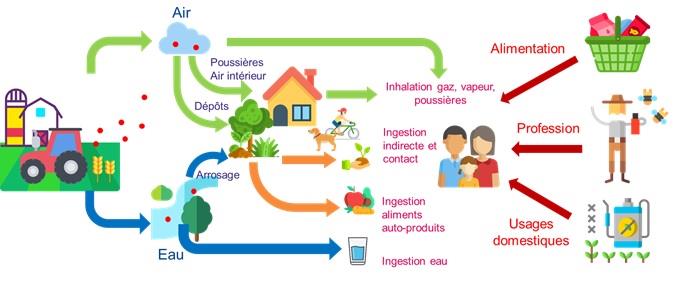
A large-scale study: 3,350 participants, 2 field study periods
The study involves 3,350 randomly selected participants, including adults aged 18 to 79 and children over 3 years old living in wine-growing areas (within 500 meters of vineyards and more than 1,000 meters from other crops) and areas far from any crops (more than 1,000 meters from any crops). Participants will be distributed across more than 250 study areas, representing contrasting local conditions, in six regions: Auvergne-Rhône-Alpes, Bourgogne-Franche-Comté, Grand Est, Nouvelle-Aquitaine, Occitanie, and Provence-Alpes-Côte d’Azur.
The PestiRiv study covers two periods of the year:
from October 2021 to February 2022, when the use of pesticides on vineyards is least frequent;
from March to August 2022, when treatments are most frequent.
Pesticide exposure will be measured in both humans and the environment through:
Collection of urine and hair samples to measure pesticides present in participants’ bodies
Collection of dust, indoor air, and fruits and vegetables from the gardens of certain participants (partner: the Scientific and Technical Center for Building).
Measurements of pesticides in outdoor air conducted in certain wine-growing areas and others far from any crops (partners: Atmo France, accredited air quality monitoring associations, and INERIS).
These measurements will be accompanied by:
Questionnaires sent to participants to identify sources that may contribute to their exposure to pesticides.
A description of the meteorological and topographical conditions that may influence the dispersion of plant protection products in the environment.
An analysis of the agricultural context of the study areas, such as the likelihood of vineyard treatments.
An analysis of national water monitoring data to determine the local contribution of this source to consumer exposure.
Measurements in the relevant environments will cover approximately fifty substances.
A pre-tested and approved study: 56% of participants were interested in the topic
The first phase of the PestiRiv study was conducted by Santé publique France and ANSES in four municipalities in the Grand Est and Nouvelle-Aquitaine regions. The objective was to ensure participant engagement and adjust the protocol if necessary by testing the methodology and gauging the support of local residents and stakeholders, while identifying reasons for refusal and the expectations of those approached. Among the 72 households that participated between October 28 and December 21, 2019, the following were observed:
Conscientious adherence to the protocol by participants, including children;
A good understanding of the questionnaires, even though some have since been adapted and simplified;
Participants were generally highly engaged, as they lived very close to the vineyards, were winemakers or families of winemakers, or were aware of health issues among their acquaintances.
This first phase of the PestiRiv study provided a better understanding of participants’ expectations and allowed for adjustments to the study protocol to improve its implementation on a national scale.
Download

enquêtes/études
1 September 2024
Study of Pesticide Exposure Among Residents Living Near Wine-Growing and Non-Wine-Growing Areas. Summary of the Pilot Study.
A study building on the work of ANSES and Santé publique France
The PestiRiv study is part of a series of scientific studies supported by ANSES and Santé publique France, aimed at improving our understanding of pesticides and their actual effects on health.
Through the national biomonitoring program (ENNS1, Elfe2, Esteban3…), led and implemented by Santé publique France, the French population’s exposure to various pollutants, including pesticides, is assessed by measuring contamination levels in samples (urine, blood, hair), investigating exposure pathways, and proposing recommendations to reduce exposure.
GEOCAP-AGRI, also led by Santé publique France in partnership with Inserm-Epicea UMR 1153 and funded by ANSES, studies the risk of childhood cancer in relation to proximity to certain crop types.
The National Exploratory Pesticide Campaign (CNEP), led by ANSES, INERIS, and Atmo France—the network of accredited air quality monitoring associations—has provided a snapshot of the substances present in outdoor air (excluding situations of close proximity to emission sources) and their concentration levels in France, both in mainland France and in the overseas territories.
All of this data is utilized within the framework of phytopharmacovigilance, a national system for monitoring adverse effects linked to the use of plant protection products led by ANSES, whose goal is to collect existing data and identify signals and alerts that require national action.
1 The 2006–2007 National Nutrition and Health Survey, one component of which aimed to describe the population’s exposure to certain heavy metals (arsenic, cadmium, mercury, lead) and pesticides, as well as the factors influencing such exposure.
2 The Elfe Cohort aims to better understand the factors (environment, family environment, living conditions, etc.) that may influence a child’s physical and psychological development, health, and socialization. Visit the survey page.
3 Esteban—a health study on the environment, biomonitoring, physical activity, and nutrition. Visit the survey page.
surveys/studies
PestiRiv: A Study to Better Understand Pesticide Exposure Among People Living ...
Santé publique France and ANSES (the French Agency for Food, Environmental and Occupational Health & Safety) are conducting the Pestiriv study to better understand pesticide exposure among people...

Pesticides
thematic dossier
Our latest news

news
Shamonda Virus: First Human Case Detected in France—What Do We Know?

news
Call for Nominations for the Renewal of the Scientific Advisory Board of the...

news












