




The disease
A neurodegenerative disease
Parkinson’s disease is a neurodegenerative disorder and, as such, is a major cause of disability, institutionalization, and hospitalization. In terms of prevalence, it ranks second among neurodegenerative disorders after Alzheimer’s disease and other forms of dementia.
Parkinson’s disease is the most common cause of parkinsonian syndromes. It is distinguished from other causes of parkinsonian syndromes, which may be linked to the use of certain medications (primarily neuroleptics) or secondary to another neurodegenerative disease (multisystem atrophy, progressive supranuclear palsy).
As with other neurodegenerative diseases, the etiology of Parkinson’s disease remains poorly understood, although several risk factors—both genetic and environmental—have been identified or are suspected.
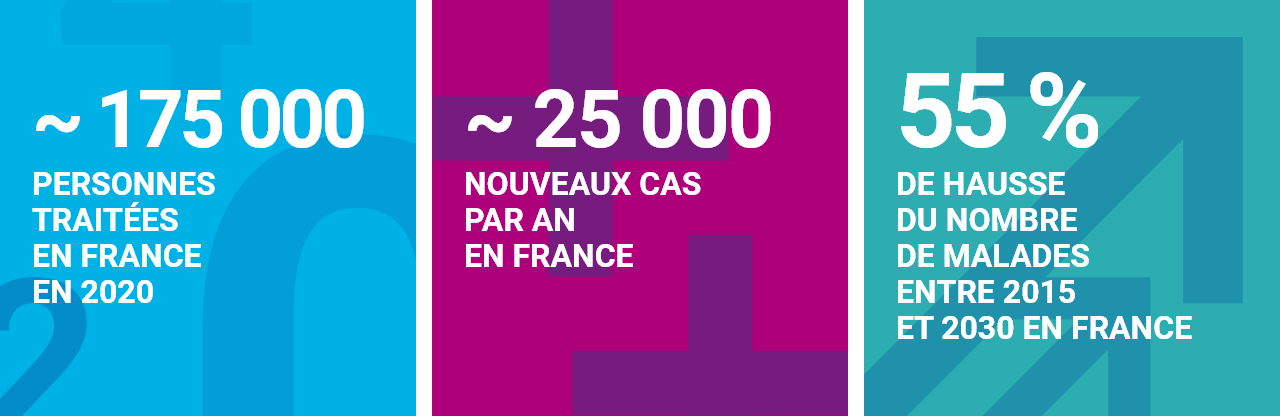
Key Statistics on Parkinson's Disease
Risk factors
Parkinson’s disease: approximately 1.5 times more common in men than in women
Age is the primary risk factor for the disease: Parkinson’s disease is rare before the age of 50; its prevalence then increases sharply with age. The average age at the start of treatment is around 75, although approximately 15 to 20% of new patients are under the age of 65.
Exposure to pesticides, primarily in occupational and agricultural settings, has been linked to an increased risk of Parkinson’s disease in several studies and meta-analyses. In France, since 2012, Parkinson’s disease has been recognized, under certain conditions, as an occupational disease among farmers exposed to pesticides.
Downloadable publication

The role of other occupational exposures, such as exposure to metals or solvents, and that of severe head trauma are also discussed.

Epidemiology and etiology of Parkinson's disease: a review of the evidence

Exposure to pesticides or solvents and the risk of Parkinson's disease

Head injury and the risk of Parkinson's disease: a systematic review and meta-analysis
Symptoms that progress slowly
Parkinson's disease is a chronic, slowly progressive condition characterized by motor symptoms:
resting tremor,
slowness and difficulty moving, or bradykinesia,
muscle rigidity,
balance problems.
In addition, various non-motor symptoms are often associated with the condition, such as constipation, fatigue, depression and anxiety, sleep disturbances, smell disorders, or cognitive impairments.
Symptomatic treatment
To date, there is no cure for Parkinson’s disease.
Treatment is symptomatic and relies primarily on levodopa and dopamine agonists; other treatments for managing non-motor symptoms (antidepressants, anxiolytics, laxatives, etc.) are often used in combination. Physical therapy and speech therapy are often necessary.
Antiparkinsonian treatment must be regularly adjusted by a neurologist due to the worsening of symptoms and the occurrence of treatment-related complications (dyskinesias, fluctuations).
The use of surgical treatment via deep brain stimulation in specialized centers is limited to specific cases meeting strict criteria.
A significant burden for the patient and their loved ones
Despite proper treatment, Parkinson’s disease progressively leads to a worsening of both motor and non-motor symptoms.
As a result, this disease is associated with:
a reduced quality of life and life expectancy. People with Parkinson’s disease have approximately twice the risk of death compared to people of similar age, in both men and women;
an increased risk of complications such as falls, swallowing difficulties, or the onset of dementia.
Links
View the list of our partners' websites
In relation to

Pesticides
thematic dossier
Pesticides are widely used in France, primarily in agriculture, and the population is heavily exposed to them. Their effects on the health of the general population are still poorly understood.

thematic dossier
Work-related illnesses
Dues à des expositions professionnelles, les principales maladies en lien avec le travail sont surveillées par Santé publique France dans l’objectif d’élaborer, avec les partenaires, les...











