



Summary of the 2021 Heat Waves: Health Impacts and Consequences for the Exposed Population
The summer of 2021 was marked by a very hot June and several heat waves. Santé publique France has published a national report on the heat waves of the summer of 2021, along with a special focus on three regions that were particularly affected: Grand-Est, Auvergne-Rhône-Alpes, and Provence-Alpes-Côte d’Azur.

Extreme heat, heat wave
thematic dossier
Every year from June 1 to September 15, Santé publique France collaborates with Météo-France to anticipate heat waves requiring enhanced preventive measures (orange and red heat wave alert levels) and monitors health data on emergency care use and mortality (among the general population and workers) to assess the impact of these episodes.
In this context, Santé publique France publishes a heat wave public health bulletin that provides a meteorological and health assessment of the heat waves that occurred in France in 2021 and their consequences for the exposed population. Specific bulletins were also produced for three regions particularly affected by heat waves during the summer monitoring period: Grand-Est, Auvergne-Rhône-Alpes, and Provence-Alpes-Côte d’Azur. These bulletins also summarize the prevention and communication measures implemented.
A summer of 2021 without severe heatwaves, with a visible impact primarily among people aged 75 and older
Nine departments affected by a heat wave in 2021
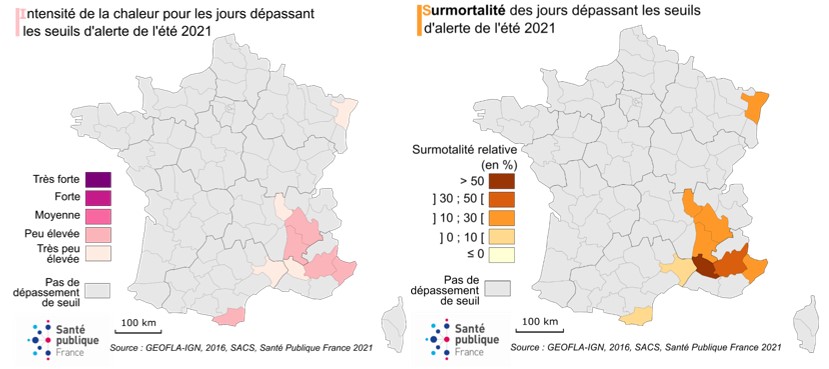
The summer of 2021 was marked by a very hot June (the 5th hottest June in France since 1900). Conversely, July and August saw several significant cooling spells, alternating with a few episodes of intense heat, including a heat wave from August 10 to 16, 2021. Nine departments experienced a heat wave, representing 12% of the metropolitan population: Drôme, Isère, Rhône, Alpes-de-Haute-Provence, Alpes-Maritimes, Vaucluse, Bas-Rhin, Pyrénées-Orientales, and Gard.
Deaths in the general population: 239 excess deaths during heat waves
During these heat waves and in the affected departments, 1 in 6 deaths was excess relative to expected mortality, amounting to 239 excess deaths. The regions most affected were Auvergne-Rhône-Alpes (85 excess deaths) and Provence-Alpes-Côte-d’Azur (118 excess deaths).
This excess mortality particularly affected people aged 75 and older, among whom 204 excess deaths were recorded. It should be noted that, during the same period in the summer of 2021 and in the same departments affected by heat waves, 76 deaths linked to the COVID-19 pandemic were recorded, the vast majority of which were among people aged 70 and older, and may have contributed to the excess mortality. However, even though the pandemic may have increased the vulnerability of certain populations to heat, Covid-19-related deaths alone cannot fully explain the excess mortality observed in these departments.
Severity of heat waves and relative excess mortality (% of excess deaths) by department for days when alert thresholds were exceeded during the summer of 2021
As is the case every year, emergency care visits were more common among people aged 75 and older
Over the course of the summer, nearly 2,500 SOS Médecins consultations and nearly 15,000 emergency room visits were recorded for the iCanicule indicator (an indicator that includes hyperthermia, heatstroke, dehydration, and hyponatremia). People aged 75 and older accounted for 47% of emergency room visits and 32% of SOS Médecins consultations related to iCanicule.
During the summer, as in previous years, people aged 75 and older were the most vulnerable to the heat, despite heat waves that exceeded alert thresholds being highly localized, short-lived, and of low intensity. It is therefore necessary to continue prevention efforts, particularly among this population.
Climate change is leading to increasingly frequent and widespread heat waves. Given the health impacts of these events, it is necessary to combine rapid preventive measures during heat waves with long-term interventions focused on climate change mitigation and adaptation in order to promote environments conducive to good health.
Prevention messages for everyone before summer and during heat waves
Each year, before the summer season, communication materials aimed at the general public and vulnerable groups are distributed to local and regional stakeholders. For healthcare professionals, practical guidance documents are also provided to those involved in heatwave prevention.
During heat waves and as soon as a department is placed under an orange alert, prevention messages are disseminated as part of the established communication system.
In addition, a TV spot and radio spots have been prepared for use only upon media request, in the event of a nationwide heat wave alert.
Download
View regional public health bulletins:

Climate change
thematic dossier












